x

 Acrylic On CanvasWallArtPop Art
 1990
1990 145.0 x 182.0 cm
Hand-painted oil on canvas in your size and frame, made to order by our artists. ( Buy Print Buy Image)





























Pick from our preset sizes that match the artwork's original proportions.

You may enter your own dimensions to fit a specific frame or space. If your selected size does not match the original image's proportions, we will either crop the artwork or extend the painting with additional hand-painted elements. A digital mockup will be sent for your approval before production begins.
Please note that the on-screen preview does not reflect the actual cropping or extension. Only the mockup will accurately show the final composition.
While custom sizes are available, we recommend selecting a dimension from the predefined list to preserve the original proportions.
Worldwide Delivery () in 3/4 weeks instead of standard 5 weeks. (17 August). No compromise on quality.


The den
Reproduction Size
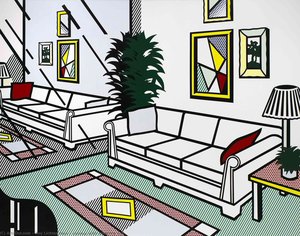
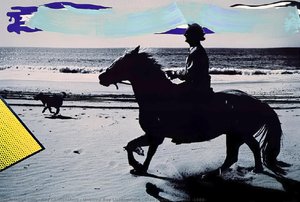
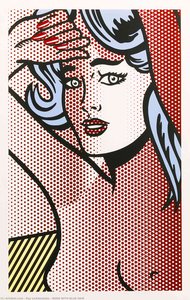
Roy Lichtenstein's "The Den," completed in 1990, isn’t merely a depiction of an interior living room; it’s a masterful distillation of Pop Art principles—a deliberate provocation against the perceived seriousness of traditional fine art. Produced by Gemini G.E.L., this woodcut and screenprint embodies Lichtenstein's signature aesthetic: bold color blocks juxtaposed with meticulously crafted Ben-Day dots, creating an illusion of texture and depth that belies its deceptively simple composition.
The color palette—primarily reds, yellows, blues, black, and white—is aggressively reductive, mirroring the limited color palettes found in commercial printing. Lichtenstein’s technique relies heavily on Ben-Day dots – tiny colored squares meticulously applied to create shading and texture. This method mimics the halftone printing process used in comic books, instantly conveying a sense of immediacy and artificiality. The resulting surface is strikingly graphic, prioritizing visual impact over nuanced tonal variation.
"The Den" emerged during Lichtenstein’s peak period as a Pop Artist, responding to the cultural anxieties of the 1960s and ’70s. He deliberately adopted the conventions of mass media—comic strips and advertising—to critique consumer culture and challenge artistic elitism. By flattening perspective and simplifying forms, Lichtenstein aimed to dismantle illusionistic painting techniques and engage viewers in a dialogue about representation itself. The artwork serves as a testament to Lichtenstein's unwavering commitment to pushing boundaries within the art world.
Despite its apparent simplicity, “The Den” carries significant symbolic weight. The vase of flowers represents beauty and fragility—themes frequently explored in Romantic art—but presented within a deliberately stylized framework. Lichtenstein’s use of bold colors and geometric shapes evokes the energy and dynamism of Pop Art, conveying a sense of playful detachment from emotional expression. Ultimately, “The Den” invites contemplation on how we perceive reality and celebrates the transformative power of artistic innovation.


1923 - 1997 , United States of America

Explore the industrial secrets of 1960s Pop Art. Discover how Ben-Day dots and silk screening transformed mass media into masterpieces by Roy Lichtenstein. An in-depth look at the intersection of mechanical printing and fine art history for students and collectors.

Explore the psychological depth of Roy Lichtenstein's color theory. An expert analysis for art students and collectors on Ben-Day dots, primary palettes, and the intersection of Pop Art with mass media history.

Explore the provocative world of Aggressive Pop Art. Discover how confrontational imagery, bold saturated hues, and mass media deconstruction redefined modern aesthetics through an expert art-historical lens.


Stay updated with the latest art news, exclusive offers, and decoration ideas.
Tell us about your project and our art experts will provide you with 3 personalized art suggestions.
Let Us Curate 3 Options Just for You - Free!


 Preview
 Send
Send Share
Share
 Details

 Download
 Similars
 X-Ray
X-Ray Diaporama
 Read More







 Glass option is only available in size under 110 CM