


x


Hand-painted oil on canvas in your size and frame, made to order by our artists.
Pick from our preset sizes that match the artwork's original proportions.

You may enter your own dimensions to fit a specific frame or space. If your selected size does not match the original image's proportions, we will either crop the artwork or extend the painting with additional hand-painted elements. A digital mockup will be sent for your approval before production begins.
Please note that the on-screen preview does not reflect the actual cropping or extension. Only the mockup will accurately show the final composition.
While custom sizes are available, we recommend selecting a dimension from the predefined list to preserve the original proportions.
Worldwide Delivery () in 3/4 weeks instead of standard 5 weeks. (18 July). No compromise on quality.


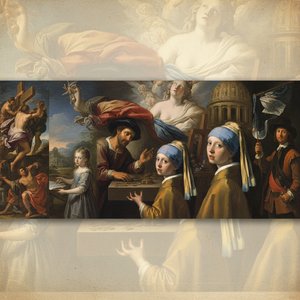
Auguste devant le tombeau d'Alexandre
Reproduction Size

Sébastien Bourdon (1616 – 1671) stands as a pivotal figure in the flourishing artistic landscape of seventeenth-century France, embodying the grandeur and emotional intensity characteristic of the Baroque period. Born in Montpellier, France, he descended from a family steeped in artistic tradition—his father was a glass painter—and received an early education that instilled within him a profound appreciation for visual storytelling.
Bourdon’s formative years were marked by apprenticeship under Jean Baptiste Tourneyn, a Parisian painter who exposed him to the stylistic conventions of his time. Crucially, this training fostered a connection with the artistic currents emanating from Rome, where he embarked on a transformative journey in 1636. Inspired by luminaries such as Nicolas Poussin, Claude Lorrain, and Caravaggio—artists whose mastery captivated Bourdon’s imagination—he honed his skills amidst the intellectual fervor of the papal court.
Bourdon's artistic style is defined by its remarkable versatility and adaptability. While he excelled in portraiture, capturing subjects with sensitivity and nuance – often employing a Rubensian approach or favoring intimate bust-length portraits against muted backgrounds – he equally demonstrated prowess in monumental canvases imbued with Baroque drama. His most celebrated achievement remains “The Crucifixion of St. Peter,” commissioned for the cathedral of Notre Dame, a masterpiece that exemplifies Bourdon’s masterful command of chiaroscuro and his ability to convey profound spiritual emotion.
Other notable works include “The Deposition,” which showcases Bourdon's meticulous attention to detail and his capacity to depict scenes brimming with palpable pathos. His artistic output extended beyond religious commissions; he produced captivating landscapes reflecting the grandeur of the Italian countryside, demonstrating a broader engagement with humanist ideals.
Bourdon’s influence resonated throughout Europe, establishing him as a founding member of the Académie royale de peinture et de sculpture in Paris. He nurtured an extensive atelier, fostering the careers of numerous pupils who carried forward his artistic legacy. Bourdon's dedication to craft and unwavering pursuit of excellence cemented his place as one of the foremost painters of his era.
Bourdon’s enduring legacy resides not only in his impressive oeuvre but also in his role as a champion of Baroque aesthetics—a style characterized by theatrical lighting, dynamic compositions, and an expressive portrayal of human emotion. His paintings continue to inspire admiration for their technical brilliance and emotional depth, securing Bourdon's position as a cornerstone of French art history.

1616 - 1671 , France
Journey through the drama & grandeur of Baroque art! Explore 10 masterpieces by Caravaggio, Rembrandt, Rubens & more. Discover stunning oil paintings, rich colors & timeless stories. Find museum-quality reproductions at .

Explore the life & art of Charles Le Brun, master of French Baroque Classicism. Discover his royal commissions, influence on Versailles, and enduring legacy through detailed analysis & stunning artworks.

Explore the life & art of Simon Vouet, a pivotal French Baroque painter who introduced Italian styles to France. Discover his masterpieces and lasting influence on 17th-century art.

Explore the captivating world of John Augustus Atkinson (1775-1830), a key figure in British Romanticism and genre painting. Discover his stunning Russian history scenes, naval art & delicate watercolors. Learn about his legacy at Most-Famous-Paintings.

Explore 10 Renaissance Humanism masterpieces by Leonardo da Vinci, Michelangelo & Raphael. Discover the stories behind these iconic paintings & sculptures and bring timeless art into your home with museum-quality reproductions from Most-Famous-Paintings.com. Explore the full collection online!


Stay updated with the latest art news, exclusive offers, and decoration ideas.
Tell us about your project and our art experts will provide you with 3 personalized art suggestions.
Let Us Curate 3 Options Just for You - Free!


 Buy print
 Send
Send Share
Share
 Details

 Download
 Similars
 X-Ray
X-Ray Diaporama


 Read More




































 Glass option is only available in size under 110 CM


