x

Hand-painted oil on canvas in your size and frame, made to order by our artists. ( Switch to Print Switch to Image)





























Pick from our preset sizes that match the artwork's original proportions.

You may enter your own dimensions to fit a specific frame or space. If your selected size does not match the original image's proportions, we will either crop the artwork or extend the painting with additional hand-painted elements. A digital mockup will be sent for your approval before production begins.
Please note that the on-screen preview does not reflect the actual cropping or extension. Only the mockup will accurately show the final composition.
While custom sizes are available, we recommend selecting a dimension from the predefined list to preserve the original proportions.
Worldwide Delivery () in 3/4 weeks instead of standard 5 weeks. (6 August). No compromise on quality.


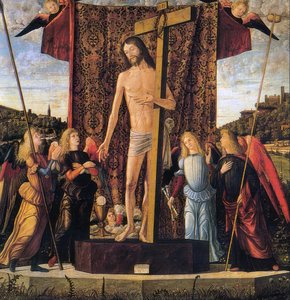
The Virgin Reading to the Infant Christ/The Virgin Adoring the Infant Christ with Saint John\n\nThe Virgin Reading to the Infant Christ (recto)
Reproduction Size
Vittore Carpaccio’s “The Virgin Reading to the Infant Christ,” painted around 1505, isn't merely a depiction of a biblical scene; it’s a carefully constructed tableau brimming with quiet contemplation and profound symbolism. Born in Venice during a period of burgeoning artistic innovation – a time where the influence of both early Italian Renaissance ideals and the more somber, narrative style of Northern European masters converged – Carpaccio crafted an image that transcends simple illustration, inviting viewers into a deeply personal moment within the sacred narrative.
The painting immediately draws the eye to the central figures: Mary, rendered with a gentle dignity, her face etched with both wisdom and maternal affection. She’s not presented as a celestial being, but as a woman – a mother – engaging in a familiar, intimate act. Her simple, dark gown contrasts subtly with the richly colored fabrics of the infant Christ and the surrounding figures, creating a visual hierarchy that emphasizes their importance while maintaining an approachable realism. The setting is deliberately understated; a modest room bathed in diffused light, suggesting a private space removed from the grandiosity often associated with religious art of the era.
Carpaccio's distinctive style is immediately recognizable. Unlike the vibrant, almost theatrical compositions favored by his contemporaries like Bellini, Carpaccio meticulously builds his scenes through a painstaking accumulation of detail. He doesn’t rely on dramatic gestures or sweeping landscapes; instead, he focuses on capturing the nuances of human expression and the textures of everyday objects. Observe the folds in Mary's garment, rendered with astonishing precision, or the delicate details of the infant Christ’s face – each element contributes to a sense of tangible reality.
The inclusion of the young Saint John, seated attentively beside the infant Christ, adds another layer of complexity to the scene. He’s not simply a passive observer; he's actively engaged in the reading, mirroring Mary’s posture and suggesting a shared reverence for knowledge and faith. This subtle interaction elevates the painting beyond a straightforward depiction of the Virgin and Child.
The act of reading itself is laden with symbolic meaning. In Carpaccio's time, literacy was a rare privilege, primarily held by clergy and wealthy elites. The scene thus represents the transmission of knowledge, faith, and divine wisdom from mother to child – a potent metaphor for the spiritual lineage that connects generations.
The book itself is likely an illuminated manuscript, a prized possession in any household. Its presence underscores the importance of scripture and the role of education in shaping religious belief. Furthermore, the composition echoes traditional depictions of the Annunciation, subtly reminding viewers of Mary’s pivotal role as the vessel through which divine grace entered the world.
“The Virgin Reading to the Infant Christ” is a cornerstone of Carpaccio’s most famous cycle, “The Legend of Saint Ursula.” Originally part of a larger series depicting the lives and adventures of various saints, this particular panel offers a glimpse into the artist’s ability to weave complex narratives with remarkable clarity and emotional resonance. The painting's journey through aristocratic collections – from the Earl of Exeter in England to the Kress Foundation – speaks to its enduring appeal and artistic merit. Today, it resides at the National Gallery of Art in Washington D.C., where it continues to captivate viewers with its quiet beauty and profound spiritual depth.


1465 - 1526 , Italy

Explore the captivating world of Vittore Carpaccio, a master storyteller of the Venetian Renaissance. Discover his intricate details, narrative cycles like 'The Legend of St. Ursula,' and unique artistic style.
Journey through the Early Renaissance! Explore 10 iconic paintings by Botticelli, Leonardo da Vinci & Michelangelo. Discover their stories, techniques & lasting impact. Find museum-quality art reproductions and elevate your home decor with .

Explore 25 breathtaking artworks by Giotto di Bondone, a Renaissance master. Discover the stories behind iconic frescoes & paintings like the Scrovegni Chapel cycle. Find museum-quality Giotto reproductions and elevate your home decor with Most-Famous-Paintings.com.
Explore 25 breathtaking masterpieces by Fra Angelico, a Renaissance master. Discover the stories behind his iconic frescoes, Annunciations & religious art. Find museum-quality reproductions and elevate your home decor with Most-Famous-Paintings.com.
Journey back to the dawn of Renaissance art! Explore 10 iconic Proto-Renaissance masterpieces by Giotto, Cimabue & Duccio. Discover their stories, techniques & lasting impact. Find museum-quality reproductions for your home at Most-Famous-Paintings.com


Stay updated with the latest art news, exclusive offers, and decoration ideas.
Tell us about your project and our art experts will provide you with 3 personalized art suggestions.
Let Us Curate 3 Options Just for You - Free!


 Preview
 Send
Send Share
Share
 Details

 Download
 Similars
 X-Ray
X-Ray Diaporama


 Read More







 Glass option is only available in size under 110 CM