Wishlist Shopping Cart Cart
Buy print Buy printBuy Image Buy Image SendSend
DetailsDetails Add to favorites Add to favorites DownloadDownload SimilarsSimilars X-RayX-Ray DiaporamaDiaporama

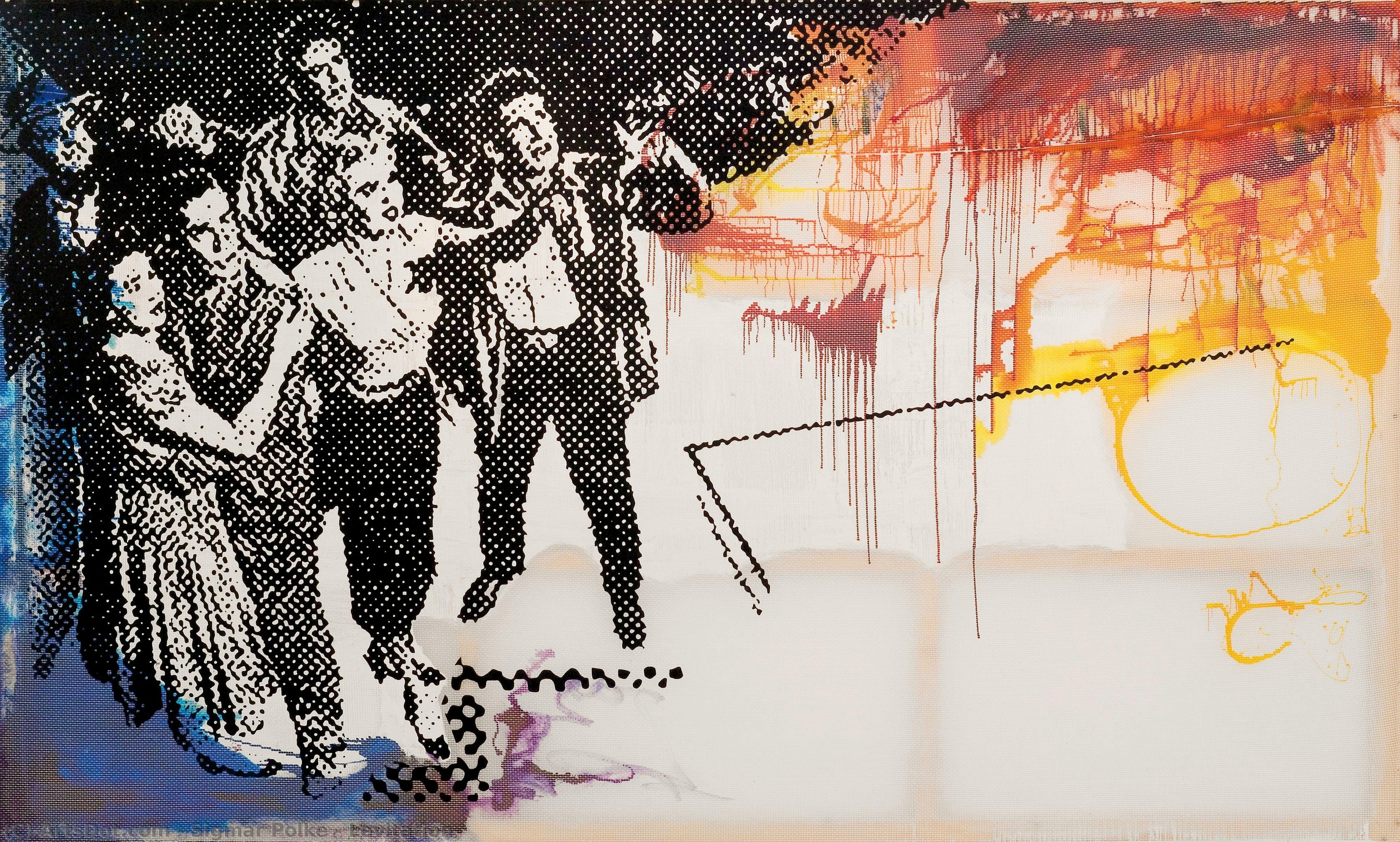
Levitation

Sigmar Polke’s ‘Levitation,’ created in 2005, is a monumental black and white photograph depicting a painterly image featuring astonished witnesses and hinting at hidden depths beyond the frame. It exemplifies Polke's signature blend of experimental techniques and subversive commentary.

Explore the innovative world of Sigmar Polke (1941-2010), a German painter & photographer renowned for experimental techniques, subversive commentary, and blending art with everyday life.

Hand Made Oil Reproduction

Hand-painted oil on canvas in your size and frame, made to order by our artists.

P118B $10
P118H $10
P118W $10
P438Z $10
P508JH $12
P508YH $12
P805H $10
P805Z $10
P919BZ $10
P919G $10
P919XJ $10
P959ZH $10
P968JZ $12
W106C $8
W218G $10
W218JH $8
W218Y $10
W307PJ $10
W316G $10
W316PJ $8
W316Y $10
W398PJ $8
W4111J $10
W500HY $15
W500JH $15
W692G $12
W849H $8
W940BG $15
W953PJ $8

Standard
custom
CM
INCH

Pick from our preset sizes that match the artwork's original proportions.

width
height

You may enter your own dimensions to fit a specific frame or space. If your selected size does not match the original image's proportions, we will either crop the artwork or extend the painting with additional hand-painted elements. A digital mockup will be sent for your approval before production begins.
Please note that the on-screen preview does not reflect the actual cropping or extension. Only the mockup will accurately show the final composition.
While custom sizes are available, we recommend selecting a dimension from the predefined list to preserve the original proportions.

Examples of what can be changed: Replace face with customer photo; Add pet (e.g., replace cat with dog); Include hidden message in background; Change background landscape or elements.
After order, Most-Famous-Paintings.com team will email client for instructions and provide a mockup preview

Worldwide Delivery () in 3/4 weeks instead of standard 5 weeks. (18 July). No compromise on quality.

why_choose_icon
Free Worldwide Express Shipping
why_choose_icon
High-Quality Linen Canvas
why_choose_icon
Full Shipping Insurance
why_choose_icon
Customs Tax Refund Guarantee
why_choose_icon
True Color Matching Guarantee
why_choose_icon
60-Day Return Policy (Defects Only)
why_choose_icon
100% Money-Back Guarantee
why_choose_icon
Bulk Discount Offer

Total Price

-

reproduction

Levitation

Reproduction Medium

Reproduction Size

-

Total Price

-

Quick Facts

  • Notable elements or techniques: Fabric stretcher visible
  • Movement: Contemporary Realism
  • Artist: Sigmar Polke
  • Dimensions: 300 x 500 cm
  • Year: 2005
  • Medium: Oil On Canvas
  • Subject or theme: Philosophical Reflection

Artwork Description

Sigmar Polke’s “Levitation”: A Meditation on Perception and Decay

Sigmar Polke (1941–2010) stands as one of Germany's most influential visual artists, renowned for his pioneering exploration of photographic techniques and his uncompromising engagement with socio-political themes. His oeuvre consistently challenges conventional notions of representation, favoring unsettling juxtapositions and a deliberate embrace of chance to provoke contemplation about the nature of reality itself. “Levitation,” created in 2005, exemplifies this artistic ethos—a monumental canvas measuring 300 x 500 cm that transcends mere visual spectacle, inviting viewers into a profound dialogue with ideas surrounding illusion, memory, and the passage of time.
  • Subject Matter: The artwork depicts a seemingly banal tableau – a table laden with objects—yet Polke elevates this commonplace scene to an existential level through meticulous detail and subtle manipulation of color and texture. A group of figures stands before it, their faces turned towards the painting, capturing a moment of shared perplexity and observation.
  • Style & Technique: Polke’s distinctive style is characterized by a masterful blend of photographic realism and painterly abstraction. He employs encaustic—a technique combining beeswax, resin, and pigment—to create surfaces that are both luminous and subtly distressed. This layering process imbues the artwork with an inherent sense of decay, mirroring the artist's preoccupation with themes of loss and transformation.
  • Historical Context: Produced in the wake of the September 11th attacks, “Levitation” reflects Polke’s broader interest in confronting anxieties surrounding global instability and questioning established narratives. The image draws inspiration from a film still, referencing cinematic conventions to heighten its emotional impact and prompting viewers to consider how visual media shapes our understanding of experience.
  • Symbolism: The fractured surface of the painting—revealing glimpses of the stretcher fabric beneath—represents a deliberate disruption of illusion and an acknowledgement of the artwork’s materiality. Trails of blood descend from the upper right corner, symbolizing vulnerability and confronting uncomfortable truths. This visual motif underscores Polke's commitment to unsettling viewers with images that challenge their assumptions about beauty and certainty.
  • Emotional Impact: “Levitation” succeeds in capturing a palpable sense of unease and wonder. The artist’s gaze directs the viewer beyond the frame, suggesting an infinite expanse of imagination—a space where anxieties coexist with aspirations for transcendence. Ultimately, Polke invites us to contemplate not just what we see but how perception itself constructs our experience of the world.
Additional Research: Levitation, Levitate, or Levitating may refer to: == Concepts == Levitation (illusion), an illusion where a magician appears to levitate a person or object Levitation (paranormal), the claimed paranormal phenomenon of levitation, occurring without any scientific explanation Levitation (physics), the process by which an object is suspended against gravity, in a stable position without solid physical contact Levitation of saints, a mystical phenomenon attributed to some saints == Music == === Albums === Levitation (Hawkwind album) Levitation (Flamingods album) Levitate (Bruce Hornsby album) Levitate (The Fall album) === Songs === “Lev”

Artist Biography

A Life Forged in Displacement: The Early Years and Artistic Formation of Sigmar Polke

Sigmar Polke’s artistic journey was profoundly shaped by the tumultuous currents of 20th-century history, beginning with his birth in Olsztyn, Poland, in 1941. His early life was marked by displacement; as a child, he fled with his family first to Thuringia and then, seeking refuge from Communist rule, to West Germany in 1953. This experience of being uprooted, of existing between worlds, instilled within him a lifelong skepticism towards fixed ideologies and a fascination with the instability of perception – themes that would become central to his art. Before dedicating himself fully to painting, Polke underwent an apprenticeship as a stained-glass worker in Düsseldorf (1959-1960), a formative experience that honed his technical skill and introduced him to the possibilities of manipulating light and color. He then formally studied at the Kunstakademie Düsseldorf (1961-1967) under a constellation of influential figures: Karl Otto Götz, Gerhard Hoehme, and most significantly, Joseph Beuys. It was within this environment that Polke began to forge his unique artistic voice, one characterized by experimentation, irony, and a relentless questioning of established norms.

Capitalist Realism and the Subversion of Ideology

Emerging in the early 1960s, Polke’s work quickly aligned with a burgeoning counter-cultural movement. In 1963, alongside Gerhard Richter, Konrad Lueg, and Manfred Kuttner, he co-founded *Kapitalistischer Realismus* (Capitalist Realism). This was not an artistic style in the traditional sense but rather a provocative gesture—a critique of both Western consumer culture and the rigid dogma of Soviet Socialist Realism. The movement’s name itself was deliberately ambiguous, suggesting that both systems were equally capable of producing artificial realities. Polke's early paintings from this period often appropriated imagery from advertising, comics, and popular media, presenting them with a detached irony that exposed their underlying ideological structures. He wasn’t simply rejecting capitalism; he was demonstrating its pervasive influence on perception itself. This initial foray into critical commentary established a pattern of subversive engagement that would define his career.

Wanderlust, Photography, and the Alchemy of Materials

The 1970s witnessed a significant shift in Polke’s artistic focus towards photography. Driven by an insatiable curiosity, he embarked on extensive travels to Afghanistan, Brazil, France, Pakistan, and the United States, documenting everyday life with a keen eye for the absurd and the unexpected. However, these weren't straightforward documentary photographs; Polke subjected his images to radical chemical manipulation, altering their colors, textures, and meanings. He embraced chance operations and deliberately introduced imperfections, challenging the notion of photography as an objective record of reality. This period reflects a deep exploration of perception—how our understanding of the world is shaped by subjective experience and mediated through technology. In the 1980s, Polke dramatically returned to painting, but not in any conventional sense. He began experimenting with unconventional materials – arsenic, meteor dust, turquoise, beeswax – incorporating them into his canvases alongside traditional pigments. This alchemical approach was driven by a desire to unlock hidden properties within matter and to create works that were constantly evolving, defying easy categorization.

Neo-Expressionism, Historical Commentary, and Lasting Legacy

Polke’s later work often engaged with historical events and perceptions thereof, frequently adopting a sardonic or critical perspective. While his style was sometimes associated with Neo-Expressionism due to its expressive brushwork and emotionally charged imagery, he remained fundamentally resistant to categorization. He continued to challenge the boundaries of painting, layering images, incorporating commercial fabrics, and embracing chance as an integral part of his creative process. His work is not easily deciphered; it resists simple interpretations and demands active engagement from the viewer. Sigmar Polke died in Cologne in June 2010 after a long battle with cancer, leaving behind a body of work that continues to inspire and provoke. He stands as one of the most important and influential artists of the postwar era, bridging Pop art, Conceptual art, and Neo-Expressionism. His experimental approach, his relentless questioning of established norms, and his profound understanding of the complexities of perception ensure his enduring legacy in contemporary art. Polke’s influence can be seen in the work of countless artists who followed, those who dare to challenge conventions and embrace ambiguity as a source of creative power.

Influences and Artistic Kinships

Throughout his career, Polke engaged with a diverse range of artistic influences. Joseph Beuys, his teacher at the Düsseldorf Kunstakademie, was particularly significant, shaping Polke’s exploration of unconventional materials and social commentary. The bold imagery and consumer culture critique of American Pop Art also resonated with him, though he filtered these influences through a distinctly German lens of skepticism and irony. Furthermore, his work engaged with the broader context of German Art Informel, an abstract expressionist movement that emphasized spontaneous gesture and material exploration. Polke’s artistic kinship with figures like Karl Otto Götz and Konrad Lüg—both fellow travelers in the early days of Capitalist Realism—further illuminates the collaborative spirit and intellectual ferment that characterized his formative years. Ultimately, Polke transcended any single label or movement, forging a unique path that continues to inspire artists today.
Sigmar Polke

Sigmar Polke

1941 - 2010 , Poland

Quick Facts

  • Artistic Movement Or Style:
    • Capitalist Realism
    • Neo-Expressionism
  • Artists Or Movements Influenced By This Artist:
    • Neo-Expressionism
    • Conceptual art
  • Artists Who Influenced This Artist:
    • Joseph Beuys
    • Pop Art
  • Date Of Birth: 1941
  • Date Of Death: 2010
  • Full Name: Sigmar Polke
  • Nationality: German
  • Notable Artworks:
    • Large
    • Hope is
    • Alice in wonderland
  • Place Of Birth (City And Country): Olsztyn, Poland
Explore artworks organized by themes, styles, and characteristics.