x

Museum-quality giclée or canvas print with fast production and flexible finish options. ( Buy Hand Made Painting Buy Image)





























Pick from our preset sizes that match the artwork's original proportions.

You may enter your own dimensions to fit a specific frame or space. If your selected size does not match the original image's proportions, we will either crop the artwork or extend the image with a mirrored or solid-fill edge. A digital mockup will be sent for your approval before production begins.
Please note that the on-screen preview does not reflect the actual cropping or extension. Only the mockup will accurately show the final composition.
While custom sizes are available, we recommend selecting a dimension from the predefined list to preserve the original proportions.
Worldwide Delivery () in 2 weeks instead of standard 4/5 weeks. (17 August)


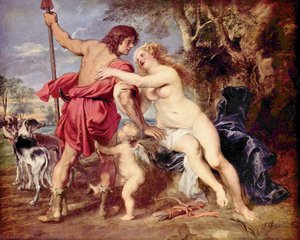
Venus and Adonis
Reproduction Size
Simon Vouet’s “Venus and Adonis,” painted in 1642, is a striking example of French Baroque art, showcasing the artist’s mastery of color, composition, and his assimilation of Italian artistic trends. This evocative scene depicts the poignant moment from Ovid's *Metamorphoses* where the mortal Adonis, captivated by hunting, rejects Venus’s advances, foreshadowing his tragic demise. The painting isn't merely a depiction of mythology; it's an exploration of love, desire, and mortality rendered with remarkable sensitivity.
Vouet, having spent over a decade in Italy (particularly Rome), was instrumental in introducing the dynamic energy and dramatic lighting characteristic of Italian Baroque painting to France. This work exemplifies that influence. Observe how Vouet utilizes tenebrism – the strong contrast between light and dark – to heighten the emotional intensity of the scene. The figures emerge from a shadowy forest setting, illuminated by strategically placed light sources that emphasize their forms and expressions. His brushwork is fluid and graceful, particularly evident in the rendering of Venus’s flowing drapery and Adonis' muscular physique. Vouet’s technique demonstrates a keen understanding of anatomy and perspective, hallmarks of his training within the Italian artistic milieu.
The 17th century was a period of significant artistic transition in France. While earlier French art often leaned towards Mannerism, Vouet’s work signaled a shift toward the more dynamic and emotionally charged style of the Baroque. His return to Paris in 1627 as “Premier Peintre du Roi” (First Painter to the King) marked a pivotal moment in French artistic history. The painting reflects the aristocratic tastes of the time, with its focus on mythological subjects and refined elegance. Vouet drew inspiration from masters like Caravaggio for his dramatic lighting and Paolo Veronese for his vibrant color palette and compositional complexity. The presence of animals—birds and dogs—adds a touch of naturalism and further enriches the scene's narrative.
Beyond its surface beauty, “Venus and Adonis” is rich in symbolism. Venus, the goddess of love and beauty, represents desire and passion. Adonis, the hunter, embodies youthful vigor and a preoccupation with earthly pursuits. His rejection of Venus foreshadows his tragic death by a wild boar – a symbol of uncontrolled passions and mortality. The surrounding forest setting contributes to the painting’s melancholic atmosphere, hinting at the fleeting nature of beauty and love. The overall emotional impact is one of poignant longing and impending loss; a sense of bittersweet beauty permeates the scene, inviting contemplation on the ephemeral qualities of life and affection.
Simon Vouet’s “Venus and Adonis” offers a captivating glimpse into 17th-century French Baroque art. Its masterful technique, rich symbolism, and emotional depth make it an enduring masterpiece. A hand-painted reproduction of this artwork will bring a touch of classical elegance and dramatic flair to any interior space—whether adorning a grand salon or adding sophistication to a more intimate setting. It’s a conversation starter, a source of inspiration, and a testament to the power of art to evoke profound emotions.

Simon Vouet was a pivotal figure in the transition of French painting from Mannerism to the Baroque style. Born into an artistic family – his father Laurent was a painter and his brother Aubin also pursued art – Vouet received early training that laid the foundation for his future success. His grandson, Ludovico Dorigny, would continue the family’s artistic legacy.
During his Italian sojourn, Vouet absorbed a diverse range of influences. He studied the dramatic lighting techniques pioneered by Caravaggio, embraced elements of Italian Mannerism, and meticulously analyzed the color palettes and di sotto in su (foreshortened perspective) employed by Paolo Veronese. He also drew inspiration from the works of Carracci, Guercino, Lanfranco, and Guido Reni, synthesizing these diverse styles into a unique artistic vision.
Simon Vouet's legacy rests on his pivotal role as a bridge between Italian and French art. He successfully imported the dynamism and grandeur of the Italian Baroque, transforming it into a style that resonated with the tastes of the French court and aristocracy. His influence is undeniable in the development of French painting during the 17th century, and his contributions continue to be recognized by art historians today.

1590 - 1649 , France

Explore the profound elegance of Baroque Classicism. Discover how 17th-century masters synthesized dramatic emotion with classical order through the lens of the Counter-Reformation and the works of legends like Carlo Maratta and Andrea Sacchi.

Explore the dramatic power of Baroque art through an expert guide to light, shadow, and emotion. Discover how the Counter-Reformation shaped 17th-century masterpieces and learn about the profound techniques used by the Old Masters to inspire awe.

Explore the dramatic evolution from Mannerist distortion to Baroque grandeur. Discover how light, shadow, and emotion redefined art history through a masterclass in technical mastery and religious fervor.

Explore the profound beauty of Greek mythology through art history. From Baroque masterpieces to Renaissance classics, discover how gods and heroes have inspired the world's greatest painters in this expert guide for collectors and history lovers.

Explore the profound differences between Baroque drama and Rococo elegance. Our expert guide delves into art history, chiaroscuro, and the evolution of European masterpieces for collectors and enthusiasts seeking deep historical context.


Stay updated with the latest art news, exclusive offers, and decoration ideas.
Tell us about your project and our art experts will provide you with 3 personalized art suggestions.
Let Us Curate 3 Options Just for You - Free!


 Preview
 Send
Send Share
Share
 Details

 Download
 Similars
 X-Ray
X-Ray Diaporama


 Read More







 Glass option is only available in size under 110 CM