x

Hand-painted oil on canvas in your size and frame, made to order by our artists.





























Pick from our preset sizes that match the artwork's original proportions.

You may enter your own dimensions to fit a specific frame or space. If your selected size does not match the original image's proportions, we will either crop the artwork or extend the painting with additional hand-painted elements. A digital mockup will be sent for your approval before production begins.
Please note that the on-screen preview does not reflect the actual cropping or extension. Only the mockup will accurately show the final composition.
While custom sizes are available, we recommend selecting a dimension from the predefined list to preserve the original proportions.
Worldwide Delivery () in 3/4 weeks instead of standard 5 weeks. (18 July). No compromise on quality.


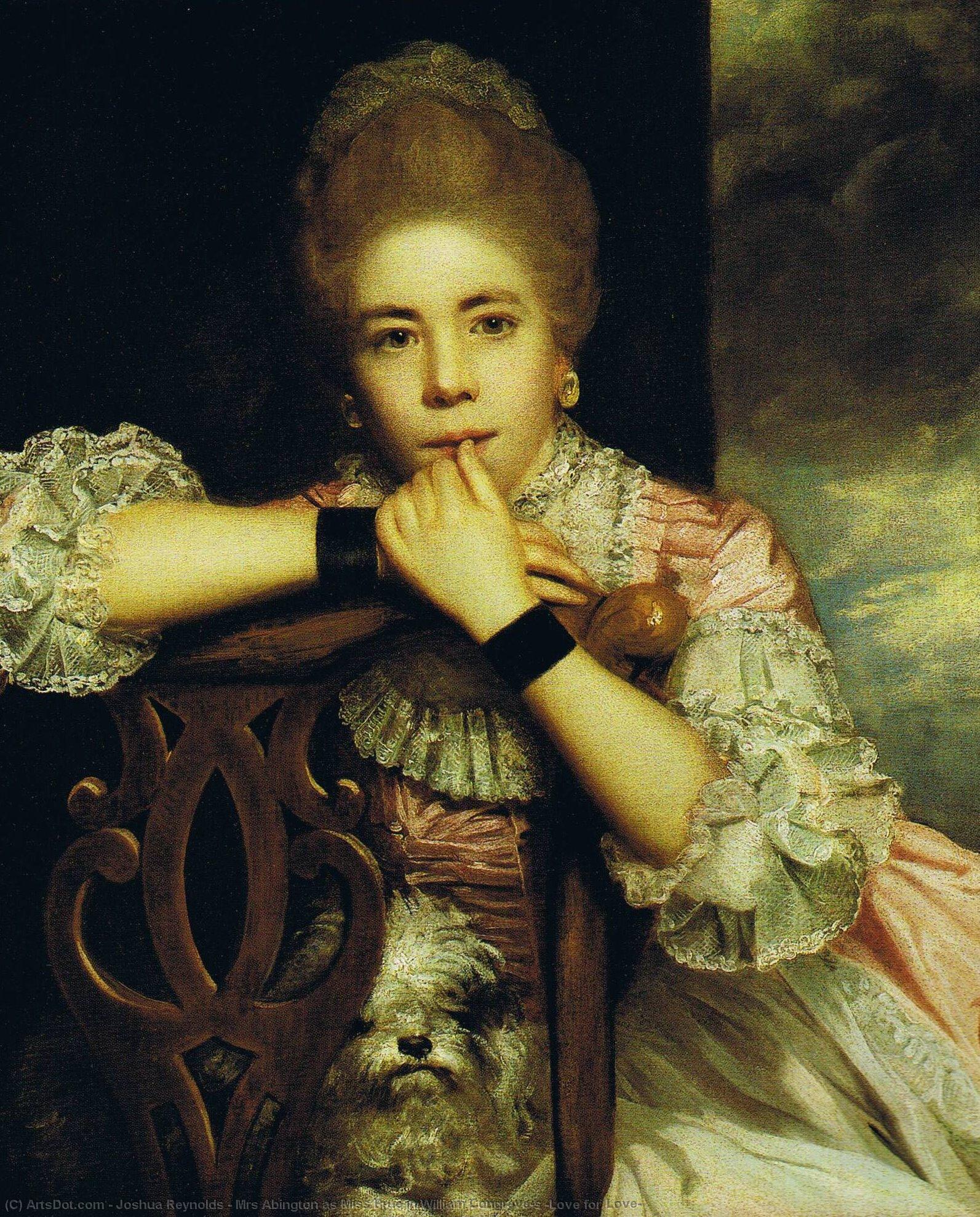
Mrs Abington as Miss Prue in William Congreve's 'Love for Love'
Reproduction Size
Sir Joshua Reynolds' “Mrs. Abington as Miss Prue in William Congreve’s ‘Love for Love’” is more than a mere portrait; it’s a vibrant snapshot of 18th-century London society, brimming with theatricality, wit, and the burgeoning spirit of the Enlightenment. Painted in 1771, this captivating work captures Frances Abington, a celebrated actress known for her dazzling performances at Drury Lane Theatre, as she embodies the mischievous Miss Prue from Congreve’s witty comedy. Reynolds masterfully blends realism with idealized elegance, creating an image that is both strikingly individual and representative of its time.
The painting immediately draws the eye to Mrs. Abington herself. Her posture, a subtle tilt of her head and hand resting thoughtfully on her chin, exudes confidence and intelligence. The delicate lace of her pink dress, the shimmering embellishments of her necklace and earrings – all speak to the fashionable sensibilities of the era. Yet, Reynolds doesn’t simply depict a likeness; he imbues her with an inner life, a sense of playful contemplation that hints at the character she embodies on stage. The lighting is particularly masterful, highlighting her features and creating a soft, flattering glow that elevates the portrait beyond a simple representation.
The inclusion of the dog in the foreground is not merely decorative; it’s a deliberate element that adds layers of meaning to the composition. The dog's intense gaze, seemingly fixed on something beyond the frame, suggests an awareness of the theatrical world surrounding Mrs. Abington – perhaps a metaphor for the audience observing her performance. It also subtly introduces a touch of domesticity and companionship into this otherwise formal portrait.
Crucially, “Mrs. Abington as Miss Prue” is inextricably linked to William Congreve’s play ‘Love for Love.’ The character of Miss Prue is a spirited young woman known for her cleverness and mischievous wit. Reynolds captures this essence perfectly, portraying Mrs. Abington not just as an actress but as a person brimming with intelligence and charm. The painting effectively translates the spirit of the comedy into visual form, inviting viewers to imagine the lively dialogue and comedic situations that unfolded on stage.
To fully appreciate this portrait, it’s essential to understand the social and cultural context in which it was created. The 18th century was a period of immense intellectual ferment – the Age of Enlightenment – characterized by reason, scientific inquiry, and a renewed interest in classical art and literature. Portraiture during this era served as more than just a means of recording likeness; it was often used to project an image of status, wealth, and refinement.
Furthermore, the role of women in society was undergoing significant transformation. While still largely confined to domestic roles, actresses like Mrs. Abington were increasingly recognized for their talent and intelligence. They became celebrated figures, admired for their beauty, wit, and dramatic skills. Reynolds’ portrait celebrates this burgeoning recognition of female agency and artistic achievement.
Beyond its historical and social significance, “Mrs. Abington as Miss Prue” possesses a powerful emotional resonance. The actress's thoughtful expression invites viewers to contemplate her inner world – her ambitions, her vulnerabilities, and her connection to the stage. The painting’s overall sense of grace and sophistication speaks to the ideals of beauty and refinement that were prized during the Enlightenment. It is a testament to Reynolds’ skill as a portraitist and his ability to capture not just a likeness but also the essence of his subject.


1723 - 1792 , United Kingdom
Explore 25 captivating portraits by Sir Joshua Reynolds, a master of British art. Discover stories behind his iconic paintings, elegant style & historical influence. Find museum-quality reproductions and elevate your home decor on Most-Famous-Paintings.com.

Explore 10 iconic portrait paintings – from Mona Lisa to Van Gogh’s self-portraits. Discover the stories behind these masterpieces, artistic techniques & find museum-quality art reproductions for your home at Most-Famous-Paintings.com.

Commission a timeless oil portrait from skilled artists at Most-Famous-Paintings. Preserve your family's legacy with museum-quality paintings, crafted to cherish for generations. Expert guidance & personalized service.

Discover the perfect artistic style for your wedding portrait! Explore realism, impressionism & more. Commission a timeless heirloom with expert guidance. Learn from .

Explore the captivating world of vintage portrait art! Discover styles, techniques & the enduring appeal of 19th-century masterpieces. Expert restoration, custom reproductions & appraisal services at Most-Famous-Paintings.


Stay updated with the latest art news, exclusive offers, and decoration ideas.
Tell us about your project and our art experts will provide you with 3 personalized art suggestions.
Let Us Curate 3 Options Just for You - Free!


 Buy print
 Send
Send Share
Share
 Details

 Download
 Similars
 X-Ray
X-Ray Diaporama


 Read More







 Glass option is only available in size under 110 CM