x


 Acrylic On CanvasWallArtBaroque dynamism
 1635
1635 204.0 x 158.0 cm
 Metropolitan Museum of Art
Hand-painted oil on canvas in your size and frame, made to order by our artists.





























Pick from our preset sizes that match the artwork's original proportions.

You may enter your own dimensions to fit a specific frame or space. If your selected size does not match the original image's proportions, we will either crop the artwork or extend the painting with additional hand-painted elements. A digital mockup will be sent for your approval before production begins.
Please note that the on-screen preview does not reflect the actual cropping or extension. Only the mockup will accurately show the final composition.
While custom sizes are available, we recommend selecting a dimension from the predefined list to preserve the original proportions.
Worldwide Delivery () in 3/4 weeks instead of standard 5 weeks. (18 July). No compromise on quality.


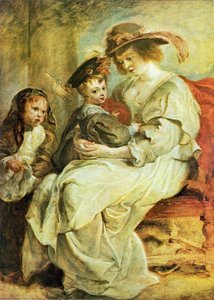
Rubens, Helena Fourment (1614–1673), and Their Son Frans (1633–1678)
Reproduction Size
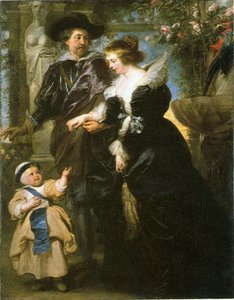
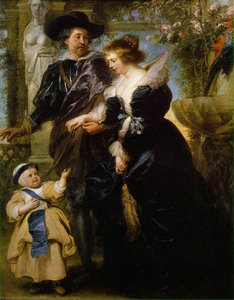
Sir Peter Paul Rubens’s “Rubens, Helena Fourment (1614–1673), and Their Son Frans (1633–1678)” is more than just a portrait; it's a carefully constructed tableau vivant, a window into the life and artistic sensibilities of one of Europe’s most celebrated painters. Completed in 1635, this intimate scene captures Rubens himself alongside his wife, Helena Fourment, and their young son, Frans, within an idealized representation of the lavish gardens surrounding his estate in Antwerp. The painting immediately draws the eye with its vibrant colors – a hallmark of Rubens's signature style – and the dynamic composition that speaks to the artist’s mastery of Baroque principles. It’s a work brimming with layered meaning, reflecting not only the family depicted but also Rubens’s own position as a prominent figure in 17th-century society.
Rubens was renowned for his ability to infuse his portraits with a sense of immediacy and psychological depth. This painting is no exception. The setting, a meticulously rendered garden – likely inspired by the gardens at Oudenaarde, where Rubens maintained a country estate – immediately establishes an atmosphere of tranquility and abundance. However, it’s the interaction between the figures that truly captivates. Rubens stands proudly, his posture suggesting authority and nobility, subtly referencing his status as a nobleman through the leather strap across his chest, a detail alluding to the sword he would have carried. The ribbon tied around Frans's chest playfully positions him as his father’s heir, a visual metaphor for legacy and artistic continuation. The inclusion of the two secondary figures – one at the top right, holding a bowl, and another at the bottom left – adds an element of narrative complexity, perhaps suggesting attendants or servants within this carefully curated world.
Perhaps the most compelling aspect of the painting lies in the juxtaposition of Rubens’s own physical characteristics with those of his wife. The artist's weathered face, marked by the passage of time, is contrasted sharply with Helena Fourment’s youthful beauty – her hand, rendered with exquisite detail and a remarkable pearlescent quality, embodies an idealized vision of feminine grace. This deliberate contrast isn’t merely aesthetic; it speaks to the dynamic between Rubens and his muse, a relationship that profoundly influenced his artistic output. Rubens himself often modeled for his own works, blurring the lines between artist and subject, and this painting serves as a potent visual representation of that intimate connection. The physicality itself—the difference in age, texture, and color—is deliberately highlighted, creating a powerful dialogue about beauty, time, and the creative process.
Technically, “Rubens, Helena Fourment (1614–1673), and Their Son Frans (1633–1678)” is a masterpiece of Baroque painting. Rubens’s signature technique—known as ‘terebinthus,’ or ‘rubbing’ – is evident in the richly layered surfaces and the meticulous rendering of textures, from the velvet of the clothing to the foliage of the garden. The use of vibrant color, particularly reds and golds, creates a sense of opulence and drama, characteristic of the period. He employed a loose, painterly style, favoring broad brushstrokes and a dynamic composition that captures movement and energy. This approach was revolutionary for its time, moving away from the more rigid conventions of earlier Renaissance portraiture. The lighting is masterful, creating strong contrasts between light and shadow, further enhancing the drama and highlighting key elements within the scene.
Most-Famous-Paintings offers meticulously crafted hand-painted reproductions of this iconic work, allowing art lovers to experience Rubens’s genius in stunning detail. Whether displayed as a statement piece in a grand salon or incorporated into a more intimate interior space, this reproduction captures the essence of the original – its vibrant colors, dynamic composition, and profound emotional resonance. Beyond its aesthetic appeal, “Rubens, Helena Fourment (1614–1673), and Their Son Frans (1633–1678)” offers a glimpse into the life and mind of one of history’s greatest artists, inviting viewers to contemplate themes of family, legacy, beauty, and the enduring power of art. Consider this reproduction not just as an image, but as a portal to a pivotal moment in artistic history.

Sir Peter Paul Rubens, a name that resonates with the very essence of Baroque dynamism, was far more than simply a painter. He was a diplomat, a scholar, and a cultural architect who fundamentally reshaped the artistic landscape of 17th-century Europe. Born in Siegen, Germany, in 1577, his early life was marked by displacement—a formative experience that would subtly permeate his later work with an undercurrent of drama and emotional depth. His father, Jan Rubens, a lawyer fleeing religious persecution for his Calvinist beliefs, uprooted the family from their native Antwerp, then under Spanish rule. This initial exile instilled in young Peter Paul a sense of resilience and adaptability, qualities that would serve him well throughout his multifaceted career. Following his father’s death in 1587, the family returned to Antwerp, where he received a humanist education before embarking on his artistic training around 1590, apprenticing under Tobias Verhaecht and Adam van Noort, honing foundational skills in drawing and painting techniques. However, it was his time with Otto van Veen that proved pivotal, exposing him to the rich legacy of Italian Renaissance art—a world he would soon embrace wholeheartedly.
In 1600, Rubens embarked on a transformative journey to Italy, a pilgrimage that irrevocably shaped his artistic vision. For eight years, he immersed himself in the masterpieces of Michelangelo, Raphael, and Titian, absorbing their mastery of form, color, and composition. The influence of these Renaissance giants is readily apparent in his early Italian works, characterized by classical themes and idealized figures. Yet, Rubens didn’t merely imitate; he synthesized these influences with his own innate talent, developing a distinctive style marked by vibrant hues, dynamic compositions, and a sensuous depiction of the human form. He studied anatomy meticulously, resulting in figures that possessed both physical realism and emotional power—robust bodies imbued with life and movement. This period wasn’t solely about artistic development; it was a profound intellectual awakening, fostering a deep appreciation for classical mythology and literature which would become recurring motifs throughout his oeuvre. Upon returning to Antwerp in 1608, Rubens swiftly established himself as the leading artist of his time, receiving a flood of commissions that testified to his burgeoning reputation and solidifying his position at the forefront of Flemish art.
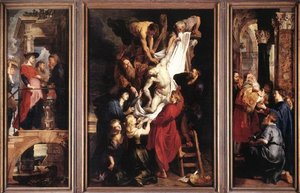
Rubens’s artistic output was astonishingly diverse and prolific. He didn't confine himself to a single genre; instead, he excelled in history paintings, mythological scenes, portraits, landscapes, and religious works—a testament to his versatility and boundless creativity. His large-scale canvases, often intended for churches, palaces, and public spaces, were breathtaking displays of technical virtuosity and dramatic storytelling. The Descent from the Cross (c. 1616-1617) exemplifies his masterful use of light and shadow to create a scene of profound emotional intensity, drawing viewers into the heart of the narrative. The Raising of the Cross (1610-1611), with its swirling figures and dynamic composition, showcases his ability to convey movement and energy—a hallmark of his Baroque style. Even in seemingly static subjects like The Judgement of Paris (c. 1636), Rubens infused a sense of life and vitality through his vibrant color palette and sensual depiction of the human form. His technique was equally remarkable – a masterful command of oil painting, employing impasto to create texture and depth, alongside delicate glazing techniques to achieve luminous effects. He frequently employed allegorical figures and symbolic imagery, layering narratives with complex meanings that invited contemplation and interpretation.
Rubens’s influence extended far beyond the realm of art. His diplomatic skills were highly sought after by the Southern Netherlands (modern-day Belgium), and he undertook numerous missions to England, France, and Spain, negotiating treaties and fostering political alliances—a unique dual role that afforded him a nuanced perspective on European affairs and further enhanced his reputation as a man of intellect and influence. In 1630, he married Hélène Fourment, who became both his muse and frequent subject in his paintings – her youthful beauty gracing many of his later works, embodying the sensuality and vitality that characterized his style. He continued to paint prolifically until his death in Antwerp in 1640, leaving behind a vast legacy that continues to inspire awe and admiration. His impact on subsequent generations of artists is immeasurable; painters like Anthony van Dyck, Jacob Jordaens, and Eugène Delacroix all drew inspiration from his dynamic compositions, vibrant colors, and sensuous figures. Rubens didn’t just define the Baroque style—he elevated painting to a new level of prestige and influence, solidifying Antwerp as a major center of artistic production during the 17th century. He remains, centuries later, a towering figure in the history of art, a testament to the power of human creativity and the enduring allure of Baroque splendor.

1577 - 1640 , Germany

Explore 10 iconic portrait paintings – from Mona Lisa to Van Gogh’s self-portraits. Discover the stories behind these masterpieces, artistic techniques & find museum-quality art reproductions for your home at Most-Famous-Paintings.com.
Journey through Alte Pinakothek's 25 most iconic paintings! Explore masterpieces by Dürer, Rembrandt & Rubens. Discover art history, techniques & find museum-quality reproductions for your home at Most-Famous-Paintings.com.

Journey through Baroque painting's glory! Explore 10 masterpieces by Caravaggio, Rembrandt & Vermeer. Discover dramatic lighting, rich colors & timeless stories. Find museum-quality art reproductions for your home at Most-Famous-Paintings.com.
Journey through the drama & grandeur of Baroque art! Explore 10 masterpieces by Caravaggio, Rembrandt, Rubens & more. Discover stunning oil paintings, rich colors & timeless stories. Find museum-quality reproductions at .

Journey through 25 iconic Claude Monet masterpieces! Explore Impressionism’s beauty, from Water Lilies to Rouen Cathedral. Discover stunning art reproductions & curated decor ideas – explore the full collection online at Most-Famous-Paintings.com.


Stay updated with the latest art news, exclusive offers, and decoration ideas.
Tell us about your project and our art experts will provide you with 3 personalized art suggestions.
Let Us Curate 3 Options Just for You - Free!


 Buy print
 Send
Send Share
Share
 Details

 Download
 Similars
 X-Ray
X-Ray Diaporama
 Read More







 Glass option is only available in size under 110 CM