x


 Acrylic On CanvasWallArtModernism
 1929
1929 70.0 x 83.0 cm
 Royal Scottish Academy of Art - Architecture
Hand-painted oil on canvas in your size and frame, made to order by our artists.





























Pick from our preset sizes that match the artwork's original proportions.

You may enter your own dimensions to fit a specific frame or space. If your selected size does not match the original image's proportions, we will either crop the artwork or extend the painting with additional hand-painted elements. A digital mockup will be sent for your approval before production begins.
Please note that the on-screen preview does not reflect the actual cropping or extension. Only the mockup will accurately show the final composition.
While custom sizes are available, we recommend selecting a dimension from the predefined list to preserve the original proportions.
Worldwide Delivery () in 3/4 weeks instead of standard 5 weeks. (18 July). No compromise on quality.


Duddingston
Reproduction Size
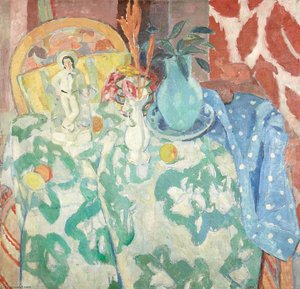
William George Gillies’ “Duddingston” isn't merely a depiction of a small Highland village; it’s a carefully constructed evocation of place, time, and the quiet dignity of rural life in 1929 Scotland. Painted against the backdrop of Holyrood Park, nestled beside the historic Duddingston Loch, this work captures a moment suspended between tradition and modernity, offering a poignant glimpse into a vanishing way of existence.

Gillies, a pivotal figure in Scottish art of the 20th century, masterfully employs a style that blends elements of Cubism with a distinctly Romantic sensibility. The composition is deliberately understated, eschewing dramatic diagonals or bold color clashes in favor of a harmonious balance achieved through careful arrangement and subtle tonal shifts. He’s not striving for photographic realism; instead, he's distilling the essence of Duddingston – its character, its atmosphere – into a series of carefully observed shapes and colors.
The painting’s strength lies in Gillies’ masterful manipulation of light and texture. He utilizes broken brushstrokes to create a sense of atmospheric depth, suggesting the hazy quality of a Scottish afternoon. The buildings are rendered with a rough, almost tactile quality, hinting at their weathered stone construction and the passage of time. Notice how he builds up layers of paint – thin washes layered over thicker impasto – to capture both the solidity of the structures and the fleeting effects of light on their surfaces. The muted palette—dominated by browns, greys, and ochres—grounds the scene in a sense of earthy realism.
Crucially, Gillies avoids sentimentality. There are no idealized figures or dramatic gestures; instead, he presents a straightforward portrayal of everyday life – villagers going about their business, a horse tethered to a post, a winding road leading into the distance. This restraint amplifies the painting’s quiet power, inviting the viewer to contemplate the simple beauty and enduring spirit of the place.
Gillies' artistic journey reveals fascinating influences. Following his studies in Paris with André Lhote, he was profoundly impacted by Paul Klee’s playful use of color and childlike imagination. This influence is particularly evident in “Duddingston,” where Gillies employs a similar approach to color – not for decorative effect, but as a means of conveying mood and atmosphere. However, unlike Klee's more overtly whimsical style, Gillies anchors his work firmly within the traditions of Scottish landscape painting, drawing inspiration from artists like Cézanne and the Romantic painters who preceded him.
The choice of Duddingston itself is significant. The village’s rich history – dating back to the 12th century – provides a powerful context for the painting. Situated adjacent to Holyrood Park, it's a place steeped in legend and tradition, offering a tangible link to Scotland’s past. The loch, with its ancient origins and association with monastic settlements, further enhances the sense of timelessness.
“Duddingston” is more than just a landscape painting; it's a testament to Gillies’ keen observational skills and his ability to capture the essence of a place. It stands as a poignant reminder of Scotland’s rural heritage, inviting us to appreciate the beauty of everyday life and the enduring power of memory. Reproductions of this work offer a valuable opportunity to bring this evocative scene into your home or office, allowing you to experience the quiet charm and understated elegance of Duddingston for years to come.


1898 - 1973 , United Kingdom

Discover the captivating world of Charles Fraser (1782-1860), a leading American artist renowned for his serene landscapes and detailed portraits of Southern life. Explore his legacy & find museum-quality reproductions at Most-Famous-Paintings.

Explore 10 famous paintings dominated by 'greige' – a timeless palette of gray & beige. Discover Monet, Van Gogh & Renoir masterpieces! Find museum-quality art reproductions and curated decor ideas at . Explore the full collection online.

Explore the captivating world of Sir William George Gillies, a leading Scottish Colourist. Discover his journey from Cubism to iconic landscapes & still lifes. Expert insights for collectors and art enthusiasts.

Explore the captivating portraits of Sir John Watson Gordon, a leading Scottish master. Discover his evolution from neoclassical style to atmospheric Tonalism and influence on 19th-century British art. Learn about his iconic sitters & legacy.

Journey into the dreamlike world of Surrealism! Explore 10 masterpieces by Dali, Magritte & Miró that redefined art. Discover their stories & find museum-quality reproductions to elevate your home decor on Most-Famous-Paintings.com.


Stay updated with the latest art news, exclusive offers, and decoration ideas.
Tell us about your project and our art experts will provide you with 3 personalized art suggestions.
Let Us Curate 3 Options Just for You - Free!


 Buy print
 Send
Send Share
Share
 Details

 Download
 Similars
 X-Ray
X-Ray Diaporama
 Read More







 Glass option is only available in size under 110 CM