Introduction
To step into the world of Cubist Expressionism is to witness a profound fracturing of reality, where the analytical precision of geometry meets the raw, unbridled pulse of human emotion. It is an era where the canvas ceased to be a window onto a stable world and instead became a mirror for a fragmented, modern psyche. At the dawn of the twentieth century, as the industrial revolution reshaped the landscape and traditional certainties began to dissolve, artists sought a new visual language—one capable of capturing both the structural complexity of objects and the psychological depth of the human experience.
While Cubism taught us to deconstruct form into multifaceted planes, Expressionism demanded that we infuse those shapes with color, distortion, and visceral feeling. The resulting movement was nothing less than a revolution of the senses. These masterpieces do not merely depict subjects; they evoke the tension, the anxiety, and the vibrant energy of an age in transition. Today, as we navigate our own era of digital fragmentation and shifting perspectives, the fractured beauty of these works feels more resonant than ever, offering a way to find meaning within the chaos.
In the following exploration, we shall traverse the most significant canvases that defined this seismic shift. From the jagged edges of structural innovation to the haunting depths of emotional distortion, these ten masterpieces stand as the definitive pillars of an era that forever altered how we perceive the very fabric of existence.
Compositional Study for ‘To Russia, to the Asses and Others’ - Marc Chagall
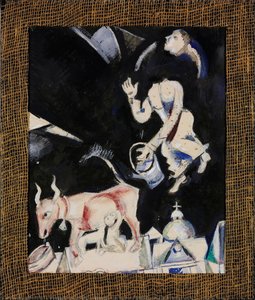 Compositional Study for ‘To Russia, to the Asses and Others’ - Marc Chagall
In Marc Chagall’s 1912 Compositional Study for ‘To Russia, to the Asses and Others’ , we encounter a fragment of a dream captured through the lens of Cubist Expressionism . The canvas vibrates with a joyous, almost hallucinatory palette of pinkish reds, deep blues, and sun-drenched yellows. Figures appear suspended in a state of whimsical disorientation, as if plucked from a Belarusian folktale. A man perched atop an animal—perhaps a donkey—serves as a focal point for this surreal journey through the unconscious, blending his Vitebsk heritage with the avant-garde energy of Paris.
There is a gaze in this work that follows you—not with judgment, but with understanding . This isn’t merely a study of form; it is a mirror . As you observe the fragmented shapes and symbolic weight of the figures, the painting serves to remind you: you are seen. You are part of this enduring, colorful story.
Portrait of the Artist Léopold Survage - Amedeo Clemente Modigliani
 Portrait of the Artist Léopold Survage - Amedeo Clemente Modigliani
In the bohemian shadows of Montparnasse, Amedeo Modigliani often sought the soul beneath the skin, frequently turning to his circle of artist friends to capture the essence of a generation. In his 1918 Portrait of the Artist Léopold Survage , we witness a pivotal moment in the evolution of Cubist Expressionism. Modigliani achieved a profound conceptual leap by merging the geometric fragmentation of Cubist structure with an emotive, elongated distortion inspired by the primal power of African mask aesthetics.
The painting breathes through a palette of muted earth tones—deep ochres and velvety blacks—that frame Survage’s haunting, sculptural features. His gaze, direct and unblinking, pierces the canvas, creating a psychological depth that transcends mere representation. This mastery of form and shadow does more than decorate; it commands presence. For the modern professional, integrating such a masterpiece into a home office or study invites a sense of quiet prestige and focused introspection, transforming a workspace into a sanctuary of intellectual depth.
Woman Knitting - Paul Klee
 Woman Knitting - Paul Klee
In Woman Knitting , Paul Klee achieves a profound sense of presence through the subtle, diffused interplay of light and shadow. Rather than relying on dramatic chiaroscuro, Klee utilizes a restrained palette of grays, blacks, and whites to create a soft, internal luminescence that breathes life into his geometric abstractions. This masterful command of tonal gradation—where charcoal textures meet delicate watercolor washes—is precisely what secured this work's place among the defining masterpieces of Cubist Expressionism . By manipulating light to define form without traditional perspective, Klee invites us into a world of quiet, structural harmony. For the discerning collector, a hand-painted oil reproduction of this piece offers more than mere decoration; it brings the tactile depth of Klee’s original brushwork and the sophisticated, monochromatic elegance of his vision into a contemporary space, adding an intellectual and luxurious layer to any curated wall.
Fire at Full Moon - Paul Klee
 Fire at Full Moon - Paul Klee
In the hauntingly beautiful Fire at Full Moon , Paul Klee invites us into a nocturnal realm where geometry and emotion collide. As a cornerstone of the Cubist Expressionism movement, this 1933 work transcends mere landscape; it is a psychological map of the subconscious. Through a meticulously orchestrated grid of fractured rectangles and trapezoids, Klee creates a sense of rhythmic tension that feels both stable and dynamic.
The luminous yellow orb of the moon acts as a beacon of intuition, casting a soft glow over deep, melancholic blues and purples, only to be interrupted by the sudden, visceral pulse of a fiery red quadrant. This interplay between cool shadows and warm, destructive energy captures the very essence of Klee’s philosophy—that art should move beyond representation to touch the soul. In contemporary interior curation, where the search for meaningful abstraction is paramount, Klee’s ability to find harmony within chaos remains a profound cultural touchstone, offering a meditative focal point that resonates with the modern desire for depth and mystery.
Beatris Hastings - Amedeo Clemente Modigliani
 Beatris Hastings - Amedeo Clemente Modigliani
There’s a gaze in Beatris Hastings by Amedeo Clemente Modigliani that follows you—not with judgment, but with understanding . This isn’t merely a portrait; it is a mirror . Its place among the defining masterpieces of Cubist Expressionism serves as a testament to its power to make the invisible visible.
In this 1915 work, Modigliani orchestrates a profound stillness using the structural innovations of Cubism and the emotional depth of Expressionism . The subject emerges from an abstract landscape of earthy ochres, creams, and deep umbers, where geometric, rectangular forms create a dreamlike, flattened perspective. The striking elongation of the neck—inspired by the rhythmic lines of African sculpture—lends an ethereal, haunting quality to the composition, while subtle touches of crimson on the lips provide a flicker of life amidst the melancholic grace.
Now, imagine that gaze in your space. Not watching you, but reminding you : you are seen. You are part of the story.
Young Woman in a Yellow Dress (also known as Madame Modot) - Amedeo Clemente Modigliani
 Young Woman in a Yellow Dress (also known as Madame Modot) - Amedeo Clemente Modigliani
In Young Woman in a Yellow Dress (also known as Madame Modot) , Amedeo Modigliani achieves a breathtaking structural harmony through the deliberate interplay of elongated verticality and saturated color. The composition relies on a rhythmic balance: the sweeping, sculptural lines of the subject’s neck and facial features create a geometric elegance that anchors the vibrant, sun-drenched weight of her yellow attire. This mastery of form is why it stands as one of the Top 10 Masterpieces That Defined the Cubist Expressionism Art Movement . The painting's internal equilibrium—a tension between the organic curves of her hair and the stark, mask-like precision of her gaze—mirrors the principles of modern minimalist design. For the contemporary collector, this work offers a profound sense of quiet prestige; its clean, essential shapes provide an atmospheric anchor that grounds a sophisticated, minimalist aesthetic. The glowing light within the pigment and the rhythmic, simplified geometry transform a simple portrait into a timeless meditation on grace and structural perfection.
Family Portrait 1 - Pablo Picasso
 Family Portrait 1 - Pablo Picasso
In Family Portrait 1 by Pablo Picasso, the lines aren’t merely drawn; they are choreographed. This is not a simple composition, but a dance frozen in time, capturing a moment of profound domestic tranquility amidst the post-war era's uncertainty. As a cornerstone of the Cubist Expressionism movement, this masterpiece moves away from fractured geometry toward the vibrant, rhythmic warmth of Synthetic Cubism .
Picasso employs a sun-drenched palette of yellows and reds, using textured, expressive brushwork to create a palpable sense of vitality. The central figure, anchored in his chair, provides a structural stability that contrasts beautifully with the delicate, watchful presence of the children in the background. What if your own walls could breathe this same rhythm? By acquiring a hand-painted oil reproduction of this work, you can anchor your space with its sophisticated interplay of light and emotional depth, bringing the sanctuary of Picasso’s vision into your personal collection.
Los amantes en la calle - Pablo Picasso
 Los amantes en la calle - Pablo Picasso
At Most-Famous-Paintings.com, our mission is to democratize beauty, ensuring that the world's most profound legacies are accessible to every collector and enthusiast. This commitment is embodied in the hauntingly beautiful Los amantes en la calle by Pablo Picasso. As a definitive pillar of the Cubist Expressionism movement, this work earns its place among the top masterpieces through its radical deconstruction of intimacy. Picasso fragments the lovers into a rhythmic dance of geometric planes and sharp angles, capturing not just a physical embrace, but the very essence of human vulnerability amidst the fractured chaos of urban life. The striking contrast of the woman's red dress against the analytical, monochromatic textures creates an emotional resonance that is both unsettling and deeply moving. This revolutionary approach to perspective continues to inspire modern aesthetics, offering a sophisticated, intellectual edge to any curated space. By choosing one of our meticulous, hand-painted oil reproductions, you can bring this transformative historical presence into your own home or office, preserving the soul of Picasso's genius for generations.
Broken Forms - Franz Marc
 Broken Forms - Franz Marc
In Broken Forms , Franz Marc invites us into a world where reality is shattered yet spiritually unified. As one of the Top 10 Masterpieces That Defined the 'Cubist Expressionism' Art Movement , this 1914 work transcends mere geometry; it is a profound meditation on the hidden rhythms of existence. While the Cubists sought to dissect objects into fragments, Marc utilized these fractured triangles and squares to pulse with an inner, spiritual life. The canvas vibrates with a rhythmic interplay of primary reds, deep blues, and luminous yellows, anchored by celestial circles that suggest a cosmic order beneath the surface chaos. This painting does more than represent nature; it distills its very essence into a dance of color and shape. Today, the work’s bold, geometric energy finds a striking resonance in contemporary minimalist interiors, where the tension between fragmentation and structural harmony continues to serve as a powerful cultural talking point.
Small Composition II - Franz Marc
 Small Composition II - Franz Marc
In Small Composition II by Franz Marc, the viewer is immediately met with a profound geometric equilibrium. The composition relies on a rhythmic arrangement of fundamental shapes—a sturdy house anchoring the left, a sharp central triangle, and a luminous circle radiating to the right. This structural harmony, characteristic of the Cubist Expressionism movement, creates a sense of timeless perfection that has allowed this 1914 masterpiece to remain a cornerstone of art history.
Marc masterfully balances the rational, fractured planes of Cubism with organic, emotive elements like reaching branches and heart-shaped motifs. This internal balance finds a striking parallel in modern minimalist design; the painting’s clean, essentialist aesthetic provides a grounding force for contemporary interiors seeking both intellectual depth and visual serenity. Through vibrant reds and yellows, Marc transcends mere abstraction, offering a spiritual resonance that continues to define the very essence of the Der Blaue Reiter legacy.
Conclusion
As the lights dim on our exploration of Cubist Expressionism, we realize these works are not merely relics of a bygone era, but enduring echoes of human perception. They remain vibrant, living presences that continue to pulse through our modern interiors and inspire the creative spirit, challenging us to see the world through a fractured yet deeply emotive lens. These masterpieces do not belong solely to the silent halls of museums; they possess a rhythmic vitality that seeks to inhabit our contemporary spaces, bridging the gap between the avant-garde past and our present lives.
At Most-Famous-Paintings.com , we believe such profound artistry should be felt, not just observed. We strive to ensure this legacy remains tangible, allowing every masterpiece to be reborn as a hand-painted reproduction. Our skilled artists work with meticulous care to honor the original's soul, capturing the very essence of each brushstroke and the complex textures that define this movement. We invite you to wander through our full collection and discover a piece of history that resonates with your own story.