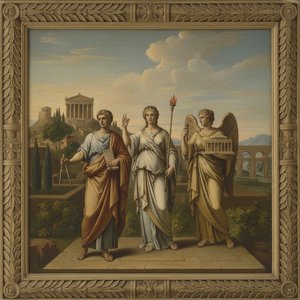
José de Avelar Rebelo: Bridging Baroque and the Dawn of a New Style
The world of 17th-century Portuguese art was undergoing a subtle but significant shift, moving away from the heavily ornamented grandeur of the late Renaissance towards a more restrained elegance. Within this evolving landscape emerged José de Avelar Rebelo (c. 1600 – 1657), a painter whose career spanned a pivotal period in the nation’s history and whose work offers a fascinating glimpse into the transition between established Baroque conventions and emerging stylistic tendencies. Initially employed as a court painter under King Dom João IV, Rebelo's legacy rests primarily on his royal portraits and his skillful representation of classical themes, reflecting both the enduring influence of the Baroque era and a nascent desire for a more refined aesthetic.
Born in Portugal, details of Rebelo’s early life remain somewhat elusive. He was appointed Royal Painter to King Dom João IV, a position that afforded him access to the highest echelons of Portuguese society. This appointment marked a significant step in his career and allowed him to contribute to the visual representation of the monarchy during a period of intense political upheaval – the Restoration War against Spanish rule. His work during this tumultuous time is particularly noteworthy, as it reflects not only artistic skill but also a keen awareness of the nation’s precarious position.
Rebelo's style can be characterized by a balanced approach to Baroque elements. He skillfully employed dramatic lighting and rich color palettes – hallmarks of the Baroque – yet tempered them with a sense of composure and clarity. His portraits, in particular, demonstrate an ability to capture not only physical likeness but also the psychological depth of his subjects. He was particularly adept at portraying nobility, imbuing his figures with dignity and gravitas. While influenced by the prevailing trends of the time, Rebelo’s work possesses a subtle individuality, hinting at a developing artistic voice.
A Master of Portraiture and Classical Themes
Rebelo's most celebrated works are undoubtedly his royal portraits. These paintings served as powerful symbols of authority and continuity during a period of national reconstruction. He produced numerous depictions of King Dom João IV, capturing the king’s regal bearing and projecting an image of strength and stability. Beyond portraiture, Rebelo also tackled classical subjects with considerable skill. His interpretations of biblical scenes and mythological narratives demonstrate a deep understanding of artistic tradition and a commitment to representing these themes with both accuracy and aesthetic appeal.
One particularly compelling example of his work is “Saint Jerome,” a painting that showcases his ability to combine dramatic composition with nuanced detail. The figure of Saint Jerome, the patron saint of scholars and translators, is depicted in a contemplative pose, surrounded by symbols of his ascetic life – an open book, a leopard skin, and a pomegranate. Rebelo’s rendering of the saint's face conveys a profound sense of inner reflection, while the use of light and shadow creates a dramatic atmosphere that draws the viewer into the scene.
Influence and Legacy
Rebelo’s artistic development occurred during a period of significant change in Portuguese art. The influence of Italian Baroque painting was still strong, but there was also a growing interest in classical antiquity and a desire to move beyond the overtly ornate styles of earlier periods. Rebelo navigated this complex landscape with skill, incorporating elements of both traditions into his own distinctive style. His work served as a bridge between the old and the new, helping to shape the visual culture of 17th-century Portugal.
Despite his contributions, Rebelo’s name has not always been prominently featured in art historical narratives. This is partly due to the fragmented nature of archival records and the challenges of reconstructing the lives and careers of artists working during this period. However, recent scholarship has begun to shed new light on Rebelo's work, recognizing its importance within the broader context of Portuguese Baroque painting. His legacy continues to be explored through ongoing research and exhibitions, ensuring that his contributions to art history are increasingly appreciated.
A Notable Figure in Lisbon’s Artistic Scene
Rebelo was not merely a royal painter; he was an active participant in the vibrant artistic scene of Lisbon. The city served as a hub for artistic innovation and exchange, attracting artists from across Europe. Rebelo's connections to other prominent figures in the Portuguese art world – including those associated with the Capilla de San José and the Centro de Arte Moderna Gulbenkian – further underscore his significance within this dynamic environment. His work reflects the broader cultural currents of Lisbon during the 17th century, a period marked by both political instability and artistic flourishing.
Furthermore, Rebelo’s influence extended beyond Portugal's borders. His portraits were admired throughout Europe, demonstrating the international appeal of his style. The enduring quality of his work is a testament to his skill as an artist and his ability to capture the essence of his subjects with remarkable sensitivity.
Concluding Thoughts
José de Avelar Rebelo remains a compelling figure in Portuguese art history, representing a crucial transitional phase between the grandeur of the late Renaissance and the more restrained elegance of the Baroque. His royal portraits, classical compositions, and skillful use of light and shadow offer a valuable window into the artistic and cultural landscape of 17th-century Portugal. While his name may not be as widely recognized as some of his contemporaries, Rebelo’s contributions deserve to be celebrated for their subtlety, sophistication, and enduring beauty.