


x

Impresiones giclée o en lienzo de calidad de museo con producción rápida y opciones de acabado flexibles. ( Encargar reproducción pintada a mano Comprar descarga)





























Elija entre nuestros tamaños predefinidos que respetan las proporciones originales de la obra.

Puede introducir sus propias dimensiones para adaptarse a un marco o espacio específico. Si el tamaño seleccionado no coincide con las proporciones de la imagen original, recortaremos la obra de arte o extenderemos la imagen con un borde con efecto espejo o de color sólido. Se enviará una maqueta digital para su aprobación antes de que comience la producción.
Tenga en cuenta que la vista previa en pantalla no refleja el recorte o la extensión real. Solo la maqueta mostrará con precisión la composición final.
Aunque existen tamaños personalizados, recomendamos seleccionar una dimensión de la lista predefinida para preservar las proporciones originales.
Envío a todo el mundo () en 2 semanas en lugar de las 4/5 semanas estándar. (15 agosto)


Nude
Tamaño de la reproducción
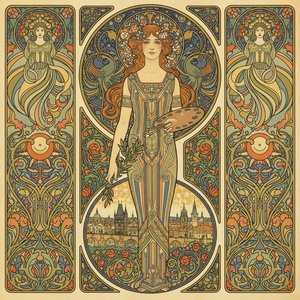
Alphonse Maria Mucha stands as one of the most recognizable figures of Art Nouveau, an artistic movement that flourished between 1890 and 1910 across Europe. Born in Brno, Czech Republic, in 1860, Mucha rejected the rigid academic traditions of his time, forging a path toward a uniquely expressive style rooted in observation and imagination.
His artistic journey began with studies at Prague’s Academy of Fine Arts, where he quickly recognized the limitations of conventional methods. Driven by an innate desire for innovation, he relocated to Paris in 1887, establishing himself amidst a vibrant intellectual milieu and immersing himself in the burgeoning Art Nouveau aesthetic.
Mucha's signature style is instantly identifiable: flowing lines reminiscent of plant stems and vines dominate his compositions, creating a mesmerizing sense of movement. Organic forms intertwine seamlessly with geometric shapes—particularly spirals—reflecting the influence of mathematicians like Ernst Haeckel and embodying the belief in harmony between nature and science that characterized the era.
The painting “Nude,” often referred to as “La Femme Nue,” exemplifies Mucha’s masterful technique. Employing tempera on canvas, he achieved remarkable luminosity and textural depth through meticulous layering of pigments. The artist skillfully utilized glazing—applying thin translucent layers over opaque colors—to build up subtle gradations of tone and color, capturing the ethereal beauty of the female nude with unparalleled sensitivity.
Beyond its aesthetic merits, “Nude” is laden with symbolic significance. Mucha’s depictions of women frequently explore themes of femininity, purity, and spiritual awakening. The veiled face—a recurring motif in his oeuvre—represents modesty and contemplation, inviting viewers to engage in a dialogue about inner beauty and transcendence.
Historically situated within the broader context of Art Nouveau's fascination with mythology and folklore, “Nude” draws inspiration from classical ideals of feminine grace. It echoes the artistic explorations undertaken by Gustave Moreau and Piero Dorazio, artists who similarly sought to elevate art beyond mere decorative function into a vehicle for conveying profound emotional and intellectual ideas.
The painting’s impact extends far beyond its time, continuing to inspire contemporary artists and designers. Its elegant simplicity combined with evocative symbolism ensures that “Nude” remains a timeless masterpiece—a testament to Mucha's visionary artistry and the enduring allure of Art Nouveau’s enchanting vision of beauty.


1860 - 1939 , República Checa
Explore the life & art of Alphonse Mucha, master of Art Nouveau! Discover his iconic posters, stunning illustrations, and the monumental Slav Epic. A comprehensive guide for collectors & enthusiasts.

Immerse yourself in the romantic allure of Art Nouveau. Explore the sinuous curves and floral elegance of the Belle Époque through our exquisite, hand-painted reproductions. Discover a timeless connection to nature’s beauty with our museum-quality collection.

Descubre las 10 obras maestras del Art Nouveau que revolucionaron el arte. Explora la belleza de Mucha, Klimt y más. Reproducciones de museo en para un hogar con estilo. ¡Inspírate ahora!

Discover the enchanting world of Art Nouveau. Explore the organic beauty, flowing lines, and Belle Époque elegance that defined an era of unparalleled craftsmanship and natural inspiration.

Explore the captivating history of nude art! Discover iconic paintings & artists from classical to modern eras. Uncover symbolism, techniques & find museum-quality reproductions at Most-Famous-Paintings.


Manténgase al día con las últimas noticias de arte, ofertas exclusivas e ideas de decoración.
Cuéntanos sobre tu proyecto y nuestros expertos en arte te ofrecerán 3 sugerencias de obras personalizadas.
Dejamos que nosotros seleccionemos 3 opciones exclusivas para ti – ¡Gratis!


 Vista previa
 Compartir
 Compartir
 Ver detalles

 Descargar
 Ver similares
 Radiografía
 Presentación de diapositivas
 Leer más







 La opción de vidrio solo está disponible en tamaños inferiores a 110 cm.


