x

Impresiones giclée o en lienzo de calidad de museo con producción rápida y opciones de acabado flexibles. ( Encargar reproducción pintada a mano Comprar descarga)





























Elija entre nuestros tamaños predefinidos que respetan las proporciones originales de la obra.

Puede introducir sus propias dimensiones para adaptarse a un marco o espacio específico. Si el tamaño seleccionado no coincide con las proporciones de la imagen original, recortaremos la obra de arte o extenderemos la imagen con un borde con efecto espejo o de color sólido. Se enviará una maqueta digital para su aprobación antes de que comience la producción.
Tenga en cuenta que la vista previa en pantalla no refleja el recorte o la extensión real. Solo la maqueta mostrará con precisión la composición final.
Aunque existen tamaños personalizados, recomendamos seleccionar una dimensión de la lista predefinida para preservar las proporciones originales.
Envío a todo el mundo () en 2 semanas en lugar de las 4/5 semanas estándar. (16 agosto)


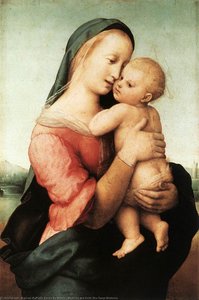
La Madonna della Steccata
Tamaño de la reproducción
Raphael Sanzio da Urbino (1483-1520), known simply as Raphael, was an Italian painter and architect of the High Renaissance. He is renowned for his harmonious compositions, clarity of form, and ease of composition. His works are characterized by their idealized beauty, serene elegance, and a sense of balance that reflects the harmony of the classical world. Giorgio Vasari famously described him as “the most divine Raphael,” highlighting his unparalleled ability to capture the essence of human grandeur within an aesthetically perfect framework.
His father Giovanni Santi served as a court painter to Duke Federico da Montefeltro, providing young Raphael with his earliest artistic exposure. This upbringing immersed him in an environment that valued art and intellectual pursuits. Following his father’s death in 1494 when Raphael was eleven years old, he likely took on responsibilities within the family workshop, further honing his skills under the guidance of local artists.
Raphael's artistic journey can be categorized into three distinct phases. His early Umbrian period was heavily influenced by Pietro Perugino and Piero della Francesca, absorbing their stylistic sensibilities. In 1504, he moved to Florence, where he encountered Leonardo da Vinci and Michelangelo—artists whose contrasting approaches profoundly shaped his own evolving style.
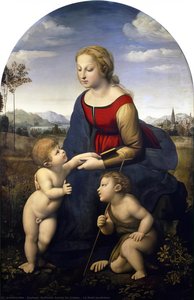
The Diotallevi Madonna (1504-1505) is an early masterpiece by Raphael, painted during his stay in Florence. It depicts the Virgin Mary holding the Christ Child, surrounded by two angels and Saint John the Baptist as a child. The painting is named after its original owner, the Florentine banker Diotallevi Ghirlandaio. This work exemplifies Raphael’s mastery of composition and his ability to convey a sense of serenity and grace.
The pyramidal structure—a cornerstone of Renaissance art—dominates the scene, with Mary positioned at the apex and Christ Child at the base. This arrangement creates a feeling of stability and harmony, mirroring the principles of classical architecture. Raphael skillfully employs soft colors—primarily blues, reds, and golds—to evoke warmth and tenderness, reflecting the humanist ideals prevalent during his time.
The Diotallevi Madonna had a profound influence on subsequent generations of artists. Raphael’s innovative use of perspective and chiaroscuro—the dramatic interplay of light and shadow—established new standards for religious painting, inspiring countless painters to emulate his techniques. Artists like Titian and Correggio drew inspiration from Raphael's harmonious compositions and luminous palette.
Today, the Diotallevi Madonna is considered one of Raphael’s greatest achievements—a testament to his artistic genius and a symbol of Renaissance beauty. Its serene depiction of motherhood embodies Christian virtues and reflects the humanist fascination with idealized forms. Reproductions of this iconic painting from Most-Famous-Paintings offer an opportunity to experience the enduring power of Raphael's vision, bringing a piece of art history into your home or office.
Most-Famous-Paintings’s meticulous hand-painted reproductions capture the subtle nuances of color and texture—preserving the essence of Raphael’s original masterpiece. Explore our collection today and discover the beauty and craftsmanship that defined the High Renaissance!


1483 - 1520 , Italia
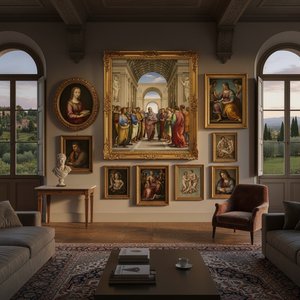
Descubre las 25 obras maestras de Rafael Sanzio, el genio del Renacimiento. Explora su historia, técnica y significado en pinturas icónicas como 'La Escuela de Atenas'. Reproducciones de arte de alta calidad para decorar tu hogar con elegancia. ¡Explora la colección completa en Most-Famous-Paintings.com!

Descubre los 25 tesoros del Museo Hermitage de San Petersburgo. Explora la historia y belleza de Rembrandt, Leonardo da Vinci y más. Reproducciones de arte en Most-Famous-Paintings.com para decorar tu hogar con obras maestras.

Descubre los 25 tesoros del Uffizi en Florencia: Botticelli, Leonardo da Vinci y más. Explora la historia, el arte renacentista y encuentra reproducciones de alta calidad para tu hogar. ¡Inspírate con Most-Famous-Paintings.com!

Descubre los 10 imprescindibles del Neoclasicismo con . Obras de David, Ingres y Canova que marcaron una era. Historia, técnica y significado de cada pieza. Encuentra reproducciones de arte de museo en

Descubre las 25 obras maestras de Renoir, el rey del impresionismo. Explora su técnica, historia y significado en cada pintura. Encuentra reproducciones de arte de alta calidad para decorar tu hogar con Most-Famous-Paintings.com.


Manténgase al día con las últimas noticias de arte, ofertas exclusivas e ideas de decoración.
Cuéntanos sobre tu proyecto y nuestros expertos en arte te ofrecerán 3 sugerencias de obras personalizadas.
Dejamos que nosotros seleccionemos 3 opciones exclusivas para ti – ¡Gratis!


 Vista previa
 Compartir
 Compartir
 Ver detalles

 Descargar
 Ver similares
 Radiografía
 Presentación de diapositivas

 Leer más







 La opción de vidrio solo está disponible en tamaños inferiores a 110 cm.