


x
 Preview
 Encargar reproducción Comprar imagen en alta resolución
 Enviar
 Detalles
 Añadir a favoritos
 Descargar
 Similares
 Radiografía
 Presentación de diapositivas
Impresión giclée o en lienzo de calidad de museo con producción rápida y opciones de acabado flexibles.
Elija entre nuestros tamaños predefinidos que respetan las proporciones originales de la obra.

Puede introducir sus propias dimensiones para adaptarse a un marco o espacio específico. Si el tamaño seleccionado no coincide con las proporciones de la imagen original, recortaremos la obra de arte o extenderemos la imagen con un borde con efecto espejo o de color sólido. Se enviará una maqueta digital para su aprobación antes de que comience la producción.
Tenga en cuenta que la vista previa en pantalla no refleja el recorte o la extensión real. Solo la maqueta mostrará con precisión la composición final.
Aunque existen tamaños personalizados, recomendamos seleccionar una dimensión de la lista predefinida para preservar las proporciones originales.
Entrega mundial () en 2 semanas en lugar de las 4/5 semanas estándar. (25 julio)


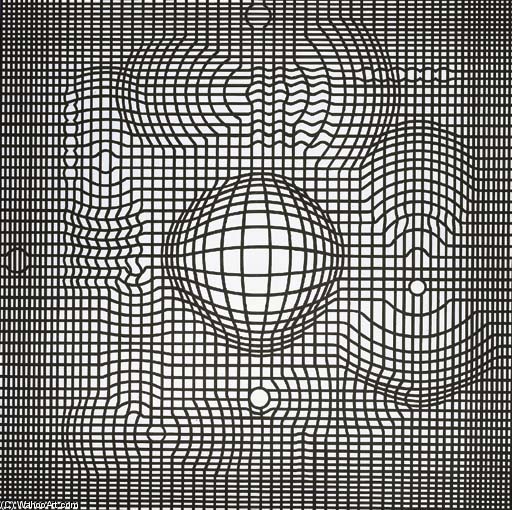
Jong
Tamaño de la reproducción
Victor Vasarely's 'Jong,' completed in 1968, is more than just an image; it’s an invitation to question the very nature of reality. This arresting work, a cornerstone of Op Art, immediately captivates with its seemingly impossible optical illusion – a distorted face emerging from a grid of meticulously crafted black and white lines, culminating in a central sphere that appears to both contain and disrupt the composition. Vasarely, born Károly Vaszary in 1906 in Pécs, Croatia, was a visionary who dedicated his life to exploring how our eyes perceive space and form. His journey began with an unexpected detour – initially pursuing medical studies before embracing the world of art in 1927 – a shift profoundly shaped by his education at the Podolini-Volkmann Academy and, crucially, Sándor Bortnyik’s ‘Műhely,’ where he absorbed the revolutionary ideas of the Bauhaus movement. This foundation laid the groundwork for his groundbreaking exploration of geometric abstraction, ultimately leading to the creation of 'Jong' – a testament to his mastery of visual deception.
'Jong’s' power lies in its masterful use of line. A dense grid of parallel lines forms the foundational structure, but these lines are deliberately warped, curved, and distorted – a technique central to Op Art. This manipulation creates an intense sense of movement and visual ambiguity, drawing the viewer into a complex interplay between perception and reality. The sphere at the heart of the composition acts as both a focal point and a destabilizing element, further amplifying the illusion. The stark monochrome palette—a deliberate choice by Vasarely—heightens the impact of this geometric play, stripping away any distractions and focusing solely on the dynamic relationship between form and space.
Beyond its purely visual effect, ‘Jong’ carries a potent symbolic weight. The distorted face, rendered through abstract distortions within the grid, can be interpreted as representing hidden identities or fragmented perceptions – themes frequently explored by Vasarely. The work suggests that what we see isn't necessarily a faithful reflection of reality but rather a subjective interpretation shaped by our own biases and experiences. This resonates with broader philosophical questions about identity, consciousness, and the nature of truth. The implied movement within the composition evokes a sense of dynamism and instability, mirroring the fluid and often contradictory aspects of human experience.
'Jong' is more than just an artwork; it’s a captivating exploration of perception itself. Its enduring appeal lies in its ability to challenge our assumptions about reality and invite us to reconsider how we see the world. Reproduced with meticulous attention to detail, this piece offers a unique opportunity to bring a touch of Op Art's dynamism and intellectual depth into any interior space – a conversation starter, a visual puzzle, and a testament to Victor Vasarely’s visionary genius.
Victor Vasarely (nacido Károly Vaszary) fue una figura clave en el desarrollo del Op Art y el arte cinético. Su obra buscaba trascender la pintura tradicional explorando ilusiones ópticas y creando experiencias visuales dinámicas. Nacido en Pécs, entonces parte de Austria-Hungría (ahora Croacia), su vida temprana incluyó estudiar medicina en la Universidad Eötvös Loránd de Budapest antes de dedicarse por completo al arte.
La contribución de Vasarely a la historia del arte es multifacética. Se movió más allá de las técnicas pictóricas tradicionales para crear obras que involucran activamente la percepción del espectador. Su enfoque sistemático desafió las nociones convencionales de creatividad artística y allanó el camino para el arte generado por computadora y el diseño digital. Al abrazar la reproducibilidad y las aplicaciones comerciales, Vasarely difuminó los límites entre el arte fino y la cultura popular, dejando una huella perdurable en ambos.

1906 - 1997 , Croacia

Explore the revolutionary world of Victor Vasarely, father of Op Art. Discover his geometric masterpieces, artistic system, & lasting impact on modern design. A guide for discerning art collectors.

Descubre 10 obras maestras del arte minimalista: Mondrian, Rothko y más. Explora la historia, técnica y el impacto de estos lienzos abstractos perfectos para una decoración serena y elegante. Encuentra reproducciones de alta calidad en Most-Famous-Paintings.com.

Descubre los 10 cuadros más impactantes dominados por el negro marfil. Explora la historia de Rembrandt, Van Gogh y otros maestros del arte clásico y moderno. Encuentra reproducciones de alta calidad para tu hogar en
Descubre las 10 pinturas más famosas dominadas por el negro marsella. Explora la historia, técnica y simbolismo de obras maestras del expresionismo alemán, gótico y arte moderno. Reproducciones de museos en .

Descubre los 10 cuadros blancos más emblemáticos de la historia del arte. Explora Monet, Van Gogh y Klimt, y su magistral uso de la luz y el color. Encuentra reproducciones de alta calidad e inspírate para tu decoración en .


Manténgase al día con las últimas noticias de arte, ofertas exclusivas e ideas de decoración.
Cuéntanos sobre tu proyecto y nuestros expertos en arte te ofrecerán 3 sugerencias de obras personalizadas.
Permítenos seleccionar 3 opciones solo para ti – ¡Gratis!


 Compartir


 Ver más




































 La opción de vidrio solo está disponible en tamaños inferiores a 110 cm.


