x

Impresiones giclée o en lienzo de calidad de museo con producción rápida y opciones de acabado flexibles. ( Comprar pintura hecha a mano Comprar imagen)





























Elija entre nuestros tamaños predefinidos que respetan las proporciones originales de la obra.

Puede introducir sus propias dimensiones para adaptarse a un marco o espacio específico. Si el tamaño seleccionado no coincide con las proporciones de la imagen original, recortaremos la obra de arte o extenderemos la imagen con un borde con efecto espejo o de color sólido. Se enviará una maqueta digital para su aprobación antes de que comience la producción.
Tenga en cuenta que la vista previa en pantalla no refleja el recorte o la extensión real. Solo la maqueta mostrará con precisión la composición final.
Aunque existen tamaños personalizados, recomendamos seleccionar una dimensión de la lista predefinida para preservar las proporciones originales.
Envío a todo el mundo () en 2 semanas en lugar de las 4/5 semanas estándar. (23 agosto)


Opus 2604
Dimensiones de la reproducción
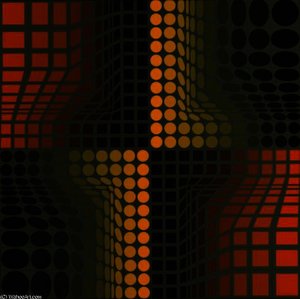
Victor Vasarely's *Opus 2604* is not merely a painting; it’s an invitation to question the very nature of visual reality. This mesmerizing work, dominated by a vibrant blue spiral punctuated with meticulously arranged circles, embodies the core tenets of Op Art – Optical Art – a movement that emerged in the mid-20th century and continues to captivate viewers with its illusionistic power. Born Károly Vaszary in 1906 in Pécs, Croatia, Vasarely’s artistic trajectory began unexpectedly, initially driven by an interest in medicine before he was drawn to the expressive possibilities of color and form. His formative years within the Bauhaus-influenced workshop of Sándor Bortnyik instilled a profound understanding of geometric abstraction and functional design, principles that would become the bedrock of his groundbreaking style.
At its heart, *Opus 2604* is a testament to Vasarely’s mastery of optical illusion. The painting employs a complex system of concentric circles – varying in size and hue – arranged within a spiraling framework. This arrangement deliberately exploits the human visual system's tendency to perceive movement and depth. The eye, constantly attempting to resolve the conflicting cues presented by the overlapping circles, creates the sensation of three-dimensionality, even though the painting itself is strictly two-dimensional. Vasarely meticulously controlled these elements, understanding that subtle shifts in scale and color could dramatically alter the viewer’s perception. This technique, central to Op Art, aimed to stimulate the eye and challenge traditional notions of representation.
The predominantly blue palette of *Opus 2604*, accented with strategic green highlights, contributes significantly to its visual impact. Blue, often associated with tranquility and infinity, reinforces the sense of depth within the spiral. The use of varying shades and intensities within the circles further enhances this illusionistic effect. Created during a period of rapid technological advancement and shifting artistic sensibilities, *Opus 2604* reflects the broader cultural fascination with science, technology, and the exploration of perception. Vasarely’s work aligns with the post-war interest in abstract art and its potential to convey complex ideas through purely visual means – a reaction against representational painting's perceived limitations.
*Opus 2604* transcends mere optical trickery; it evokes a sense of dynamism, movement, and perhaps even the feeling of infinite space. The spiral itself is a powerful symbol – often associated with growth, evolution, and the cyclical nature of time. Vasarely’s deliberate arrangement of circles creates a visual rhythm that draws the viewer's eye across the canvas, generating a meditative experience. The painting’s enduring appeal lies in its ability to stimulate both intellectual curiosity and emotional response, prompting viewers to contemplate their own relationship with perception and reality.
Victor Vasarely (nacido Károly Vaszary) fue una figura clave en el desarrollo del Op Art y el arte cinético. Su obra buscaba trascender la pintura tradicional explorando ilusiones ópticas y creando experiencias visuales dinámicas. Nacido en Pécs, entonces parte de Austria-Hungría (ahora Croacia), su vida temprana incluyó estudiar medicina en la Universidad Eötvös Loránd de Budapest antes de dedicarse por completo al arte.
La contribución de Vasarely a la historia del arte es multifacética. Se movió más allá de las técnicas pictóricas tradicionales para crear obras que involucran activamente la percepción del espectador. Su enfoque sistemático desafió las nociones convencionales de creatividad artística y allanó el camino para el arte generado por computadora y el diseño digital. Al abrazar la reproducibilidad y las aplicaciones comerciales, Vasarely difuminó los límites entre el arte fino y la cultura popular, dejando una huella perdurable en ambos.

1906 - 1997 , Croacia

Explore the science of Op Art through the lens of masters like Victor Vasarely. Discover how geometric abstraction uses optical illusions to create movement and delve into the neuroaesthetics of perception with our expert art history guide.

Explore the profound impact of Minimalism and Geometric Abstraction. From Mondrian to Malevich, discover how stripping art to its essential forms revolutionized modern aesthetics through our expert-led historical guide.

Master the complexities of Geometric Abstraction. Our expert guide explores the evolution from Cubist deconstruction to Bauhaus precision, decoding the power of shape and form. Perfect for art students seeking deep historical context and academic insight into modern masterpieces.


Manténgase al día con las últimas noticias de arte, ofertas exclusivas e ideas de decoración.
Cuéntanos sobre tu proyecto y nuestros expertos en arte te ofrecerán 3 sugerencias de obras personalizadas.
Permítenos seleccionar 3 opciones exclusivas para ti – ¡Gratis!


 Ver en contexto
 Enviar
 Compartir
 Detalles

 Descargar
 Similares
 Radiografía
 Presentación de diapositivas

 Ver más







 La opción de vidrio solo está disponible en tamaños inferiores a 110 cm.