x

Óleo sobre lienzo pintado a mano en el tamaño y marco de su elección, realizado por encargo por nuestros artistas. ( Pedir impresión Comprar descarga)





























Elija entre nuestros tamaños predefinidos que respetan las proporciones originales de la obra.

Puede ingresar sus propias dimensiones para adaptarse a un marco o espacio específico. Si el tamaño seleccionado no coincide con las proporciones de la imagen original, recortaremos la obra o extenderemos la pintura con elementos adicionales pintados a mano. Se le enviará una maqueta digital para su aprobación antes de comenzar la producción.
Tenga en cuenta que la vista previa en pantalla no refleja el recorte o la extensión reales. Solo la maqueta mostrará con precisión la composición final.
Si bien existen tamaños personalizados, recomendamos seleccionar una dimensión de la lista predefinida para preservar las proporciones originales.
Envío a todo el mundo () en 3-4 semanas en lugar de las 5 semanas estándar. (21 agosto). Sin comprometer la calidad.


Terz
Tamaño de la reproducción
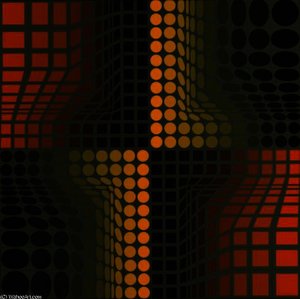
Victor Vasarely's "Terz" is more than just a painting; it’s an invitation into the very fabric of perception, a testament to the revolutionary impact of Op Art and the burgeoning fascination with geometric abstraction in the mid-20th century. This captivating work, rendered in a striking interplay of blue and white, immediately draws the viewer into its meticulously constructed world – a miniature universe contained within a seemingly simple arrangement of squares.
Born Károly Vaszary in 1906 in Pécs, Croatia (then part of Austria-Hungary), Vasarely’s artistic trajectory was initially rooted in the scientific. His early studies in medicine at Eötvös Loránd University hinted at a logical, analytical mind – a perspective that would later become central to his groundbreaking approach to art. However, abandoning the path of healing for painting in 1927 marked a profound shift, fueled by an intense desire to explore how the eye perceives and interprets visual information. This pursuit led him to the influential Podolini-Volkmann Academy and, crucially, Sándor Bortnyik’s “Műhely” workshop, where he absorbed the principles of functional design and geometric abstraction championed by the Bauhaus movement – a movement that prioritized clarity, functionality, and an understanding of optical illusions.
"Terz" exemplifies the core tenets of Op Art, a style pioneered by Vasarely and his contemporaries. This artistic movement sought to create optical illusions through precise arrangements of color and shape, manipulating the viewer’s perception of depth, movement, and space. The painting's seemingly static composition is anything but; the carefully calibrated squares generate an illusion of continuous motion, drawing the eye across the canvas in a mesmerizing dance. Vasarely wasn't simply depicting shapes; he was actively engaging with the science of visual perception, demonstrating how our brains construct reality based on sensory input.
The execution of "Terz" is characterized by an almost obsessive attention to detail. The numerous small squares are arranged in a circular fashion, creating a sense of continuity and echoing the principles of modular design. This deliberate construction isn't haphazard; it’s a carefully calculated harmony – a visual equation designed to exploit the brain’s natural tendency to seek patterns and order. Vasarely’s mastery lies in his ability to harness this inherent human response, transforming a simple geometric arrangement into a powerfully evocative image. The use of contrasting colors further amplifies the illusion, enhancing the sense of depth and movement.
"Terz," like much of Vasarely’s work, transcends mere visual representation to explore fundamental questions about reality itself. The geometric forms can be interpreted as representing the building blocks of the universe – a reflection of Vasarely's fascination with mathematics, physics, and the underlying order of existence. The painting evokes a sense of calm contemplation, inviting viewers to lose themselves in its intricate patterns and contemplate the nature of perception. It’s a piece that rewards repeated viewing, revealing new nuances and complexities with each encounter.
Victor Vasarely (nacido Károly Vaszary) fue una figura clave en el desarrollo del Op Art y el arte cinético. Su obra buscaba trascender la pintura tradicional explorando ilusiones ópticas y creando experiencias visuales dinámicas. Nacido en Pécs, entonces parte de Austria-Hungría (ahora Croacia), su vida temprana incluyó estudiar medicina en la Universidad Eötvös Loránd de Budapest antes de dedicarse por completo al arte.
La contribución de Vasarely a la historia del arte es multifacética. Se movió más allá de las técnicas pictóricas tradicionales para crear obras que involucran activamente la percepción del espectador. Su enfoque sistemático desafió las nociones convencionales de creatividad artística y allanó el camino para el arte generado por computadora y el diseño digital. Al abrazar la reproducibilidad y las aplicaciones comerciales, Vasarely difuminó los límites entre el arte fino y la cultura popular, dejando una huella perdurable en ambos.

1906 - 1997 , Croacia

Explore the science of Op Art through the lens of masters like Victor Vasarely. Discover how geometric abstraction uses optical illusions to create movement and delve into the neuroaesthetics of perception with our expert art history guide.

Explore the profound impact of Minimalism and Geometric Abstraction. From Mondrian to Malevich, discover how stripping art to its essential forms revolutionized modern aesthetics through our expert-led historical guide.


Manténgase al día con las últimas noticias de arte, ofertas exclusivas e ideas de decoración.
Cuéntanos sobre tu proyecto y nuestros expertos en arte te ofrecerán 3 sugerencias de obras personalizadas.
Dejamos que nosotros seleccionemos 3 opciones exclusivas para ti – ¡Gratis!


 Vista previa
 Compartir
 Compartir
 Ver detalles

 Descargar
 Ver similares
 Radiografía
 Presentación de diapositivas

 Leer más







 La opción de vidrio solo está disponible en tamaños inferiores a 110 cm.