


x

Meie kunstnike poolt tellimusel valmistatud käsitsi maalitud õli-kainaste teos teie soovitud suuruses ja raamis. ( Lülita trükile Vaata pilti)





























Vali meie eelmääratud suurused, mis vastavad teose algupärastele proportsioonidele.

Sa võite sisestada oma mõõtmed konkreetse raami või ruumi sobivuse tagamiseks. Kui teie valitud suurus ei vasta originaalpildi proportsioonidele, siis kärvime kunstiteost või laiendame maali täiendavate käsitsi maalitud elementidega. Enne tootmise algust saadetakse teile heakskiitmiseks digitaalne eelvaade.
Palun pidage meeles, et ekraanil kuvatav eelvaade ei kajasta tegelikku kärpimist või laiendamist. Ainult eelvaade näitab täpselt lõplikku kompositsiooni.
Kuigi on saadaval kohandatud suurused, soovitame originaalproportsioonide säilimiseks valida mõõdud eelmääratletud nimekirjast.
Maailmline tarne 3–4 nädala jooksul tavalise 5 nädala asemel. (8 august). Kvaliteedis kompromisse ei tehta.


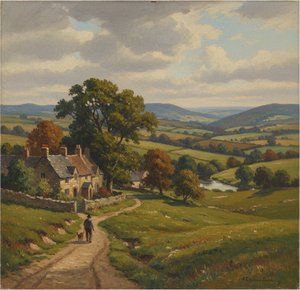
A View In Glamorganshire
Reproduktsiooni suurus
Born in the industrious town of Preston, Lancashire, in 1729, Anthony Devis emerged as a profound voice within the landscape painting tradition of eighteenth-century Britain. His life and career, spanning nearly six decades until his death in 1816, were defined by an unwavering dedication to the observation of the natural world. While his early years were shaped by the practicalities of his father’s carpentry trade—a background that likely instilled in him a foundational respect for precision and structure—his artistic soul was guided by a much more ethereal pursuit. Devis possessed a rare ability to capture the sublime beauty of the English countryside, transforming mere topographical records into emotive experiences that resonated with the burgeoning Romantic sensibilities of his era.
The artist’s development was deeply rooted in familial connection and classical study. He benefited immensely from his relationship with Arthur Devis, an accomplished painter whose influence provided a vital bridge to the professional art world. As Devis established himself in London around 1760, he became a fixture in the prestigious circles of the Free Society of Artists and the Royal Academy. These institutions were not merely venues for exhibition but stages upon which he could showcase his mastery of light and atmosphere to the most discerning patrons of the age. His work often bridged the gap between the meticulous accuracy of topographical painting and the idealized, sweeping vistas inspired by the masters of the past.
To understand the depth of Devis’s technique, one must look to the giants upon whose shoulders he stood. His approach to composition and color was profoundly shaped by the dramatic works of Claude Lorrain and Nicolas Poussin. From these masters, Devis learned the art of atmospheric perspective—the subtle manipulation of color gradations and clarity to create an illusion of immense depth and distance. This skill allowed him to guide the viewer’s eye through his landscapes, from the detailed textures of a foreground thicket to the hazy, ethereal silhouettes of distant hills.
His brushwork was characterized by a meticulous care that honored the reality of his subjects while imbuing them with a sense of timelessness. Whether he was depicting the rugged power of The Weeping Rock at Hackfall or the serene, structured beauty of Upton House, Devis utilized light not just as a tool for visibility, but as a narrative element. In his hands, sunlight could evoke the warmth of a summer afternoon or the melancholic chill of a winter twilight, making his landscapes feel less like static images and much more like living, breathing environments.
Beyond the canvas, Anthony Devis left an indelible mark on the decorative arts through one of the most charming collaborations in British history. His work with Josiah Wedgwood on the celebrated ‘Green Frog’ service remains a testament to his ability to translate landscape sensibilities into ceramic form. This intersection of fine art and industrial design highlights how Devis's aesthetic vision permeated the very fabric of Georgian material culture.
The historical significance of Devis lies in his role as a chronicler of a changing Britain. His oeuvre serves as a visual archive of the English landscape, capturing specific locales with a fidelity that honors both the physical reality and the emotional resonance of the land. His contributions can be summarized through several key pillars of his legacy:
Today, the works of Anthony Devis continue to captivate collectors and historians alike. He remains a pivotal figure whose tranquil landscapes offer a window into the soul of the British countryside, reminding us of a time when the meticulous observation of nature was the highest form of poetic expression.

1729 - 1816 , United Kingdom

Explore the life & art of George Barret Sr., a pioneer of British pastoral painting. Discover his influence on Romantic landscape art, patronage, and collecting tips from Most-Famous-Paintings.
Explore the captivating landscapes & portraits of Brian Hatton (1887-1916), a promising British artist lost too soon. Discover his unique style, Herefordshire roots, and lasting legacy in early 20th-century art.

Explore the captivating Orientalist paintings of John Frederick Lewis! Discover his mastery of detail, genre scenes & influence on 19th-century British art. Learn about his life, techniques & legacy at Most-Famous-Paintings.

Explore the captivating genre scenes of Thomas George Webster, a Victorian painter bridging British traditions with American themes. Discover his style, influences & legacy in 19th-century art history.

Explore the life & work of Reginald Grenville Eves, a leading British portraitist who transitioned to captivating landscape painting. Discover his legacy and prominent works at Most-Famous-Paintings.


Püsige kursis viimaste kunstiuudistega, eksklusiivsete pakkumistega ja sisustamisideetega.
Kirjeldage meile oma projekti ja meie kunstieksperdid pakuvad teile 3 isikupärast kunstiettepanekut.
Laske meil koostada just teile mõeldud 3 valikut – tasuta!


 Eelvaade
 Saada
Saada Jaga
Jaga
 Teave teose kohta

 Laadi alla
 Sarnased teosed
 Röntgenuuring
 Slaidietendus
 Loe lähemalt







 Klaasivalik on saadaval ainult suuruses kuni 110 cm


