
Müü võimsalt oma kunsti
Soovitusnimekiri Ostukorv Cart
EelvaadeEelvaade AR-eelvaadeAR-eelvaade Osta käsitsi maalitud maal Osta käsitsi maalitud maalOsta pilt Osta pilt SaadaSaada
Teave teose kohtaTeave teose kohta Lisa lemmikutesse Lisa lemmikutesse Laadi allaLaadi alla Sarnased teosedSarnased teosed RöntgenuuringRöntgenuuring SlaidietendusSlaidietendus

untitled (3287)

Witness the enigmatic world of Gustave Moreau with this stunning reproduction of 'Untitled (3287)'. A Symbolist masterpiece featuring a crowned woman and castle, embodying power & myth.

Gustave Moreau oli üks mõjukasid Symbolismi suurimest kunstnike maailmas, kes tundmatu ilu ja müstilise sügavuse saavutamiseks kasutas kujutavat keelt. Tema töö keskendus legendidele ja Piibli lugudele ning oli täis värvilist jõudu ja sügavat psühholoogilist mõju. Moreau maalid olid täis sümboleid ja pakkusid vaatajatele palju küsimusi. Lisaks sellele oli tema stiil omanäoline ja oli mõjukas hilje

Giclée / Kunstiprint

Muuseumikvaliteediga giclée- või kangasprint kiire tootmisega ja paindlikud viimistlusvõimalused. (Osta käsitsi maalitud maal Osta käsitsi maalitud maalOsta pilt Osta pilt)

P118B $10
P118H $10
P118W $10
P438Z $10
P508JH $12
P508YH $12
P805H $10
P805Z $10
P919BZ $10
P919G $10
P919XJ $10
P959ZH $10
P968JZ $12
W106C $8
W218G $10
W218JH $8
W218Y $10
W307PJ $10
W316G $10
W316PJ $8
W316Y $10
W398PJ $8
W4111J $10
W500HY $15
W500JH $15
W692G $12
W849H $8
W940BG $15
W953PJ $8

Standard
custom
CM
INCH

Vali meie eelmääratud suurused, mis vastavad teose algupärastele proportsioonidele.

laius
kõrgus

Saate sisestada oma mõõdud, et need sobiks konkreetse raami või ruumi sisse. Kui valitud suurus ei vasta originaalteose proportsioonidele, lõigame teose ära või laiendame pilti peegeldatud või ühtlase servaga. Enne tootmisprotsessi algust saadetakse Teie kinnitamiseks digitaalne näidis.
Palun märka, et ekraanil kuvatav eelvaade ei kajasta tegelikku lõigamist või laiendamist. Ainult näidis kujutab täpselt lõplikku kompositsiooni.
Kuigi erimõõdu on saadaval, soovitame originaaproportsioonide säilitamiseks valida mõõt ette määratud nimekirjast.

Ülemaailmne tarne () 2 nädala jooksul, tavalise 4/5 nädala asemel. (22 august)

why_choose_icon
Tasuta ekspresssaatmine üle maailma
why_choose_icon
Kõrgekvaliteediline linakangas
why_choose_icon
Täielik transpordikindlustus
why_choose_icon
Tollimaksude tagastamise garantii
why_choose_icon
Värvitoime täpsuse garantii
why_choose_icon
60-päevane tagastusõig: ainult tootmisdefektide korral
why_choose_icon
100% raha tagasi garantii
why_choose_icon
Hulgusoodustus

Kogu summa

$ 68

reproduction

untitled (3287)

Giclée / Kunstiprint

Reproduktsiooni suurus

-

Kogusumma

$ 68

Teave teose kohta

  • Medium: Painting
  • Title: untitled (3287)
  • Influences:
    • Romanticism
    • Biblical
  • Location: Musée Moreau
  • Subject or theme: Power, majesty, myth
  • Artistic style: Dreamlike, symbolic

Kunstiviktoriin

Iga küsimuse kohta on ainult üks õige vastus.

Küsimus 1:
What is the primary symbolic element depicted in Gustave Moreau’s ‘untitled (3287)’?
Küsimus 2:
Based on the image description, what architectural structure is prominently featured in the background?
Küsimus 3:
Gustave Moreau is most closely associated with which artistic movement?
Küsimus 4:
The presence of birds in the scene likely contributes to what aspect of the artwork?
Küsimus 5:
Considering Moreau’s biography, what was a key characteristic of his artistic approach?

Kogumuse kirjeldus

A Dream Woven in Color: Gustave Moreau’s “Untitled (3287)”

Gustave Moreau's "Untitled (3287)" is not merely a portrait; it’s an immersion into the richly layered, intensely personal world of Symbolist painting. Painted between 1880 and 1890, this work transcends simple representation, offering instead a glimpse into the artist’s meticulously constructed dreamscape – a realm where myth, religion, and psychological depth intertwine. The image depicts a woman, her face partially obscured yet radiating an undeniable authority, holding aloft a large cross. This isn't a straightforward depiction of Christian piety; rather, it feels imbued with a potent, almost unsettling significance, hinting at a complex relationship between faith, power, and the feminine archetype.

Moreau, born in Paris in 1826, was a pivotal figure in the Symbolist movement. Rejecting the objective realism of his predecessors, he sought to capture not what the eye sees, but what the soul feels. Influenced by artists like William Blake and Dante Alighieri, Moreau drew heavily on mythology, folklore, and religious iconography – transforming these ancient sources into intensely subjective visual narratives. His art was often described as “dreamlike,” a deliberate attempt to access the subconscious and express emotions beyond the realm of rational thought. This painting exemplifies that approach perfectly.

The Anatomy of Symbolism: Composition and Technique

The composition itself is deliberately arresting. The woman, draped in flowing robes of deep crimson and gold, dominates the foreground, her posture conveying both strength and vulnerability. The cross she holds isn’t a symbol of simple salvation but appears to be an object of contemplation, almost as if weighing its significance. Behind her rises a formidable castle-like structure – a potent symbol of authority, power, and perhaps even imprisonment. The cloudy sky above suggests uncertainty and the unknown, while scattered birds add a touch of fleeting beauty and fragility to the scene.

Moreau’s technique is equally captivating. He employed a meticulous layering of glazes—thin, translucent washes of color applied over time—to create an ethereal luminosity. The colors themselves are rich and saturated, particularly the deep reds and golds, contributing to the painting's opulent and dreamlike quality. Notice the intricate detail in the fabrics, the subtle modeling of the woman’s face, and the atmospheric perspective used to render the castle and sky. Moreau was a master of creating texture through this glazing technique, giving his paintings a remarkable sense of depth and tactile richness.

Decoding the Symbolism: Myth, Religion, and the Feminine

The symbolism within “Untitled (3287)” is layered and open to interpretation. The cross, as mentioned earlier, transcends its traditional Christian meaning. It could represent sacrifice, judgment, or even a burden of responsibility. The woman herself embodies a complex archetype – a figure of power and mystery, reminiscent of both the Virgin Mary and figures from ancient mythology. Her partially obscured face invites speculation about her identity and role within the narrative.

The castle, frequently appearing in Moreau’s work, symbolizes not just earthly power but also the constraints imposed by societal expectations and religious dogma. The birds, often associated with freedom and spirituality, offer a counterpoint to this sense of confinement. Moreau was deeply interested in exploring the intersection of these themes – particularly the role of women within both religious and mythological contexts. His work frequently depicted female figures as powerful, enigmatic beings who held sway over both the earthly and spiritual realms.

A Legacy of Dreamers: Moreau’s Influence and Enduring Appeal

Gustave Moreau's influence on subsequent generations of artists is undeniable. He served as a key precursor to movements like Art Nouveau and Expressionism, inspiring figures such as Henri Matisse and Raoul Roual. His exploration of the subconscious, his embrace of symbolism, and his masterful use of color and texture continue to resonate with viewers today. “Untitled (3287)” stands as a testament to Moreau’s unique vision – a captivating invitation into a world where dreams and reality blur, and where the most profound truths are often found not in what is seen, but in what is felt.

Most-Famous-Paintings offers meticulously crafted hand-painted reproductions of this extraordinary artwork, allowing you to bring its evocative beauty into your own space. Each reproduction captures the nuances of Moreau’s technique and the painting's rich symbolism, providing a stunning addition to any collection or interior design scheme. Explore our selection today and experience the magic of Gustave Moreau firsthand.

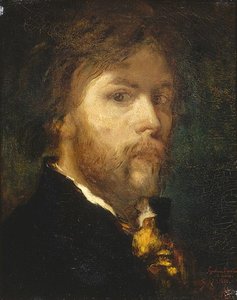
Kunstniku elulugu

A Dream Weaver of Symbolism: The Life and Art of Gustave Moreau

Gustave Moreau, a name synonymous with the ethereal beauty and enigmatic depths of Symbolist painting, emerged from 19th-century Paris as a singular artistic voice. Born in 1826 into a bourgeois family—his father an architect and archivist—Moreau’s early life was steeped in intellectual curiosity and aesthetic sensibility. From a young age, he displayed a remarkable gift for drawing, nurtured through traditional academic training at the École des Beaux-Arts under figures like François-Édouard Picot. However, Moreau's artistic path would diverge sharply from the prevailing Realist and Impressionist currents of his time. He wasn’t interested in capturing fleeting moments or objective reality; instead, he sought to unlock the hidden realms of myth, religion, and the human psyche through a deeply personal and symbolic visual language. His journey was one of inward exploration, translating subjective emotions and spiritual yearnings onto canvas with an obsessive attention to detail and a vibrant, often opulent palette.

The Forge of Imagination: Influences and Artistic Development

Moreau’s artistic development wasn't born in a vacuum. While rejecting the dominant trends of his era, he drew inspiration from diverse sources. The dramatic use of color and exotic subject matter found in the works of Eugène Delacroix resonated deeply with him, igniting a passion for narrative painting imbued with emotional intensity. He also held Renaissance masters like Michelangelo and Leonardo da Vinci in high esteem, admiring their mastery of composition, anatomy, and psychological insight. Yet, Moreau wasn’t merely imitating these artists; he was synthesizing their influences into something entirely new. His travels to Italy in the 1850s proved pivotal, immersing him in the art of antiquity and the Renaissance, providing a wealth of motifs and stylistic cues that would populate his future works. He meticulously copied Old Master paintings, not as an exercise in replication, but as a means of absorbing their techniques and unlocking their secrets. This dedication to craft, combined with his burgeoning interest in mythology and literature, laid the foundation for his unique artistic vision. Moreau’s formative years were marked by a profound engagement with intellectual currents shaping European thought. He devoured texts on philosophy, psychology, and mythology—particularly those exploring Jungian archetypes and Freud's psychoanalytic theories—influencing his artistic explorations into the subconscious mind. His fascination with Dante Alighieri’s *Inferno* fueled his imaginative depictions of hellish landscapes and tormented figures, reflecting a preoccupation with confronting existential anxieties. Simultaneously, he cultivated an admiration for the grandeur and spiritual solemnity of Byzantine art, absorbing its stylistic conventions—particularly the use of gold leaf and stylized iconography—which would become hallmarks of his own oeuvre.

A World of Symbols: Themes and Techniques

Moreau’s paintings are not simply illustrations of myths or biblical stories; they are complex allegories that invite contemplation and interpretation. He delved into narratives like those of Salome, Orpheus, Jupiter and Semele, and countless others, not to retell them literally, but to explore their underlying psychological and spiritual truths. His canvases teem with symbolic imagery—serpents representing temptation, jewels signifying earthly desires, and figures embodying abstract concepts like grief, loss, or redemption. He masterfully created a dreamlike atmosphere through intricate detail, rich textures, and an often unsettling juxtaposition of light and shadow. Moreau’s technique was characterized by meticulous layering of paint, creating surfaces that shimmer with iridescent colors and evoke a sense of otherworldly beauty. His use of gold leaf further enhanced this effect, lending his works a Byzantine quality that underscored their spiritual dimension. He wasn't concerned with capturing realistic textures or perspectives; instead, he prioritized the expressive power of color and form to convey mood and meaning. Moreau’s artistic output spanned decades, producing over 15,000 paintings, watercolors and drawings—a staggering testament to his unwavering commitment to creative endeavor. His stylistic evolution mirrored broader shifts in artistic sensibilities throughout the Victorian era, transitioning from early academic realism toward a more expressive Symbolist style characterized by flattened perspectives and stylized forms. Recurring motifs included biblical figures—particularly Mary Magdalene—and mythological subjects—drawing heavily on Greco-Roman mythology and folklore—reflecting his enduring fascination with timeless narratives and archetypal imagery. Notable artworks include *Salome Dancing before Herod*, *Jupiter and Semele*, *Orpheus*, *The Apparition*, and *Desdemona*, each embodying Moreau’s distinctive visual language and conveying profound psychological insights.

Legacy and Influence: The Enduring Power of Symbolism

Though initially met with mixed reactions, Moreau became a central figure in the burgeoning Symbolist movement during the 1890s. Unlike some of his contemporaries who actively sought public attention, he remained somewhat reclusive, preferring to work independently and avoid artistic debates. However, his influence was undeniable. In 1893, he accepted a professorship at the École des Beaux-Arts, where he profoundly impacted generations of artists, including Henri Matisse and Georges Rouault. He encouraged his students to embrace imagination, symbolism, and individual expression, urging them to break free from conventional artistic norms. While Symbolism eventually waned in popularity after Moreau’s death in 1898, his work experienced a significant reevaluation in the latter half of the 20th century. Today, he is widely regarded as one of the most important figures in the movement and a precursor to modern art. The Musée Gustave Moreau, housed in his former studio and home in Paris, stands as a testament to his enduring legacy—a sanctuary where visitors can immerse themselves in the captivating world of this extraordinary artist. His paintings continue to resonate with audiences today, offering glimpses into the hidden depths of the human soul and reminding us of the power of art to transcend the boundaries of reality.
Gustav Morelau

Gustav Morelau

1826 - 1898 , Prantsusmaa

Lühikesed faktid

  • Artistic Movement Or Style: Symbolism
  • Artists Who Influenced This Artist:
    • Eugène Delacroix
    • Michelangelo
    • Leonardo da Vinci
  • Date Of Birth: 6. aprill 1826
  • Date Of Death: 18. aprill 1898
  • Full Name: Gustave Moreau
  • Nationality: Prantslased
  • Notable Artworks:
    • Salome Dancing before Herod
    • Jupiter and Semele
    • Orpheus
  • Place Of Birth: Pariis, Prantsuda
Avastage teoseid, mis on koondatud teemade, stiilide ja omaduste kaupa.




































