x


 Preview
 Telli trükis Osta digipilt
 Saada
Saada
 Teave teose kohta
 Lisa lemmikutesse
 Laadi alla
 Sarnased teosed
 Röntgenuuring
 Slaidietendus
Meie kunstnike poolt tellimusel valmistatud käsitsi maalitud õli-kainaste teos teie soovitud suuruses ja raamis.





























Vali meie eelmääratud suurused, mis vastavad teose algupärastele proportsioonidele.

Sa võite sisestada oma mõõtmed konkreetse raami või ruumi sobivuse tagamiseks. Kui teie valitud suurus ei vasta originaalpildi proportsioonidele, siis kärvime kunstiteost või laiendame maali täiendavate käsitsi maalitud elementidega. Enne tootmise algust saadetakse teile heakskiitmiseks digitaalne eelvaade.
Palun pidage meeles, et ekraanil kuvatav eelvaade ei kajasta tegelikku kärpimist või laiendamist. Ainult eelvaade näitab täpselt lõplikku kompositsiooni.
Kuigi on saadaval kohandatud suurused, soovitame originaalproportsioonide säilimiseks valida mõõdud eelmääratletud nimekirjast.
Maailmline tarne 3–4 nädala jooksul tavalise 5 nädala asemel. (27 juuli). Kvaliteedis kompromisse ei tehta.


Duel de Masque
Reproduktsiooni suurus
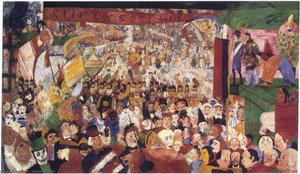
James Ensor's "Duel de Masque" (c. 1890) isn’t merely a painting; it’s an immersive plunge into the unsettling heart of masquerade and social decay. This large-scale oil on canvas, largely lost to definitive documentation regarding its exact dimensions, immediately confronts the viewer with a scene brimming with theatrical excess and veiled menace. Set against a muted, almost melancholic backdrop – suggesting a bleak winter morning – it depicts a gathering of figures caught in the aftermath of a duel, their identities obscured by elaborate costumes and masks. The painting’s power lies not in dramatic action, but in its carefully constructed atmosphere of unease, hinting at hidden resentments and unspoken anxieties beneath the veneer of festive entertainment.
Ensor, born in Ostend, Belgium, to an English father and a Belgian mother, possessed a uniquely dual heritage that profoundly shaped his artistic vision. His childhood spent amidst the vibrant chaos of carnival celebrations – a world saturated with masks, puppets, and theatrical performances – became a foundational element of his oeuvre. This fascination with disguise and concealment is powerfully evident in “Duel de Masque,” where each figure embodies a carefully constructed persona, deliberately distancing themselves from genuine emotion or identity. The artist’s early exposure to this world of illusion undoubtedly fueled his exploration of the darker aspects of human nature, often presented through distorted figures and unsettling imagery.
The central motif of “Duel de Masque” – the mask itself – is far more than a simple decorative element. It represents a deliberate attempt to conceal, to create an artificial identity, and ultimately, to distance oneself from responsibility. Each character wears a costume that actively obscures their true nature: a Pierrot with a bloodied face, a Duc de Guise shrouded in velvet, a Domino clutching his head – all figures trapped within the confines of their chosen roles. The skeletal figure prominently displayed adds another layer of symbolic weight, representing mortality and the inevitable decay beneath the surface of social performance. The inclusion of a surgeon, dressed as a doge of Venice, suggests an attempt to mend wounds both physical and emotional, yet his efforts are futile against the pervasive sense of ruin.
Beyond the individual costumes, the painting’s composition contributes significantly to its unsettling effect. The figures are arranged in a deliberately claustrophobic space, creating a feeling of confinement and tension. The muted color palette – dominated by grays, browns, and blacks – further enhances this sense of gloom, while the stark lighting emphasizes the drama of the scene. The deliberate blurring of lines between reality and illusion—the painted backdrop, the theatrical costumes, the obscured faces—forces the viewer to question the nature of truth and deception.
“Duel de Masque” is widely considered a pivotal work in James Ensor's development as an artist, foreshadowing his later explorations into Expressionism and Surrealism. While he initially struggled with the rigid conventions of the Académie Royale des Beaux-Arts in Brussels, Ensor ultimately forged his own distinctive style—characterized by bold colors, distorted figures, and a preoccupation with psychological themes. His willingness to challenge artistic norms and embrace unconventional subject matter established him as a radical innovator within the Belgian art scene.
The painting’s influence extends far beyond its immediate historical context. Ensor's exploration of masks, social satire, and the anxieties of modern life resonated with artists who would later define these movements. Reproductions of “Duel de Masque,” particularly in high-quality formats offered by Most-Famous-Paintings.com, provide a powerful window into Ensor’s artistic vision—a captivating glimpse into a world where appearances are deceiving, and the masks we wear conceal profound emotional turmoil. The painting's enduring appeal lies in its ability to provoke thought and evoke a visceral response, reminding us of the complexities of human identity and the ever-present tension between appearance and reality.
James Sidney Edouard, Baron Ensor (Ostend, 13 April 1860 – 19 November 1949) was a Flemish-Belgian painter and printmaker, an important influence on expressionism and surrealism who lived in Ostend for almost his entire life. He was associated with the artistic group Les XX.
James Ensor’s father, James Frederic Ensor, born in Brussels to English parents, was a cultivated man who studied engineering in England and Germany. Ensor's mother, Maria Catharina Haegheman, was Belgian. Ensor himself lacked interest in academic study and left school at the age of fifteen to begin his artistic training with two local painters. From 1876, he attended drawing lessons at the College of the Blessed Virgin in Ostend.
Ensor’s early paintings reflected a more traditional approach, depicting scenes of everyday life rendered in somber tones. Works like *Russian Music* (1881) and *The Drunkards* (1883) reveal a nascent talent grappling with realism, but even within these early pieces, hints of the unsettling imagery to come are present. A pivotal shift occurred as Ensor’s palette brightened and his subject matter grew increasingly bizarre. He began to populate his canvases with carnivals, skeletons, puppets, and allegorical figures—a world steeped in fantasy and often bordering on the grotesque. This wasn't merely a stylistic change; it was a deliberate exploration of the darker aspects of human existence, a rejection of societal norms, and an embrace of the irrational.
In 1883 Ensor, along with a few older students of the Brussels‘ academy, would take leave of the artists‘ association *L'Essor*. They established the artists‘ association* Les Vingt*. This will play an important role in the dissemination of various international *avant-garde* movements. Ensor’s father’s shop in Ostend was a main purveyor of carnival paraphernalia, and this fascination would permeate his artwork.
Throughout his career, Ensor produced a series of works that continue to shock and fascinate audiences today. *The Scandalized Masks* (1883) stands as an early testament to his fascination with the power of disguise and its ability to reveal hidden emotions. Perhaps his most controversial work, *Christ’s Entry into Brussels* (1888-1889), remains a powerful satire of religious hypocrisy and societal indifference—a painting initially met with harsh criticism but now celebrated as a masterpiece. The unsettling image of Christ entering a city teeming with grotesque masked figures is a potent commentary on the disconnect between spiritual ideals and human behavior.
James Ensor was recognized as a pivotal figure in the transition from 19th-century Symbolism to early 20th-century Expressionism and Surrealism—a true pioneer of modern art. His fearless exploration of the subconscious, his embrace of grotesque imagery, and his rejection of academic conventions paved the way for future generations of artists who dared to challenge artistic norms. He is remembered as a visionary artist whose uncompromising vision continues to inspire contemplation and debate.

1860 - 1949 , Belgium

Explore the evolution of Willem de Kooning's iconic Abstract Expressionist paintings. Discover his signature style, key themes & investment potential with expert insights for discerning art collectors.

Explore the captivating world of Pop Surrealism with Most-Famous-Paintings. Discover key artists like George Condo & Robert Williams, investment potential, and the movement's cultural impact. Expert insights for collectors.
Avastage Max Ernsti 25 parimat teost! Sukelduge surrealismi ja dadaismi maailma, tutvuge kunstniku lugude ja tehnikatega. Leidke täiuslik maali oma interjööri Most-Famous-Paintings.com-ist – kvaliteetsed kunstireprodutsioonid ja kollektsioonid.

Discover the vibrant world of Ágatha Ruiz de la Prada, a leading figure in contemporary Spanish art. Explore her eclectic style, emotional depth & legacy – a must-read for discerning collectors.
Avastage René Magritte 25 kõige ikoonilisemat maali! Sukeldume surrealismi maailma, õppige kunstniku lugu ja tehnikat ning leidke inspiratsiooni oma kodukaunistuseks. Kvaliteetsed reprodubktsioonid Most-Famous-Paintings.com-is. Avastage kogu kollektsioon online!


Püsige kursis viimaste kunstiuudistega, eksklusiivsete pakkumistega ja sisustamisideetega.
Kirjeldage meile oma projekti ja meie kunstieksperdid pakuvad teile 3 isikupärast kunstiettepanekut.
Laske meil koostada just teile mõeldud 3 valikut – tasuta!


 Jaga
Jaga


 Loe lähemalt







 Klaasivalik on saadaval ainult suuruses kuni 110 cm