x


 Preview
 Telli trükis Osta digipilt
 Saada
Saada
 Teave teose kohta
 Lisa lemmikutesse
 Laadi alla
 Sarnased teosed
 Röntgenuuring
 Slaidietendus
Meie kunstnike poolt tellimusel valmistatud käsitsi maalitud õli-kainaste teos teie soovitud suuruses ja raamis.





























Vali meie eelmääratud suurused, mis vastavad teose algupärastele proportsioonidele.

Sa võite sisestada oma mõõtmed konkreetse raami või ruumi sobivuse tagamiseks. Kui teie valitud suurus ei vasta originaalpildi proportsioonidele, siis kärvime kunstiteost või laiendame maali täiendavate käsitsi maalitud elementidega. Enne tootmise algust saadetakse teile heakskiitmiseks digitaalne eelvaade.
Palun pidage meeles, et ekraanil kuvatav eelvaade ei kajasta tegelikku kärpimist või laiendamist. Ainult eelvaade näitab täpselt lõplikku kompositsiooni.
Kuigi on saadaval kohandatud suurused, soovitame originaalproportsioonide säilimiseks valida mõõdud eelmääratletud nimekirjast.
Maailmline tarne 3–4 nädala jooksul tavalise 5 nädala asemel. (27 juuli). Kvaliteedis kompromisse ei tehta.


Greed (sketch)
Reproduktsiooni suurus
James Ensor’s “Greed,” a sketch rendered in stark black and white, isn’t merely a depiction of material wealth; it’s a visceral plunge into the corrupting influence of avarice. Born in 1860 amidst the vibrant chaos of Ostend's seaside resort, Ensor developed an artistic sensibility profoundly shaped by his upbringing – a childhood saturated with the peculiar objects and theatrical atmosphere of his parents’ souvenir shop. This early exposure to masks, curiosities, and the fleeting spectacle of carnival would become recurring motifs in his unsettling yet captivating oeuvre, culminating in works like “Greed,” which serves as a potent visual metaphor for humanity's darkest desires.

Ensor’s style, particularly in this sketch, is immediately recognizable – a masterful blend of Symbolism, Expressionism, and touches of Surrealism. He eschews naturalistic representation, instead employing distorted figures, exaggerated gestures, and a deliberately jarring color palette (though here rendered in monochrome, the underlying tension remains). The composition itself is deliberately chaotic; three central figures are crammed into a claustrophobic space, surrounded by an array of objects – a chair, scattered items, and most prominently, birds. These avian symbols aren’t simply decorative; they represent the fleeting nature of wealth, the constant surveillance, and perhaps even the feeling of being trapped within one's own greed.
The figures themselves are deliberately ambiguous. Their faces are obscured, their postures suggest a desperate scramble for possession, and their eyes – though unseen – seem to radiate an unsettling intensity. The sketch’s immediacy—the visible charcoal strokes, the lack of refinement—underscores the raw emotion at play, conveying a sense of urgency and moral decay.
“Greed” isn't simply a personal portrait of excess; it functions as a pointed social commentary. Ensor was deeply critical of the materialism and superficiality he observed in Belgian society at the turn of the 20th century. His work often exposed hypocrisy, challenged conventional morality, and confronted viewers with uncomfortable truths about human nature. This sketch, created around 1904, reflects this ongoing engagement with societal ills – a stark reminder that unchecked desire can lead to ruin.
Further research reveals Ensor’s fascination with the “Seven Deadly Sins,” which he frequently explored in his art. "Greed" powerfully embodies this theme, aligning with the sin of avarice and highlighting its destructive consequences. The image resonates with a broader context within Ensor's artistic output, particularly his series depicting the other sins – envy, lust, wrath, gluttony, pride, and sloth—creating a disturbing yet compelling visual narrative.
Most-Famous-Paintings offers meticulously crafted hand-painted reproductions of James Ensor’s “Greed,” allowing you to bring this powerful image into your home or office. Our artists replicate the sketch's unique texture and emotional intensity with exceptional skill, ensuring a faithful representation of Ensor’s vision. Whether you are an art collector, interior designer seeking a statement piece, or simply someone drawn to Ensor’s unsettling beauty, our reproductions provide a stunning way to experience this iconic work of art. Explore the full range of sizes and framing options available on our website – each reproduction is created with archival quality materials for lasting preservation.

James Sidney Edouard, Baron Ensor (Ostend, 13 April 1860 – 19 November 1949) was a Flemish-Belgian painter and printmaker, an important influence on expressionism and surrealism who lived in Ostend for almost his entire life. He was associated with the artistic group Les XX.
James Ensor’s father, James Frederic Ensor, born in Brussels to English parents, was a cultivated man who studied engineering in England and Germany. Ensor's mother, Maria Catharina Haegheman, was Belgian. Ensor himself lacked interest in academic study and left school at the age of fifteen to begin his artistic training with two local painters. From 1876, he attended drawing lessons at the College of the Blessed Virgin in Ostend.
Ensor’s early paintings reflected a more traditional approach, depicting scenes of everyday life rendered in somber tones. Works like *Russian Music* (1881) and *The Drunkards* (1883) reveal a nascent talent grappling with realism, but even within these early pieces, hints of the unsettling imagery to come are present. A pivotal shift occurred as Ensor’s palette brightened and his subject matter grew increasingly bizarre. He began to populate his canvases with carnivals, skeletons, puppets, and allegorical figures—a world steeped in fantasy and often bordering on the grotesque. This wasn't merely a stylistic change; it was a deliberate exploration of the darker aspects of human existence, a rejection of societal norms, and an embrace of the irrational.
In 1883 Ensor, along with a few older students of the Brussels‘ academy, would take leave of the artists‘ association *L'Essor*. They established the artists‘ association* Les Vingt*. This will play an important role in the dissemination of various international *avant-garde* movements. Ensor’s father’s shop in Ostend was a main purveyor of carnival paraphernalia, and this fascination would permeate his artwork.
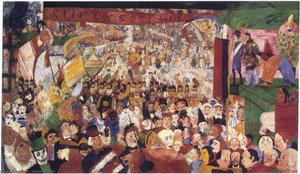
Throughout his career, Ensor produced a series of works that continue to shock and fascinate audiences today. *The Scandalized Masks* (1883) stands as an early testament to his fascination with the power of disguise and its ability to reveal hidden emotions. Perhaps his most controversial work, *Christ’s Entry into Brussels* (1888-1889), remains a powerful satire of religious hypocrisy and societal indifference—a painting initially met with harsh criticism but now celebrated as a masterpiece. The unsettling image of Christ entering a city teeming with grotesque masked figures is a potent commentary on the disconnect between spiritual ideals and human behavior.
James Ensor was recognized as a pivotal figure in the transition from 19th-century Symbolism to early 20th-century Expressionism and Surrealism—a true pioneer of modern art. His fearless exploration of the subconscious, his embrace of grotesque imagery, and his rejection of academic conventions paved the way for future generations of artists who dared to challenge artistic norms. He is remembered as a visionary artist whose uncompromising vision continues to inspire contemplation and debate.

1860 - 1949 , Belgium
Avastage Max Ernsti 25 parimat teost! Sukelduge surrealismi ja dadaismi maailma, tutvuge kunstniku lugude ja tehnikatega. Leidke täiuslik maali oma interjööri Most-Famous-Paintings.com-ist – kvaliteetsed kunstireprodutsioonid ja kollektsioonid.

Avastage mängulise kujunduse psühholoogilist mõju maalides! Uurime huumori, veideruse ja alateadvuse rolli emotsionaalses heaolus ja sotsiaalses seotuses. Kvaliteetne artikkel kunstihuvilistele.

Explore 10 legendary acrylic paintings that revolutionized modern art! From Helen Frankenthaler's color fields to Richter’s abstract power, discover the stories behind these iconic masterpieces. Find museum-quality reproductions & elevate your home decor on Most-Famous-Paintings.com.

Explore the captivating landscapes of William James Müller, the leading artist of the Bristol School. Discover his Victorian masterpieces, Egyptian travels & Lycian sketches – a journey through 19th-century art and technique.

Explore 10 legendary 'Acrylic on Paper' masterpieces by artists like Helen Frankenthaler & Gerhard Richter. Discover abstract expressionism, color field painting & the evolution of modern art. Find museum-quality reproductions for your home at Most-Famous-Paintings.com.


Püsige kursis viimaste kunstiuudistega, eksklusiivsete pakkumistega ja sisustamisideetega.
Kirjeldage meile oma projekti ja meie kunstieksperdid pakuvad teile 3 isikupärast kunstiettepanekut.
Laske meil koostada just teile mõeldud 3 valikut – tasuta!


 Jaga
Jaga


 Loe lähemalt







 Klaasivalik on saadaval ainult suuruses kuni 110 cm