


x

Meie kunstnike poolt tellimusel valmistatud käsitsi maalitud õli-kainaste teos teie soovitud suuruses ja raamis. ( Osta print Osta pilt)





























Vali meie eelmääratud suurused, mis vastavad teose algupärastele proportsioonidele.

Sa võite sisestada oma mõõtmed konkreetse raami või ruumi sobivuse tagamiseks. Kui teie valitud suurus ei vasta originaalpildi proportsioonidele, siis kärvime kunstiteost või laiendame maali täiendavate käsitsi maalitud elementidega. Enne tootmise algust saadetakse teile heakskiitmiseks digitaalne eelvaade.
Palun pidage meeles, et ekraanil kuvatav eelvaade ei kajasta tegelikku kärpimist või laiendamist. Ainult eelvaade näitab täpselt lõplikku kompositsiooni.
Kuigi on saadaval kohandatud suurused, soovitame originaalproportsioonide säilimiseks valida mõõdud eelmääratletud nimekirjast.
Maailmline tarne 3–4 nädala jooksul tavalise 5 nädala asemel. (21 august). Kvaliteedis kompromisse ei tehta.


Study for Grüner Rand
Reproduktsiooni suurus
Wassily Kandinsky's "Study for Grüner Rand," painted in 1920, isn’t merely a depiction of a scene; it’s an immersion into the nascent world of abstract expressionism. Born from a confluence of influences – the vibrant hues of Russian folk art, the profound emotional resonance of Wagnerian opera, and the burgeoning theories of Theosophy – this watercolor captures a pivotal moment in Kandinsky's artistic evolution. It represents a deliberate departure from representational painting, moving towards a purely subjective language of color and form, a visual embodiment of inner experience.
The painting’s subject is deliberately ambiguous, shrouded in a dreamlike atmosphere. A woman, rendered with fluid brushstrokes and a simplified palette, occupies the foreground, seemingly engaged in an activity – perhaps dancing, perhaps contemplating. However, it's crucial to recognize that this isn't about literal representation. Kandinsky wasn't striving for photographic accuracy; instead, he sought to translate his emotional and spiritual responses onto the canvas. The figures are not portraits but rather conduits for feeling, their forms dissolving into a dynamic interplay of color and line.
Kandinsky’s technique is characterized by its bold use of color – a hallmark of his mature style. He employed a limited palette, primarily utilizing shades of red, blue, yellow, and black, yet he masterfully manipulated these hues to evoke a wide range of emotions. The vibrant reds suggest passion and energy, while the blues convey tranquility and introspection. Yellows radiate warmth and optimism, and blacks provide grounding and depth. Crucially, Kandinsky believed that color possessed an inherent spiritual quality, independent of its visual appearance. He meticulously studied color theory, drawing inspiration from Goethe’s theories on colors and their psychological effects.
Notice the layering of washes – a technique characteristic of watercolor—that creates a sense of depth and luminosity. Kandinsky wasn't simply applying paint; he was building up layers of color, allowing them to interact and bleed into one another, mirroring the complexities of human emotion. The loose brushwork contributes to the painting’s ethereal quality, further emphasizing its focus on feeling rather than form.
Beyond the immediate visual impact, “Study for Grüner Rand” is rich in symbolic meaning. The woman herself can be interpreted as a representation of the soul, seeking connection with the surrounding world. The scattered figures and instruments – a violin, cellos, and trombone – evoke musicality and harmony, reflecting Kandinsky’s belief that art should transcend mere visual representation to become a form of spiritual expression. The title itself, “Grüner Rand” (Green Border), hints at boundaries—the limits of perception, the divisions between the inner and outer worlds.
Kandinsky's work during this period was deeply influenced by Theosophy, which posited that all things in the universe were interconnected through geometric forms. He believed that art could reveal these underlying patterns and facilitate a deeper understanding of reality. “Study for Grüner Rand” embodies this belief, presenting a visual representation of a complex spiritual landscape.
“Study for Grüner Rand” stands as a crucial bridge between Kandinsky’s earlier figurative work and his later, fully abstract paintings. It demonstrates his growing commitment to exploring the expressive potential of pure color and form. This piece is not just a beautiful artwork; it's a foundational document in the history of modern art, paving the way for generations of artists who sought to liberate themselves from the constraints of representation and embrace the power of abstraction. Its enduring appeal lies in its ability to evoke profound emotions and invite viewers into a world of pure feeling.

Wassily Wassilyevich Kandinsky, born in Moscow in 1866, was a revolutionary figure who irrevocably altered the course of modern art. His journey wasn’t one of immediate artistic calling; initially destined for a career in law and economics at the University of Moscow, it was a profound encounter with Impressionist painting – specifically Claude Monet's “Haystacks” – and a deeply moving experience witnessing Wagner’s opera "Lohengrin" that ignited within him an irrepressible desire to pursue art. This pivotal moment, occurring around age thirty, marked not merely a career change but a complete transformation of perspective, setting him on a path toward pioneering abstraction.
Early influences included Russian folk art, gleaned from an ethnographic expedition to the Vologda region in 1889, which instilled a fascination with vibrant color palettes and symbolic imagery. This foundation would prove crucial as he began to develop his unique artistic language. These early explorations weren’t simply about aesthetic preference; they were rooted in a deep cultural connection and a burgeoning understanding of how art could communicate beyond the literal.
Kandinsky’s early works reveal a strong expressionistic bent, characterized by bold colors and emotional intensity – pieces like “Papeln (Poplars)” from 1902 exemplify this period. However, he wasn't content with merely representing the external world; he sought to express inner realities, spiritual truths that transcended mere visual depiction. This quest led him gradually away from representational art and toward a revolutionary exploration of color, form, and their emotional resonance.
He began to believe that colors possessed inherent psychological effects, capable of evoking specific feelings and sensations in the viewer. This conviction was deeply intertwined with his burgeoning interest in Theosophy, a spiritual movement emphasizing esoteric knowledge and universal brotherhood. As he delved deeper into these ideas, Kandinsky’s paintings became increasingly non-objective, shedding recognizable forms in favor of abstract compositions driven by an “inner necessity.” This wasn't simply about abandoning representation; it was about discovering a new visual language capable of expressing the intangible realms of emotion and spirituality.
The period following his involvement with the influential artist group Der Blaue Reiter (The Blue Rider), which he co-founded in Munich in 1911, saw a further evolution in Kandinsky’s style. While earlier works often featured fluid, organic shapes, he began to explore geometric abstraction, focusing on the interplay of circles, triangles, and squares. “Several Circles” (140 x 140 cm) stands as a prime example of this phase – a dynamic composition where color and form interact in a harmonious yet energetic dance.
This wasn't cold or sterile geometry; rather, it was imbued with spiritual significance. Kandinsky believed that geometric shapes possessed inherent symbolic meaning, and their arrangement within the canvas could evoke specific emotional responses. His theoretical writings, most notably “Concerning the Spiritual in Art” (1911), articulated these beliefs, laying the groundwork for a new understanding of abstract art as a vehicle for expressing profound spiritual truths. He argued that art should not aim to imitate nature but rather to reveal the artist’s inner world and connect with the viewer on a deeper, more intuitive level.
The outbreak of World War I forced Kandinsky's return to Russia in 1914, but following the Russian Revolution, he found himself increasingly at odds with the prevailing artistic climate. In 1920, he accepted a teaching position at the Bauhaus school in Germany, where he profoundly influenced generations of artists with his theories on color, form, and abstraction. The Bauhaus provided an ideal environment for Kandinsky to further develop his ideas and explore new creative avenues.
He continued to experiment with geometric forms and vibrant colors, often incorporating layered impasto techniques to create textured surfaces that added depth and complexity to his compositions – as seen in later works like “An Intimate Party” (1942). After the closure of the Bauhaus by the Nazi regime in 1933, Kandinsky moved to France, where he remained for the rest of his life. His impact on modern art is immeasurable; he is widely recognized as a pioneer of abstract expressionism and a key figure in the development of non-representational painting. His works are held in major museums worldwide, including the Tretyakov Gallery in Moscow, which houses his monumental “Composition VII,” a testament to his artistic vision and enduring legacy.
Kandinsky’s exploration of color, form, and spirituality continues to inspire artists today, solidifying his place as one of the most important figures in 20th-century art history. He didn't just paint pictures; he painted emotions, ideas, and the very essence of the human spirit.

1866 - 1944 , Venemaa
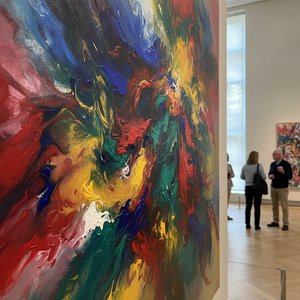
Explore the profound emotional depth of Lyrical Abstraction. Discover how masters like Raymond Parker used color and form to bridge Impressionism and Abstract Expressionism. Learn about this pivotal movement through our expert-led art history guide.

Explore the profound emotional depth of Color Field painting. Discover the history of mid-century abstraction, from Rothko to Newman, and learn how pure color transforms the viewer's experience through our expert art history guide.

Explore the profound history and technical mastery of watercolor painting. From medieval manuscripts to the luminous works of John Singer Sargent, discover how artists capture light and transparency through this delicate, enduring medium.

Discover the profound emotional depth and investment potential of contemporary abstraction. Our expert guide explores how texture, movement, and form create timeless value for discerning art collectors and sophisticated interiors.


Püsige kursis viimaste kunstiuudistega, eksklusiivsete pakkumistega ja sisustamisideetega.
Kirjeldage meile oma projekti ja meie kunstieksperdid pakuvad teile 3 isikupärast kunstiettepanekut.
Laske meil koostada just teile mõeldud 3 valikut – tasuta!


 Eelvaade
 Saada
Saada Jaga
Jaga
 Teave teose kohta

 Laadi alla
 Sarnased teosed
 Röntgenuuring
 Slaidietendus


 Loe lähemalt







 Klaasivalik on saadaval ainult suuruses kuni 110 cm


