


x

 OilWallArtDutch Golden Age
 1660
1660 76.0 x 62.0 cm
 Metropolitan Museum of Art
Stampa giclée o su tela di qualità museale, con produzione rapida e diverse opzioni di finitura. ( Ordina la riproduzione dipinta a mano Acquista download)





























Scegli tra le nostre dimensioni predefinite, che rispettano le proporzioni originali dell'opera d'arte.

È possibile inserire dimensioni personalizzate per adattare l'opera a una cornice o a uno spazio specifico. Se la dimensione selezionata non corrisponde alle proporzioni dell'immagine originale, procederemo al ritaglio dell'opera o all'estensione dell'immagine con un bordo specchiato o a tinta unita. Un mockup digitale ti verrà inviato per approvazione prima dell'inizio della produzione.
Si prega di notare che l'anteprima a schermo non riflette il ritaglio o l'estensione effettivi. Solo il mockup mostrerà accuratamente la composizione finale.
Sebbene siano disponibili dimensioni personalizzate, si raccomanda di selezionare una dimensione dall'elenco predefinito per preservare le proporzioni originali.
Consegna in tutto il mondo () in 2 settimane invece delle normali 4/5 settimane. (22 Agosto)


Curiosity
Dimensioni della riproduzione
Gerard ter Borch's “Curiosity,” painted around 1660-62, isn’t a grand historical scene or a dramatic portrait; instead, it offers a profoundly intimate glimpse into the quiet domesticity of the Dutch Golden Age. This remarkable work, measuring just 76 x 62 cm, immediately draws the viewer in with its masterful use of light and shadow, creating an atmosphere of subtle tension and unspoken connection. The painting depicts three women – a seamstress meticulously working at her needle, a lady absorbed in a book, and a third figure observing them from a distance – within a modestly furnished room. It’s a scene brimming with understated observation, capturing the nuances of human interaction with remarkable psychological depth.
Ter Borch was a pioneer of Dutch genre painting, renowned for his ability to portray everyday life with an unparalleled level of realism and emotional sensitivity. Unlike many of his contemporaries who favored heroic subjects or elaborate compositions, Ter Borch focused on the ordinary – the moments of quiet contemplation, the subtle gestures, and the unspoken relationships that define human experience. “Curiosity” exemplifies this approach perfectly; it’s not about showcasing wealth or status but rather exploring the complexities of female companionship and the quiet drama of domestic life.
The painting's power lies in Ter Borch’s extraordinary technical skill. He employs a technique known as ‘chiaroscuro,’ dramatically contrasting areas of light and shadow to create a sense of depth and volume. Notice how the soft, diffused light illuminates the women’s faces and hands, while the background remains shrouded in darkness, drawing our attention to their immediate presence. The textures are equally compelling – the delicate weave of the seamstress's dress, the smooth surface of the book, the rough fabric of the chair—all rendered with painstaking detail.
Ter Borch’s meticulous approach is evident in his rendering of fabrics and drapery. He doesn’t simply depict them; he captures their tactile quality, allowing us to almost feel the weight and texture of each garment. This attention to detail extends to every element of the scene, creating a remarkably immersive experience for the viewer. The subtle variations in tone and shading contribute significantly to the painting's overall sense of realism and immediacy.
The composition itself is laden with symbolic meaning. The seamstress, focused on her work, represents diligence and industry – a valued trait in 17th-century Dutch society. The lady reading suggests intellectual pursuits and a connection to the wider world beyond the domestic sphere. And the woman observing them from afar—a figure often interpreted as the artist’s wife, Gesina ter Borch—hints at a subtle power dynamic and perhaps a hint of melancholy. Her averted gaze invites speculation about her thoughts and feelings.
The inclusion of the dog adds another layer of complexity to the scene. It represents loyalty, companionship, and the simple pleasures of domestic life. The dog’s presence further emphasizes the intimacy of the setting and the close-knit relationships between the women. “Curiosity” isn't merely a portrait; it’s a carefully constructed tableau that invites us to contemplate the mysteries of human connection and the quiet beauty of everyday moments.
Most-Famous-Paintings offers exquisite, hand-painted reproductions of Gerard ter Borch’s “Curiosity,” meticulously crafted by our team of skilled artists using traditional techniques. Each reproduction captures the original painting's luminous quality and psychological depth, allowing you to bring this remarkable work into your home or office. Available in a range of sizes, our high-quality prints are perfect for collectors, interior designers, and anyone who appreciates the beauty and artistry of Dutch Golden Age painting. Explore our selection today and experience the timeless allure of “Curiosity.”

Gerard ter Borch (Zwolle, dicembre 1617 – Deventer, 8 dicembre 1681) è stato un pittore olandese, figura chiave del periodo dell’età dell’oro. La sua abilità nel catturare la vita quotidiana e i dettagli intimi lo ha reso uno dei più apprezzati artisti del suo tempo.
Gerard ter Borch nacque a Zwolle, in una famiglia di artisti. Suo padre, Gerard ter Borch il Vecchio, fu un pittore e poeta che gli fornì le prime istruzioni artistiche. Ter Borch dimostrò presto un talento eccezionale, viaggiando per l'Europa tra il 1632 e il 1650. Questi viaggi lo esposero a diverse influenze artistiche, tra cui quelle italiane, spagnole e francesi. Studiò con Pieter de Molijn ad Haarlem e trascorse del tempo a Londra, Roma e Münster.
Lo stile di ter Borch è caratterizzato da un realismo attento ai dettagli, una luce soffusa e una composizione equilibrata. I suoi dipinti spesso raffigurano scene di vita quotidiana, come interni domestici, ritratti e momenti di conversazione. Un elemento distintivo del suo lavoro è la capacità di catturare l'atmosfera intima e psicologica dei soggetti rappresentati.
Tra le opere più significative di Gerard ter Borch si annoverano:
Ter Borch ottenne un notevole successo durante la sua vita, diventando membro del consiglio cittadino di Deventer e godendo della stima dei suoi contemporanei.
L'opera di Gerard ter Borch ha esercitato una profonda influenza su numerosi pittori olandesi, tra cui Gabriel Metsu, Gerrit Dou, Eglon van der Neer e Johannes Vermeer. La sua attenzione ai dettagli, la sua capacità di creare atmosfere intime e il suo realismo attento hanno contribuito a definire l'estetica del periodo dell’età dell’oro olandese. Ter Borch è oggi considerato uno dei maestri indiscussi della pittura olandese del XVII secolo.

1617 - 1681 , Paesi Bassi

Esplora il mondo di Gerard ter Borch, maestro dell'Età dell'Oro olandese. Analisi approfondita del suo stile pittorico, le scene di genere e l'uso magistrale della luce. Scopri i simboli nascosti nelle sue opere e la sua eredità artistica.
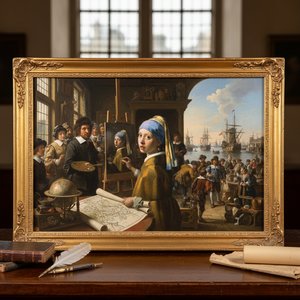
Explore the Dutch Golden Age of painting! Discover key artists like Vermeer & ter Borch, their innovative techniques, and the rich cultural context behind these Baroque masterpieces. Learn about collecting & appreciating this iconic art period.

Explore the Dutch Golden Age of painting (1600-1700) with Most-Famous-Paintings. Discover Rembrandt, Vermeer & other masters. Learn about techniques, history & find museum-quality reproductions.

Explore the captivating world of Dutch Golden Age genre painting! Discover realistic depictions of daily life, masterful artists like Ostade & Metsu, and hidden symbolism. Learn about this influential art movement with Most-Famous-Paintings.

Explore the rich history of genre painting! Discover Dutch Masters & European artists who captured everyday life with stunning realism. Learn about symbolism, techniques & lasting influence.


Rimani aggiornato sulle ultime novità dell'arte, sulle offerte esclusive e sulle idee di decorazione.
Raccontaci del tuo progetto e i nostri esperti d'arte ti proporranno 3 suggerimenti artistici personalizzati.
Lascia che creiamo per te una selezione di 3 opzioni su misura – Gratis!


 Anteprima in scala reale
 Condividi
 Condividi
 Dettagli

 Scarica immagine
 Articoli simili
 Radiografia
 Slideshow
 Leggi tutto







 L'opzione vetro è disponibile solo per dimensioni inferiori a 110 cm


