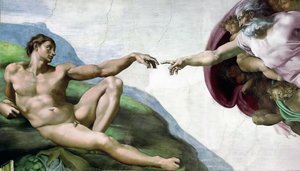
Michelangelo Buonarroti: A Renaissance Forged in Stone and Paint
Michelangelo di Lodovico Buonarroti Simoni (6 March 1475 – 18 February 1564), known mononymously as Michelangelo, was an Italian sculptor, painter, architect, and poet of the High Renaissance. He was born in the Republic of Florence but was mostly active in Rome from his 30s onwards. His life was an extraordinary convergence of talent, ambition, and divine inspiration. Though initially met with resistance from his father regarding an artistic path, young Michelangelo’s innate gift for drawing proved undeniable, setting him on a course to redefine the boundaries of sculpture, painting, and architecture. His early apprenticeship under Domenico Ghirlandaio provided foundational skills in fresco and draftsmanship, but it was within the Medici gardens—a haven of classical antiquity—that his artistic soul truly awakened. Immersed in the study of Greek and Roman sculptures, Michelangelo absorbed the principles of anatomy, proportion, and idealized beauty that would become hallmarks
The Risen Christ: A Monument to Faith and Human Form
Michelangelo’s *Risen Christ*, completed in 1521, stands as arguably his most iconic achievement—a testament not only to artistic mastery but also to the profound spiritual convictions that underpinned his entire oeuvre. Situated within Santa Maria sopra Minerva church in Rome, this monumental marble sculpture embodies the ideals of the High Renaissance: anatomical accuracy, classical elegance, and emotional depth. Unlike depictions prioritizing the agony of crucifixion, Michelangelo deliberately focused on portraying Jesus Christ resurrected—bearing the weight of the cross not as an instrument of suffering but as a symbol of triumphant victory over death. This deliberate choice reflects a broader humanist preoccupation with understanding human experience through observation and reason, mirroring the burgeoning interest in classical antiquity that shaped artistic sensibilities during this transformative period.
- Subject and Narrative: The sculpture depicts Jesus Christ emerging from the tomb, radiating strength and serenity. Michelangelo’s intention was to convey not merely physical resurrection but also spiritual liberation—a victory over mortality achieved through faith and divine grace.
- Artistic Style & Historical Context: Influenced by sculptural models from antiquity, particularly those of Polykleitos and Praxiteles, *Risen Christ* exemplifies the humanist aesthetic championed by Leonardo da Vinci and Raffaello Sanzio. It represents a pivotal moment in artistic history—a conscious effort to reconcile religious dogma with humanistic values.
- Technique & Materiality: Michelangelo employed masterful marble carving techniques—including *contrapposto*, a pose characterized by balanced weight distribution—to imbue the statue with dynamism and lifelike movement. The smooth, polished surface contrasts sharply with the textured drapery, creating a captivating interplay of light and shadow that enhances the sculpture’s expressive power.
Symbolism: Triumph Over Suffering
The nude figure of Christ is laden with symbolic significance. Stripped bare—physically and spiritually—he embodies purity and vulnerability, yet simultaneously radiates unwavering resolve. The cross itself, though present as a reminder of sacrifice, transcends its literal representation to become a banner of victory—a visual declaration of triumph over death and despair. Michelangelo’s careful attention to detail—from the musculature to the facial expression—communicates profound emotion: sorrow for Christ’s earthly suffering mingled with awe at his divine ascension. The sculpture's deliberate positioning—facing east—references Christian iconography and reinforces its message of hope and redemption.
A Legacy Enduring Through Time
Michelangelo’s *Risen Christ* continues to inspire artists and viewers alike, securing its place as one of the greatest sculptures ever created. Its rediscovery in 2000—after centuries of obscurity—added another layer of intrigue to its story—a narrative punctuated by abandonment, perseverance, and ultimately, acclaim. This masterpiece exemplifies Michelangelo’s unparalleled ability to transform stone into expressions of faith, beauty, and human experience—a legacy that resonates powerfully across generations.
Additional Research
The sculpture's history is marked by several notable events: its initial conception in 1514, the abandonment of the first version due to a flaw in the marble (the black vein), its subsequent rediscovery in 2000, and its installation in Santa Maria sopra Minerva church. Studying these details provides invaluable insight into Michelangelo’s creative process and the cultural context surrounding his work.