x

Olio su tela dipinto a mano nelle tue dimensioni e con la tua cornice, realizzato su ordinazione dai nostri artisti. ( Passa alla stampa Passa all'immagine)





























Scegli tra le nostre dimensioni predefinite, che rispettano le proporzioni originali dell'opera d'arte.

È possibile inserire dimensioni personalizzate per adattare l'opera a una cornice o a uno spazio specifico. Se la dimensione selezionata non corrisponde alle proporzioni dell'immagine originale, provvederemo a ritagliare l'opera o a estendere il dipinto con elementi aggiuntivi dipinti a mano. Un mockup digitale ti sarà inviato per approvazione prima dell'inizio della produzione.
Si prega di notare che l'anteprima a schermo non riflette il ritaglio o l'estensione effettivi. Solo il mockup mostrerà accuratamente la composizione finale.
Sebbene siano disponibili dimensioni personalizzate, consigliamo di selezionare una dimensione dall'elenco predefinito per preservare le proporzioni originali.
Consegna in tutto il mondo () in 3/4 settimane anziché nelle normali 5 settimane. (11 Agosto). Nessun compromesso sulla qualità.


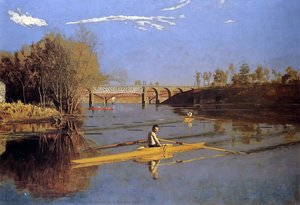
The Meadows, Gloucester
Dimensioni della riproduzione
Thomas Cowperthwait Eakins (1844–1916) stands as an unparalleled figure in American art—a painter who relentlessly pursued the essence of human experience. He wasn’t merely concerned with *representing* the world; he sought to dissect it, understand its anatomy, both physical and psychological, and then reconstruct it on canvas with an uncompromising honesty that often provoked controversy.
Eakins's artistic vision was profoundly shaped by his upbringing in Philadelphia—a city far removed from the grand landscapes favored by Romantic painters. Instead, he focused on capturing the gritty realities of urban life, portraying figures engaged in commonplace activities: doctors examining patients, rowers battling currents, hunters tracking prey. This deliberate choice to depict ordinary subjects wasn’t a rejection of beauty; it was an assertion that truth resided within the mundane—a conviction that fueled his artistic endeavors and cemented his legacy as one of America's most astute observers of human behavior.
Early Influences and Artistic Formation
Eakins’s fascination with anatomy began early in life, nurtured by his father’s profession as a writing master and calligraphy teacher. He meticulously studied the human form—drawing inspiration from classical sculpture and anatomical treatises—a practice that would become central to his artistic technique. This dedication to precision extended beyond mere representation; Eakins aimed to convey not just what he saw but also how it *felt*, striving for an emotional resonance that transcended superficial aesthetics.
His formative years at Central High School in Philadelphia solidified his commitment to scientific observation and artistic rigor. Surrounded by fellow artists—most notably Charles Lewis Fussell—he honed his skills in drawing, perspective, and modeling the human body with unwavering accuracy. The influence of Jean-Léon Gérôme’s Parisian atelier was particularly significant, fostering a stylistic approach characterized by meticulous detail and an unflinching commitment to realism.
The Meadows, Gloucester
"The Meadows, Gloucester," painted in 1883, exemplifies Eakins's distinctive style—a masterful blend of observation and artistic interpretation. Executed in oil on panel, the canvas captures a tranquil rural scene featuring horses grazing peacefully amidst lush greenery. The composition is carefully balanced, with trees framing the meadow and providing depth to the landscape. Two figures are subtly integrated into the scene, suggesting an intimate connection between humanity and nature—a recurring motif in Eakins’s oeuvre.
Eakins's technique demonstrates a remarkable understanding of light and color, achieved through painstaking layering of brushstrokes that capture the nuances of atmospheric conditions. The muted palette reflects the overcast day depicted in the painting, creating an atmosphere of serenity and contemplation. Furthermore, Eakins’s meticulous anatomical rendering—evident in the depiction of the horses' musculature—underscores his unwavering commitment to scientific accuracy.
Symbolism and Emotional Impact
Beyond its technical brilliance, “The Meadows” resonates with deeper symbolic meanings. The meadow itself represents fertility and renewal—a visual metaphor for the cyclical rhythms of life—while the horses embody strength and grace. Together, they convey a sense of harmony between man and beast, mirroring Eakins’s belief that art could illuminate the complexities of human experience.
Ultimately, “The Meadows” transcends mere depiction; it invites viewers to contemplate the beauty inherent in everyday life—a testament to Eakins's profound artistic vision and his enduring influence on American art history.


1844 - 1916 , Stati Uniti d'America

Explore the ethereal beauty of Luminism. Discover how 19th-century American masters captured light and atmosphere through profound landscape painting. Learn about this iconic movement and find museum-quality, hand-painted oil reproductions to bring historical brilliance to your home.


Rimani aggiornato sulle ultime novità dell'arte, sulle offerte esclusive e sulle idee di decorazione.
Raccontaci del tuo progetto e i nostri esperti d'arte ti proporranno 3 suggerimenti artistici personalizzati.
Lascia che creiamo per te una selezione di 3 opzioni su misura – Gratis!


 Anteprima in scala reale
 Condividi
 Condividi
 Dettagli

 Scarica immagine
 Articoli simili
 Radiografia
 Slideshow


 Leggi tutto







 L'opzione vetro è disponibile solo per dimensioni inferiori a 110 cm