x

Olio su tela dipinto a mano nelle tue dimensioni e con la tua cornice, realizzato su ordinazione dai nostri artisti. ( Ordina stampa Acquista download)





























Scegli tra le nostre dimensioni predefinite, che rispettano le proporzioni originali dell'opera d'arte.

È possibile inserire dimensioni personalizzate per adattare l'opera a una cornice o a uno spazio specifico. Se la dimensione selezionata non corrisponde alle proporzioni dell'immagine originale, provvederemo a ritagliare l'opera o a estendere il dipinto con elementi aggiuntivi dipinti a mano. Un mockup digitale ti sarà inviato per approvazione prima dell'inizio della produzione.
Si prega di notare che l'anteprima a schermo non riflette il ritaglio o l'estensione effettivi. Solo il mockup mostrerà accuratamente la composizione finale.
Sebbene siano disponibili dimensioni personalizzate, consigliamo di selezionare una dimensione dall'elenco predefinito per preservare le proporzioni originali.
Consegna in tutto il mondo () in 3/4 settimane anziché nelle normali 5 settimane. (22 Agosto). Nessun compromesso sulla qualità.


Ion-20
Dimensioni della riproduzione
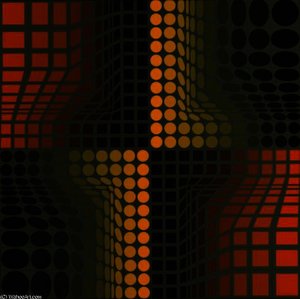
“Ion-20,” created by the visionary Victor Vasarely, is more than just a painting; it's an invitation to question your perception. This striking work, rendered in vibrant red, blue, and white hues, exemplifies the groundbreaking style of Op Art – Optical Art – that captivated the art world in the mid-20th century. Vasarely, born Károly Vaszary in 1906 in Pécs, Croatia, initially pursued a medical career before dedicating himself to exploring the fascinating relationship between mathematics and visual experience. His journey began with formal training at the Podolini-Volkmann Academy and the influential Műhely workshop under Sándor Bortnyik, where he absorbed the principles of functional design and geometric abstraction – concepts that would become the bedrock of his artistic practice.
At first glance, “Ion-20” appears as a chaotic jumble of squares. However, a closer examination reveals a meticulously constructed illusion. Vasarely’s genius lies in manipulating color and form to create an optical effect, deliberately disrupting our natural tendency to perceive objects as stable and unified. The overlapping shapes, varying sizes, and contrasting colors actively engage the viewer's eye, generating a sense of movement and depth that seems to defy the two-dimensional surface. This technique, central to Op Art, challenges the brain’s processing of visual information, creating a dynamic and mesmerizing experience. The painting’s title, “Ion-20,” subtly hints at the underlying mathematical principles – specifically, the concept of ionization – that informed Vasarely's artistic explorations.
Created using oil on canvas, "Ion-20" is a prime example of Op Art’s broader aims. Emerging in the 1960s, Op Art sought to translate scientific theories about perception and visual illusions into artistic expression. Artists like Vasarely were fascinated by the way our eyes and brains interpret patterns and shapes, leading them to create works that deliberately tricked the viewer's senses. This movement was heavily influenced by developments in psychology and neuroscience, reflecting a growing interest in understanding how we see the world. Vasarely’s work anticipated later explorations in motion graphics and digital art, demonstrating the enduring power of manipulating visual perception.
"Ion-20" doesn't convey explicit narrative content; its strength lies in its purely formal qualities. The geometric abstraction represents a detachment from representational imagery, focusing instead on the fundamental elements of form and color. The vibrant palette evokes feelings of energy, dynamism, and perhaps even a slight sense of disorientation – mirroring the perceptual challenges presented by the artwork. This piece is an invitation to contemplate the nature of perception itself, prompting viewers to consider how their brains actively construct reality.
Victor Vasarely (nato Károly Vaszary) è stato una figura fondamentale nello sviluppo dell'Op Art e dell'arte cinetica. La sua opera mirava a trascendere la pittura tradizionale esplorando illusioni ottiche e creando esperienze visive dinamiche. Nato a Pécs, all'epoca parte dell'Austria-Ungheria (ora Croazia), la sua prima vita vide lo studio della medicina presso l'Università Eötvös Loránd di Budapest prima di dedicarsi completamente all'arte.
Il contributo di Vasarely alla storia dell'arte è multiforme. Ha superato le tecniche pittoriche tradizionali per creare opere che coinvolgono attivamente la percezione dello spettatore. Il suo approccio sistematico ha sfidato le nozioni convenzionali di creatività artistica e ha aperto la strada all'arte generata al computer e al design digitale. Abbracciando la riproducibilità e le applicazioni commerciali, Vasarely ha offuscato i confini tra arte figurativa e cultura popolare, lasciando un segno duraturo in entrambi.

1906 - 1997 , Croazia

Explore the science of Op Art through the lens of masters like Victor Vasarely. Discover how geometric abstraction uses optical illusions to create movement and delve into the neuroaesthetics of perception with our expert art history guide.


Rimani aggiornato sulle ultime novità dell'arte, sulle offerte esclusive e sulle idee di decorazione.
Raccontaci del tuo progetto e i nostri esperti d'arte ti proporranno 3 suggerimenti artistici personalizzati.
Lascia che creiamo per te una selezione di 3 opzioni su misura – Gratis!


 Anteprima in scala reale
 Condividi
 Condividi
 Dettagli

 Scarica immagine
 Articoli simili
 Radiografia
 Slideshow

 Leggi tutto







 L'opzione vetro è disponibile solo per dimensioni inferiori a 110 cm