x

Olio su tela dipinto a mano nelle tue dimensioni e con la tua cornice, realizzato su ordinazione dai nostri artisti. ( Acquista stampa Acquista immagine)





























Scegli tra le nostre dimensioni predefinite, che rispettano le proporzioni originali dell'opera d'arte.

È possibile inserire dimensioni personalizzate per adattare l'opera a una cornice o a uno spazio specifico. Se la dimensione selezionata non corrisponde alle proporzioni dell'immagine originale, provvederemo a ritagliare l'opera o a estendere il dipinto con elementi aggiuntivi dipinti a mano. Un mockup digitale ti sarà inviato per approvazione prima dell'inizio della produzione.
Si prega di notare che l'anteprima a schermo non riflette il ritaglio o l'estensione effettivi. Solo il mockup mostrerà accuratamente la composizione finale.
Sebbene siano disponibili dimensioni personalizzate, consigliamo di selezionare una dimensione dall'elenco predefinito per preservare le proporzioni originali.
Consegna in tutto il mondo () in 3/4 settimane anziché nelle normali 5 settimane. (23 Agosto). Nessun compromesso sulla qualità.


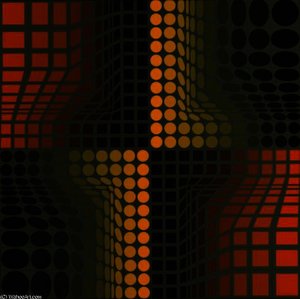
Opus 2604
Dimensioni riproduzione
Victor Vasarely's *Opus 2604* is not merely a painting; it’s an invitation to question the very nature of visual reality. This mesmerizing work, dominated by a vibrant blue spiral punctuated with meticulously arranged circles, embodies the core tenets of Op Art – Optical Art – a movement that emerged in the mid-20th century and continues to captivate viewers with its illusionistic power. Born Károly Vaszary in 1906 in Pécs, Croatia, Vasarely’s artistic trajectory began unexpectedly, initially driven by an interest in medicine before he was drawn to the expressive possibilities of color and form. His formative years within the Bauhaus-influenced workshop of Sándor Bortnyik instilled a profound understanding of geometric abstraction and functional design, principles that would become the bedrock of his groundbreaking style.
At its heart, *Opus 2604* is a testament to Vasarely’s mastery of optical illusion. The painting employs a complex system of concentric circles – varying in size and hue – arranged within a spiraling framework. This arrangement deliberately exploits the human visual system's tendency to perceive movement and depth. The eye, constantly attempting to resolve the conflicting cues presented by the overlapping circles, creates the sensation of three-dimensionality, even though the painting itself is strictly two-dimensional. Vasarely meticulously controlled these elements, understanding that subtle shifts in scale and color could dramatically alter the viewer’s perception. This technique, central to Op Art, aimed to stimulate the eye and challenge traditional notions of representation.
The predominantly blue palette of *Opus 2604*, accented with strategic green highlights, contributes significantly to its visual impact. Blue, often associated with tranquility and infinity, reinforces the sense of depth within the spiral. The use of varying shades and intensities within the circles further enhances this illusionistic effect. Created during a period of rapid technological advancement and shifting artistic sensibilities, *Opus 2604* reflects the broader cultural fascination with science, technology, and the exploration of perception. Vasarely’s work aligns with the post-war interest in abstract art and its potential to convey complex ideas through purely visual means – a reaction against representational painting's perceived limitations.
*Opus 2604* transcends mere optical trickery; it evokes a sense of dynamism, movement, and perhaps even the feeling of infinite space. The spiral itself is a powerful symbol – often associated with growth, evolution, and the cyclical nature of time. Vasarely’s deliberate arrangement of circles creates a visual rhythm that draws the viewer's eye across the canvas, generating a meditative experience. The painting’s enduring appeal lies in its ability to stimulate both intellectual curiosity and emotional response, prompting viewers to contemplate their own relationship with perception and reality.
Victor Vasarely (nato Károly Vaszary) è stato una figura fondamentale nello sviluppo dell'Op Art e dell'arte cinetica. La sua opera mirava a trascendere la pittura tradizionale esplorando illusioni ottiche e creando esperienze visive dinamiche. Nato a Pécs, all'epoca parte dell'Austria-Ungheria (ora Croazia), la sua prima vita vide lo studio della medicina presso l'Università Eötvös Loránd di Budapest prima di dedicarsi completamente all'arte.
Il contributo di Vasarely alla storia dell'arte è multiforme. Ha superato le tecniche pittoriche tradizionali per creare opere che coinvolgono attivamente la percezione dello spettatore. Il suo approccio sistematico ha sfidato le nozioni convenzionali di creatività artistica e ha aperto la strada all'arte generata al computer e al design digitale. Abbracciando la riproducibilità e le applicazioni commerciali, Vasarely ha offuscato i confini tra arte figurativa e cultura popolare, lasciando un segno duraturo in entrambi.

1906 - 1997 , Croazia

Explore the science of Op Art through the lens of masters like Victor Vasarely. Discover how geometric abstraction uses optical illusions to create movement and delve into the neuroaesthetics of perception with our expert art history guide.

Explore the profound impact of Minimalism and Geometric Abstraction. From Mondrian to Malevich, discover how stripping art to its essential forms revolutionized modern aesthetics through our expert-led historical guide.

Master the complexities of Geometric Abstraction. Our expert guide explores the evolution from Cubist deconstruction to Bauhaus precision, decoding the power of shape and form. Perfect for art students seeking deep historical context and academic insight into modern masterpieces.


Rimani aggiornato sulle ultime novità dell'arte, sulle offerte esclusive e sulle idee di decorazione.
Raccontaci del tuo progetto e i nostri esperti d'arte ti proporranno 3 suggerimenti artistici personalizzati.
Lascia che creiamo per te una selezione di 3 opzioni su misura – Gratis!


 Anteprima in scala reale
 Invia
Invia Condividi
 Dettagli opera

 Scarica immagine
 Simili
 Radiografia
 Slideshow

 Espandi i dettagli







 L'opzione vetro è disponibile solo per dimensioni inferiori a 110 cm