x

Stampa giclée o su tela di qualità museale, con produzione rapida e diverse opzioni di finitura. ( Ordina la riproduzione dipinta a mano Acquista download)





























Scegli tra le nostre dimensioni predefinite, che rispettano le proporzioni originali dell'opera d'arte.

È possibile inserire dimensioni personalizzate per adattare l'opera a una cornice o a uno spazio specifico. Se la dimensione selezionata non corrisponde alle proporzioni dell'immagine originale, procederemo al ritaglio dell'opera o all'estensione dell'immagine con un bordo specchiato o a tinta unita. Un mockup digitale ti verrà inviato per approvazione prima dell'inizio della produzione.
Si prega di notare che l'anteprima a schermo non riflette il ritaglio o l'estensione effettivi. Solo il mockup mostrerà accuratamente la composizione finale.
Sebbene siano disponibili dimensioni personalizzate, si raccomanda di selezionare una dimensione dall'elenco predefinito per preservare le proporzioni originali.
Consegna in tutto il mondo () in 2 settimane invece delle normali 4/5 settimane. (15 Agosto)


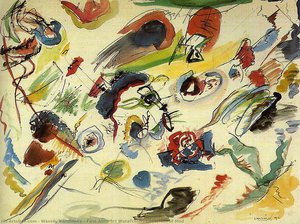
Nel Blu
Dimensioni della riproduzione
“In the Blue,” painted by Wassily Kandinsky around 1907-1912, isn't merely a depiction of color; it’s an immersion into a realm of pure feeling, a testament to the burgeoning movement of abstract art. This captivating work, housed within the vibrant heart of the early 20th century, transcends representational imagery and invites the viewer on a deeply personal journey through form, hue, and emotion. It represents a pivotal moment in Kandinsky’s artistic evolution, marking his decisive break from traditional perspective and his embrace of non-objective art – a radical shift that would fundamentally reshape the course of modern painting.
The canvas explodes with an intense azure, not as a simple backdrop but as a dynamic force. This dominant blue isn't static; it pulsates with energy, layered with washes of crimson, ochre, and lemon yellow. Geometric shapes – circles, triangles, and squares – dance across the surface, their relationships suggesting both harmony and tension. These forms aren’t arranged according to logical rules or spatial constraints; instead, they are governed by an internal logic, a visual language that speaks directly to the subconscious. Kandinsky himself described his approach as “inner necessity,” emphasizing that each element was driven by an intuitive impulse rather than external observation.
Kandinsky’s technique is characterized by its deliberate layering and blending of colors. He employed a wet-on-wet method, allowing the pigments to mingle and bleed into one another, creating subtle gradations and atmospheric effects. The brushstrokes are loose and expressive, conveying a sense of spontaneity and immediacy. The use of tempera on canvas allows for rich color saturation and a luminous quality that enhances the painting’s emotional impact. Notice how the circles, often associated with wholeness and spirituality in Kandinsky's work, seem to radiate outwards, suggesting expansion and release. The triangles, conversely, can be interpreted as symbols of stability and grounding, providing a counterpoint to the dynamism of the other forms.
The painting’s historical context is crucial to understanding its significance. Kandinsky was deeply influenced by music theory, believing that colors possessed inherent sonic qualities. He sought to translate musical harmonies into visual equivalents, aiming to create paintings that could evoke similar emotional responses as a symphony. “In the Blue” embodies this principle perfectly – it’s not simply a picture; it's an auditory experience rendered in pigment and form. It aligns with the broader artistic currents of the time, including the influence of Russian Symbolism and the burgeoning interest in spirituality within art.
Beyond its formal qualities, “In the Blue” is rich in symbolic meaning. The blue itself represents depth, infinity, and the spiritual realm – a key element in Kandinsky’s exploration of inner space. The vibrant reds and yellows evoke passion, energy, and vitality, while the softer ochres suggest warmth and earthiness. The interplay between these colors creates a complex emotional landscape, inviting viewers to project their own feelings and experiences onto the canvas. It's not about depicting a specific scene or object; it’s about conveying an atmosphere, a mood, a state of being.
Kandinsky believed that art should be capable of awakening emotions and stimulating intuition. “In the Blue” achieves this admirably, prompting viewers to contemplate their own relationship with color, form, and the unseen forces that shape our inner world. It’s a painting that rewards repeated viewing, revealing new layers of meaning and emotional resonance with each encounter. A reproduction of this work can bring a sense of tranquility and contemplation into any space, serving as a constant reminder of the power of art to transcend the limitations of language and logic.
Artist Information:
Additional Research:


1866 - 1944 , Russia

Explore the profound impact of Minimalism and Geometric Abstraction. From Mondrian to Malevich, discover how stripping art to its essential forms revolutionized modern aesthetics through our expert-led historical guide.


Rimani aggiornato sulle ultime novità dell'arte, sulle offerte esclusive e sulle idee di decorazione.
Raccontaci del tuo progetto e i nostri esperti d'arte ti proporranno 3 suggerimenti artistici personalizzati.
Lascia che creiamo per te una selezione di 3 opzioni su misura – Gratis!


 Anteprima in scala reale
 Condividi
 Condividi
 Dettagli

 Scarica immagine
 Articoli simili
 Radiografia
 Slideshow

 Leggi tutto







 L'opzione vetro è disponibile solo per dimensioni inferiori a 110 cm