


x
 Realism
 1879
1879 310.0 x 530.0 cm
 シュタットリッヒェ・クンストハレ・カールスルーエ




























作品のオリジナル比率に合わせた、当店の規定サイズからお選びください。

特定のフレームやスペースに合わせて、ご希望のサイズをご入力いただけます。選択されたサイズが元の画像の比率と異なる場合、アートワークをトリミングするか、手描きで要素を追加して絵画を拡張いたします。デジタルモックアップ を制作し、制作開始前にご確認(承認)をいただきます。
画面上のプレビューは、実際のトリミングや拡張を正確に反映しているものではありません。最終的な構図は、モックアップによってのみ正確にご確認いただけます。
カスタムサイズもご利用いただけますが、元の比率を維持するためには、あらかじめ用意されたリストからサイズを選択することをお勧めいたします。

Türkenlouis (
複製画のサイズ

Ferdinand Keller, often referred to by his noble title von Keller, remains one of the most captivating figures of the German Romantic movement. Born on August 5, 1842, in Karlsruhe, his early life was marked by a profound sense of adventure and global perspective that would later infuse his canvases with an exotic, far-reaching spirit. As the son of a civil engineer, Keller’s childhood was shaped by the vast landscapes of Brazil, where he accompanied his father on ambitious infrastructural projects. It was amidst the lush, tropical greenery of South America that the young artist first taught himself to draw, sketching the vibrant flora and sun-drenched vistas that would forever haunt his artistic imagination. This early exposure to a world far beyond the borders of Europe provided him with a unique visual vocabulary, blending classical European training with a deep-seated fascination for the exotic and the untamed.
Upon returning to Germany, Keller sought formal refinement at the prestigious Academy of Fine Arts in Karlsruhe. Under the mentorship of Johann Wilhelm Schirmer, he mastered the rigorous techniques of landscape painting and learned to imblaming nature with psychological depth. However, Keller was never one to be confined by the rigid boundaries of academic conservatism. Seeking a more expressive realism, he pursued private instruction in the studio of the sculptor Hans Canon and embarked on transformative journeys through Switzerland and France. These travels were not merely sightseeing expeditions but essential periods of artistic maturation, where he absorbed the burgeoning currents of Symbolism and learned to use light and shadow to evoke the unseen tensions of the human soul.
Keller’s oeuvre is a breathtaking tapestry of genre and history painting, characterized by an unparalleled ability to capture dramatic tension and emotional complexity. He achieved international acclaim early in his career, most notably at the 1867 International Exposition of Paris, where his work “The Death of Philip II” stunned audiences with its narrative power and psychological intensity. This talent for storytelling found its most visceral expression in his celebrated depictions of bullfighting. In these works, Keller did not merely document a spectacle; he transformed the arena into a stage for primal struggles between life and death, man and beast, utilizing bold brushwork and a dramatic palette to immerse the viewer in the heat and dust of the ring.
Beyond the arena, his artistry extended into the realms of royal commissions and grand historical narratives. His technical prowess earned him the respect of European nobility, leading to significant decorations for prestigious venues such as the Karlsruhe Court Theater and the Dresden Semperoper. One of his most enduring legacies is the "History of Baden," a monumental series commissioned by Frederick I, Grand Duke of Baden. Through these paintings, Keller acted as both a chronicler and an artist, weaving the political and cultural identity of his homeland into a grand, symbolic epic that remains a cornerstone of German historical art.
As his career progressed, Keller’s role transitioned from a rising star to a pillar of the artistic community. Serving as the director of the Karlsruhe Academy from 1880 to 1913, he influenced generations of subsequent painters, instilling in them the same dedication to technical excellence and emotional truth that had defined his own journey. His ability to bridge the gap between the meticulous detail of classical realism and the evocative mystery of Symbolism allowed him to remain relevant even as artistic movements shifted toward modernity.
Ferdinand Keller passed away in 1922 in Baden-Baden, leaving behind a legacy that transcends simple categorization. His work continues to resonate because it speaks to the universal human experience—the thrill of the hunt, the solemnity of history, and the quiet majesty of the natural world. To look upon a Keller painting is to enter a realm where every shadow holds a secret and every landscape tells a story, ensuring his place as a true pioneer of the Romantic spirit.

1842 - 1922

Explore the rich history & techniques of oil painting – from Renaissance masters to Impressionism. Discover pigments, layering methods, and why this timeless medium endures. Expert insights for artists & art enthusiasts.

Explore the rich history & enduring techniques of oil painting on canvas. Discover the science behind its longevity, conservation practices, and contemporary relevance. Expert insights for art enthusiasts.

Explore the rich history & enduring techniques of oil painting with Most-Famous-Paintings. Discover masterpieces, learn about art collecting, and find authentic handmade reproductions crafted by skilled artists.

油彩の技法、歴史、巨匠たちの秘密を徹底解説。古典美術愛好家向けに、初期フランドル絵画から現代の実践まで深く掘り下げます。Most-Famous-Paintingsで高品質な複製画やカスタムオーダーも承ります。
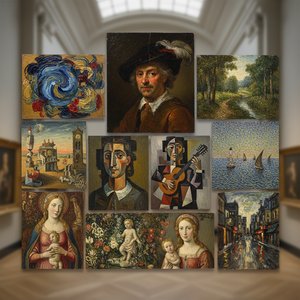
Explore 10 legendary 'Oil on Board' masterpieces by Van Gogh, Monet & more! Discover art history, iconic styles like Impressionism, and find museum-quality reproductions to elevate your home decor. Explore the full collection online at Most-Famous-Paintings.com.


最新の美術ニュース、限定オファー、そしてインテリアのアイデアをいち早くお届けします。
お客様のプロジェクトについてお聞かせください。当社の美術専門家が、お客様に合わせた3つのパーソナライズされた芸術提案をご提供いたします。
あなたにぴったりの3作品を無料で厳選いたします


 プレビュー
プレビュー
 プリントを購入
 シェアする
シェアする シェアする
シェアする
 詳細を見る
詳細を見る

 ダウンロード
 似ている作品
 X線調査
X線調査 スライドショー
 詳細を見る
詳細を見る









 ガラスオプションは、110cm未満のサイズでのみご利用いただけます。


