


x
 Painting
 1958Modern
 28.0 x 36.0 cm
 スミソニアン国立郵便博物館
オンラインプレビューをはるかに凌ぐ、高解像度で鮮明なデジタル画像をご購入いただけます。
各ファイルは、社内の専門家が高度なツールと熟練した手作業によるレタッチを用いて、細心の注意を払って準備されています。すべての画像において、卓越した鮮明度、正確な色彩再現性、そして繊細なディテールを保証いたします。
最終ファイルは、プロフェッショナルな編集・印刷環境ですぐにご利用いただけるよう最適化された状態で、72時間以内にメールにてお届けいたします。これは、一流のデザインスタジオ、出版社、ギャラリーから信頼されているものと同等の品質です。
Most-Famous-Paintings.com を選ぶことは、単に画像を手に入れることではありません。それは、プロの手によって精密に仕上げられ、満足保証が付いた高品質なデジタルアートワークを受け取ることを意味します。ご注文いただいた際に自動的に付随する内容は、以下の通りです:

ご注文から72時間以内に、高解像度のデジタル画像ファイルがメールでお手元に届きます。すぐにそのままご利用いただけます。

お客様の作品は、高度なAIツールと専門家による手作業の編集を組み合わせてプロフェッショナルに最適化されており、細部のディテール、鮮明さ、そして正確な色再現性を最大限に引き出しています。

ファイルを誤って削除したり、紛失してしまったりしましたか?ご安心ください。いつでも無料で再送いたします。

関税や手数料、配送料を気にすることなく、お気に入りのアートワークをすぐにお楽しみいただけます。デジタルダウンロードは常に免税です。

プロ仕様のツールとカラーマネジメント技術を用いることで、デジタル画像が元の色を最大限に忠実に再現することを保証いたします。

ご購入いただいたデジタル画像にご満足いただけない場合は、60日以内であれば、修正または100%の返金(理由を問う必要はありません)をさせていただきます。

ご満足いただけない場合は、デジタルファイルを受け取ってから60日以内であれば、理由を問わず全額返金いたします。

3枚購入で10%OFF - 5枚購入で15%OFF - 10枚以上購入で20%OFF。クリエイティブなプロジェクト、ギャラリー、エージェンシーに最適です。
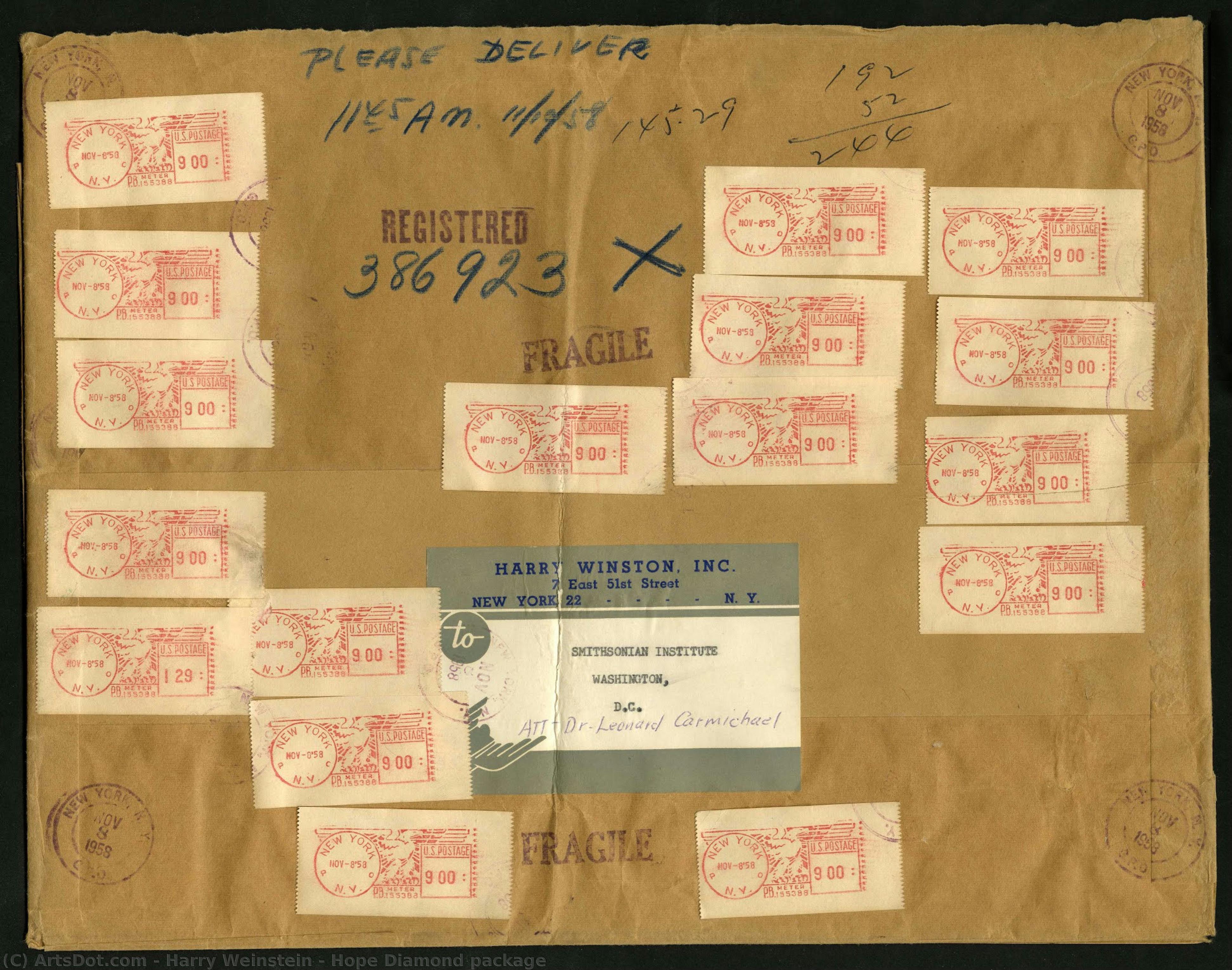
In the quiet intersection of postal history and fine art lies "Hope Diamond package," a captivating work by Harry Weinstein that invites viewers into a world of international intrigue and historical transit. At first glance, the painting presents us with a humble brown envelope, yet beneath its weathered surface lies a rich tapestry of global connection. This is not merely a depiction of mail; it is a window into a moment in time, captured through the meticulous rendering of a mailing wrapper destined for the Smithsonian's National Postal Museum. The piece breathes life into the mundane, transforming a simple object of logistics into a vessel of storytelling and mystery.
Beyond its visual charm, the painting carries a heavy symbolic resonance. The handwritten note, "Please deliver registered mail," acts as a poignant reminder of the care and gravity associated with precious cargo. It hints at the legendary status of the Hope Diamond itself, suggesting that even in its most transit-oriented form, the object possesses an aura of importance that demands protection. This tension between the fragility of paper and the permanence of historical legend creates a compelling emotional pull for the observer. The artwork serves as a meditation on communication—how ideas, treasures, and histories are packaged, sent, and eventually preserved for posterity.
For the discerning collector or interior designer, this piece offers a unique opportunity to introduce a conversation starter into a curated space. Its aesthetic is both scholarly and soulful, making it an ideal centerpiece for a library, a study, or a sophisticated gallery wall. As a high-quality reproduction, it brings the meticulous craftsmanship of Weinstein’s era into the modern home, offering a touch of academic elegance and a deep connection to the global heritage of the postal arts. To possess this work is to hold a fragment of a world where every stamp told a story and every envelope carried the weight of the world.

Born in Southampton, England, on June 8th, 1829, John Everett Millais was a pivotal figure in the vibrant artistic landscape of Victorian Britain. His life’s work, deeply intertwined with the burgeoning Pre-Raphaelite Brotherhood, marked a significant shift away from established academic traditions and toward a renewed appreciation for nature, medieval legend, and the emotional resonance of storytelling. From humble beginnings – his father a gentleman of considerable means – Millais's artistic journey was one of both prodigious talent and personal complexities, ultimately shaping him into one of the most celebrated painters of his era.
Millais’s early education was remarkably advanced for a boy of his age. He received instruction from various tutors, including a governess who instilled in him a love of literature and art, and later studied at Sass's Art School in London, where he quickly distinguished himself with his technical skill and natural ability. His entry into the Royal Academy Schools at just eleven years old was an unprecedented achievement, demonstrating his exceptional promise. This early success foreshadowed a career defined by both critical acclaim and occasional controversy. The influence of his family’s connections – particularly his mother's association with the poet Julian del Casal – provided him with access to intellectual circles that further nurtured his artistic sensibilities.
In 1848, at the age of nineteen, Millais played a crucial role in the formation of the Pre-Raphaelite Brotherhood alongside William Holman Hunt and Dante Gabriel Rossetti. Dissatisfied with the prevailing artistic conventions of the Royal Academy – characterized by historical painting dominated by grand narratives and idealized figures – the group sought to revive the spirit of the early Renaissance masters, particularly those before Raphael. They believed in returning to a more direct and truthful representation of nature, rejecting the artificiality and sentimentality prevalent in contemporary art.
The Brotherhood’s manifesto, penned by Rossetti, outlined their core principles: a commitment to truth, sincerity, and the study of medieval literature and legend. Millais's early works, such as *Pizarro Seizing the Inca of Peru* (1849), immediately established him as a key member, showcasing his meticulous attention to detail and dramatic compositions. However, this painting also sparked considerable debate within the Academy, with some critics finding its realism unsettling and its subject matter morally questionable.
Millais’s most celebrated works are arguably *Ophelia* (1851-52) and *Christ in the House of His Parents* (also known as *The Carpenter's Shop*) (1850-52). *Ophelia*, depicting the tragic heroine from Shakespeare’s *Hamlet* drowning in a stream, remains one of the most recognizable images in art history. Its vibrant colors, meticulous rendering of foliage and water, and poignant portrayal of sorrow captivated audiences and cemented Millais's reputation as a master of naturalism. The painting’s initial reception was mixed, with some critics objecting to its perceived lack of moralizing sentimentality.
*Christ in the House of His Parents*, however, proved far more controversial. The depiction of Christ as a young boy working alongside his carpenter father challenged conventional religious iconography and sparked outrage among conservative viewers who found it shockingly realistic. Despite this initial backlash, the painting’s powerful emotional impact and technical brilliance eventually secured its place as a cornerstone of Pre-Raphaelite art.
As Millais matured as an artist, his style evolved beyond the strict tenets of the Pre-Raphaelite Brotherhood. He increasingly embraced a more lyrical and atmospheric approach, exploring themes of childhood, beauty, and the changing seasons. His portraits, particularly those of prominent figures like Gladstone and Tennyson, demonstrated his growing mastery of capturing personality and character. He also turned to illustration, producing evocative images for publications such as *Once a Week* and *The Illustrated London News*, further expanding his public profile.
John Everett Millais died in London on August 13th, 1896, at the age of 67. His legacy endures as one of the most influential artists of the Victorian era. His pioneering work with the Pre-Raphaelite Brotherhood helped to reshape British art, paving the way for subsequent movements such as Impressionism and Art Nouveau. Millais’s unwavering commitment to truthfulness, his profound appreciation for nature, and his ability to imbue his paintings with emotional depth continue to resonate with viewers today, ensuring that his work remains a vital part of the artistic canon.

1896 - 1978 , United States of America


最新の美術ニュース、限定オファー、そしてインテリアのアイデアをいち早くお届けします。
お客様のプロジェクトについてお聞かせください。当社の美術専門家が、お客様に合わせた3つのパーソナライズされた芸術提案をご提供いたします。
あなたにぴったりの3作品を無料で厳選いたします


 プレビュー
プレビュー
 プリントを購入
 シェアする
シェアする シェアする
シェアする
 詳細を見る
詳細を見る

 ダウンロード
 似ている作品
 X線調査
X線調査 スライドショー
 詳細を見る
詳細を見る


