


x
迅速な制作と多彩な仕上げオプションを備えた、ミュージアムクオリティのジークレーまたはキャンバスプリント。 ( 手描きの絵画を購入 画像を購入)
作品のオリジナル比率に合わせた、当店の規定サイズからお選びください。

特定のフレームやスペースに合わせて、ご自身でサイズを指定することも可能です。選択されたサイズが元の画像の比率と一致しない場合、作品をトリミングするか、鏡面反射または単色での塗りつぶしによって画像を拡張いたします。制作を開始する前に、ご確認用のデジタルモックアップをお送りいたします。
画面上のプレビューには、実際のトリミングや拡張は反映されませんのでご注意ください。最終的な構図を正確に確認できるのは、モックアップのみとなります。
カスタムサイズも承っておりますが、元の比率を維持するためには、あらかじめ用意されたリストからサイズを選択することをお勧めいたします。

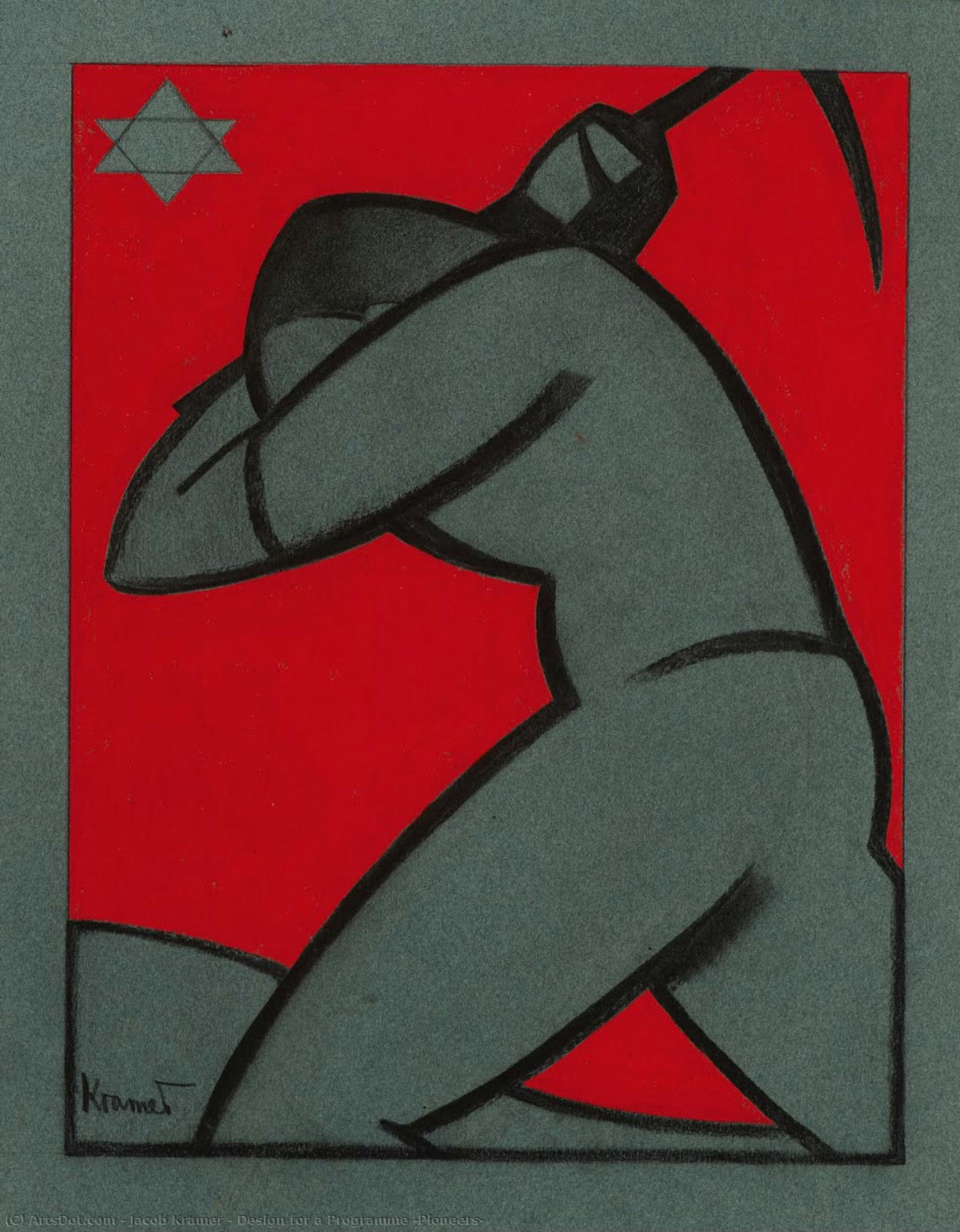
Design for a Programme (Pioneers)
複製画のサイズ

The story of Jacob Kramer is one of profound movement, a journey that began in the heart of Ukraine and found its spiritual and artistic anchor in the industrial landscapes of England. Born in 1892 in Klyntsi to a middle-class Jewish family, Kramer’s early years were steeped in a rich cultural tapestry. His father, Max Kramer, was an accomplished painter, and his mother, Cecilia, was a gifted performer of Slavic and Hebrew folk songs. This lineage of creativity provided the fertile soil from which Jacob’s talent would grow. When the family migrated to Leeds in 1900, the young artist brought with him a heritage that would forever inform the emotional depth and spiritual resonance of his work. His early life was not merely a period of settling into a new land, but a foundational era where the echoes of Eastern European tradition met the burgeoning modernism of the British art scene.
Kramer’s artistic evolution was shaped by a series of pivotal encounters and educational milestones that propelled him toward the vanguard of modern art. After attending evening classes at the Manchester School of Art, he returned to Leeds to study at the Leeds School of Art, where his talent was quickly recognized with prestigious scholarships. However, it was his involvement with the radical Leeds Arts Club that truly ignited his creative spirit. This influential circle exposed him to the revolutionary ideas of Expressionism and the profound spiritual concepts championed by masters like Wassily Kandinsky. His education continued at the Slade School of Fine Art in London, where he moved within a circle of legendary figures such as David Bomberg and Mark Gertler. These connections placed him at the heart of the Vorticist movement and the broader modernist dialogue, allowing him to weave together the raw energy of contemporary movements with his own deeply personal, introspective vision.
To encounter a painting by Jacob Kramer is to enter a world where color serves as a direct conduit for the soul. His technique was characterized by a bold, rhythmic use of pigment and a dynamic brushwork that felt both controlled and spontaneous. Eschewing mere imitation of reality, Kramer sought to capture the underlying emotional truth of his subjects. Whether he was rendering a quiet still life, a rugged landscape, or an intimate portrait, there was always a palpable sense of contemplation and movement. His canvases often pulsated with a vibrant intensity, utilizing thick applications of paint to create texture that mirrored the complexity of human emotion. This expressive approach allowed him to bridge the gap between the physical world and a higher spiritual plane, making his work a testament to the power of Expressionism in the British tradition.
The themes within his oeuvre often reflected a delicate balance between beauty and melancholy. His ability to infuse even the most mundane subjects with a sense of cosmic significance is perhaps best exemplified in his celebrated works held in prestigious collections like the Yale University Art Gallery. In pieces such as “Manikin in the Snow,” one can witness his mastery of atmosphere—the way he uses light and shadow to evoke a sense of isolation and quiet wonder. His work was never static; it was an ongoing quest to find the sacred within the secular, the eternal within the ephemeral. This spiritual quest, deeply rooted in his Jewish heritage and his exposure to modern mysticism, gave his art a unique gravity that set him apart from many of his contemporaries.
The historical significance of Jacob Kramer lies in his role as a vital bridge between diverse cultural influences and the development of Modern British Art. He was not merely a participant in the movements of his time, such as Vorticism or the London Group, but an artist who synthesized these disparate elements into a cohesive, personal language. His career, marked by solo exhibitions in London and Bradford, demonstrated a resilience and a commitment to artistic integrity that commanded respect across the art world. Even as he navigated the complexities of the twentieth century, his focus remained steadfast on the expressive potential of his medium.
Today, Kramer’s legacy is preserved through his presence in the most esteemed institutions in the world, including the Tate and the National Portrait Gallery. His contributions are recognized not just for their aesthetic brilliance, but for their role in expanding the boundaries of what British art could achieve. He remains an exemplar of how an artist can take the fragments of a displaced life—the memories of Ukraine, the grit of Leeds, and the intellectual rigor of London—and forge them into a singular, timeless vision that continues to resonate with viewers seeking depth, color, and soul.

1892 - 1962 , Ukraine


最新の美術ニュース、限定オファー、そしてインテリアのアイデアをいち早くお届けします。
お客様のプロジェクトについてお聞かせください。当社の美術専門家が、お客様に合わせた3つのパーソナライズされた芸術提案をご提供いたします。
あなたにぴったりの3作品を無料で厳選いたします


 プレビュー
プレビュー
 シェアする
シェアする シェアする
シェアする
 詳細を見る
詳細を見る

 ダウンロード
 似ている作品
 X線調査
X線調査 スライドショー
 詳細を見る
詳細を見る






































 ガラスオプションは、110cm未満のサイズでのみご利用いただけます。


