作品詳細説明
A Celebration of Childhood Innocence: Exploring Marc Chagall’s “A Blue Painter”
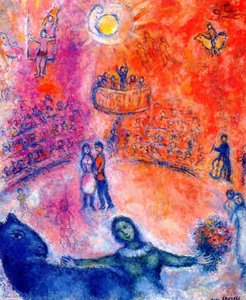
The painting "A Blue Painter" by Marc Chagall, completed in 1980, isn't merely a depiction of figures; it’s an embodiment of memory and longing—a testament to the enduring influence of formative experiences on artistic expression. Standing before this canvas is akin to stepping into Chagall’s dreamscape, where recognizable forms dissolve into fantastical imagery underpinned by a profound emotional resonance.
Subject Matter and Composition
At first glance, the scene presents a simple tableau: a man seated in a chair, accompanied by a woman standing behind him. However, Chagall elevates this commonplace arrangement through meticulous detail and an unconventional compositional strategy. Scattered around them are several additional individuals—a boy on the left, two figures on the right—creating a dynamic interplay of movement and presence. Dominating the center is a vase brimming with flowers, while another vase graces the upper right corner, adding visual richness to the overall composition. A potted plant anchors the background, providing a grounding element amidst the swirling colors and imaginative forms.
Style and Technique: Cubist Influences Combined With Surrealism
Chagall’s artistic style defies easy categorization, blending elements of Cubism with Surrealism—a hallmark of his oeuvre throughout his prolific career. The fractured planes characteristic of Cubism subtly disrupt our perception of space, mirroring the fragmented nature of memory itself. Simultaneously, Surrealist techniques—such as juxtaposition and dreamlike imagery—transport us beyond rational thought into a realm governed by subconscious impulses. Chagall employs bold brushstrokes and vibrant hues—primarily blues—to convey emotion rather than striving for photographic realism. The artist’s distinctive style is instantly recognizable, characterized by elongated figures, stylized faces, and an exuberant use of color that captures the essence of his artistic vision.
Historical Context: Vitebsk Under Siege
“A Blue Painter” emerged from a pivotal moment in Chagall's life—the siege of Vitebsk during World War II. The town, already scarred by Soviet repression, endured relentless bombing raids targeting Jewish institutions and cultural heritage. This traumatic experience profoundly impacted Chagall’s psyche and fueled his artistic preoccupation with themes of displacement, loss, and resilience. The painting reflects the anxieties and uncertainties of wartime Vitebsk, yet it transcends mere documentation to convey a deeper spiritual yearning—a desire for solace amidst chaos and an affirmation of faith in the face of adversity.
Symbolism: Recurring Motifs and Emotional Resonance
Throughout his work Chagall consistently employs symbolic motifs that resonate with universal themes of spirituality, mythology, and folklore. In “A Blue Painter,” the figures represent individuals grappling with existential questions—their postures conveying vulnerability and contemplation. The vase symbolizes beauty and fertility—a reminder of life’s enduring promise despite suffering. The blue color itself carries significant weight, evoking feelings of tranquility, melancholy, and spiritual illumination—reflecting Chagall's own inner landscape during this period of upheaval.
Emotional Impact: A Window Into Chagall’s Soul
Ultimately “A Blue Painter” succeeds in capturing the profound emotional impact of Chagall’s artistic sensibility. It invites viewers to contemplate themes of memory, loss, and faith—provoking introspection and fostering empathy for the artist's personal struggles. The painting’s luminous colors and dreamlike imagery transport us into Chagall’s inner world—allowing us to glimpse the poet of color’s enduring vision of humanity and its relationship with the divine. It remains a powerful reminder that art can transcend mere representation, communicating emotion and conveying spiritual truth in ways that resonate across generations.