Exploring the Energetic Dance of Color and Form in Paul Klee’s “Fire Wind”
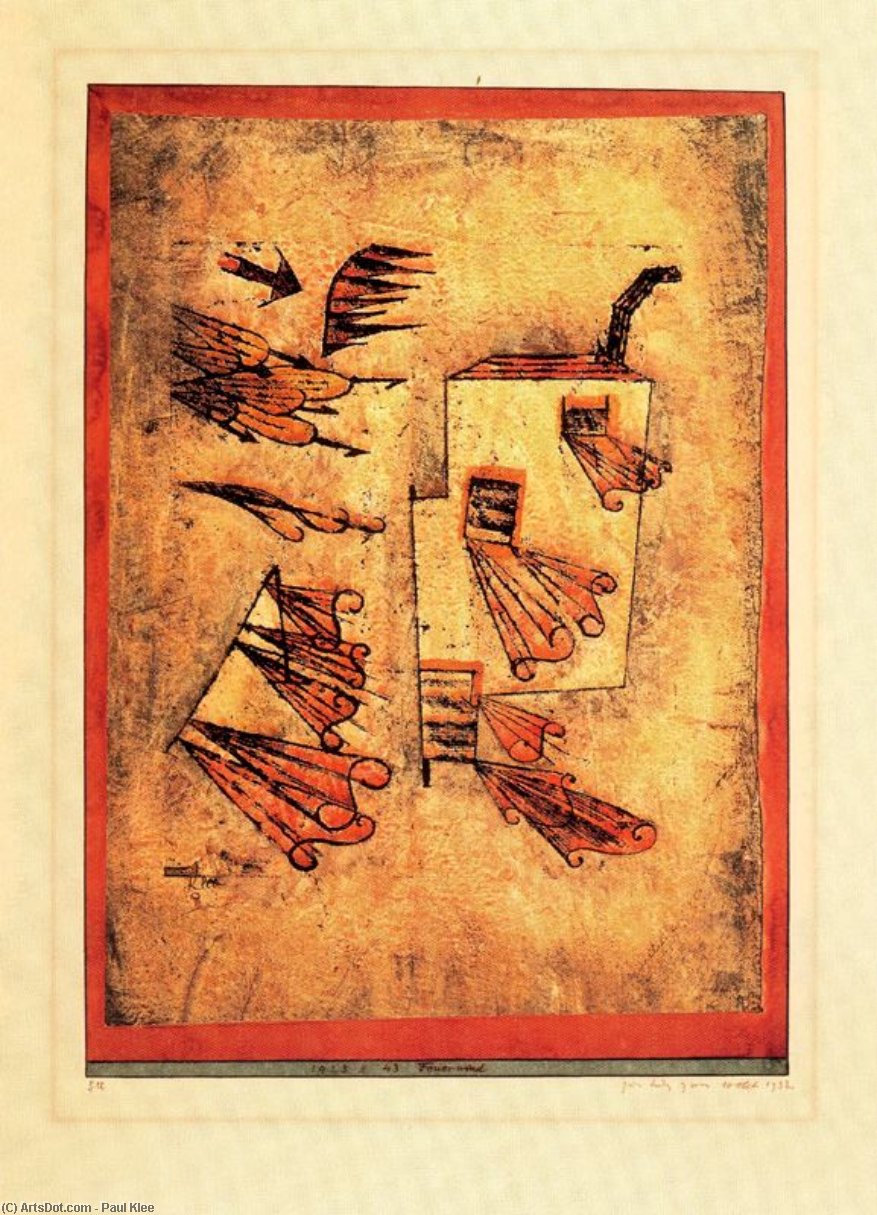
Paul Klee's "Fire Wind," a captivating canvas from 1937, transcends mere visual representation; it embodies a profound exploration of emotion and abstraction—a hallmark of his distinctive artistic vision. The painting immediately draws the eye with its dominant crimson hue, establishing a foundation of passion and dynamism that permeates the entire composition. However, to grasp the true essence of this artwork lies in delving deeper into its intricate layering of shapes and textures.
- Subject Matter: Klee’s depiction isn't concerned with depicting a literal landscape or portraiture. Instead, he presents a stylized scene featuring figures—primarily human silhouettes—engaged in seemingly purposeful actions. These individuals are positioned amidst geometric forms reminiscent of architectural structures and musical notations, suggesting an interplay between spatial organization and melodic rhythm.
- Style: “Fire Wind” firmly resides within Klee’s signature style – a blend of Expressionism and Cubism that prioritizes emotional resonance over precise realism. The fragmented shapes—circles, squares, triangles—are juxtaposed to create visual tension and convey a sense of movement, mirroring the turbulent energy of a swirling wind.
- Technique: Klee employed watercolor and gouache on paper, utilizing a technique known as “pointillism.” This method involves applying tiny dots of color onto the surface of the canvas, resulting in an ethereal luminosity and textural richness. The careful placement of these dots contributes significantly to the painting’s overall impressionistic effect.
Historical Context: Weimar Republic and Artistic Experimentation
“Fire Wind” was created during the turbulent years of the Weimar Republic in Germany—a period marked by political instability, economic hardship, and a fervent embrace of artistic innovation. Klee’s work reflects this spirit of experimentation, aligning with broader trends within European art at the time. Artists were actively rejecting traditional conventions, seeking new ways to express inner feelings and grapple with existential questions. The influence of Surrealism is palpable in Klee's approach, particularly evident in the dreamlike quality of his imagery and the subconscious exploration of form.
Symbolic Resonance: Musical Harmony and Elemental Forces
Beyond its formal qualities, “Fire Wind” resonates with symbolic significance. The geometric shapes—particularly squares and triangles—are often interpreted as representing stability and structure, contrasting sharply with the swirling circles that embody movement and dynamism. These elements intertwine to evoke a sense of balance between order and chaos – mirroring the concept of musical harmony where opposing forces coexist in equilibrium. Furthermore, the color red itself carries powerful connotations of passion, energy, and primal instinct—underscoring Klee’s intention to communicate profound emotional states.
Emotional Impact: A Meditation on Movement and Transformation
Ultimately, “Fire Wind” succeeds as a masterful depiction of inner experience. It invites contemplation and encourages viewers to consider the relationship between form, color, and emotion. The painting’s luminous watercolor washes create an atmosphere of serenity amidst the energetic interplay of shapes—a testament to Klee's ability to capture fleeting moments of beauty and transform them into enduring symbols of artistic vision. Its timeless appeal lies in its capacity to resonate with audiences across generations who appreciate the power of abstract art to convey complex feelings.









 Preview
 プリントを購入
 シェアする
シェアする シェアする
シェアする
 詳細を見る
詳細を見る

 ダウンロード
 似ている作品
 X線調査
X線調査 スライドショー
 詳細を見る
詳細を見る


