作品を販売する
ウィッシュリスト ショッピングカート Cart
x
プレビュープレビュー ARで試着ARで試着 手描きの絵画を購入 手描きの絵画を購入画像を購入 画像を購入 シェアするシェアする
詳細を見る詳細を見る お気に入りに追加 お気に入りに追加 ダウンロードダウンロード 似ている作品似ている作品 X線調査X線調査 スライドショースライドショー

Windmills

Discover 'Windmills' by William Grant Murray – a serene 1911 landscape painting of a Dutch windmill scene. Explore its historical context & timeless beauty.

William Grant Murray (1877-1950): British artist renowned for landscapes, portraits & murals. Principal of Swansea Art School & curator of Glynn Vivian Gallery. Explore his figurative paintings and significant contributions to Welsh art.

ジークレー/アートプリント

迅速な制作と多彩な仕上げオプションを備えた、ミュージアムクオリティのジークレーまたはキャンバスプリント。 (手描きの絵画を購入 手描きの絵画を購入画像を購入 画像を購入)

P118B $10
P118H $10
P118W $10
P438Z $10
P508JH $12
P508YH $12
P805H $10
P805Z $10
P919BZ $10
P919G $10
P919XJ $10
P959ZH $10
P968JZ $12
W106C $8
W218G $10
W218JH $8
W218Y $10
W307PJ $10
W316G $10
W316PJ $8
W316Y $10
W398PJ $8
W4111J $10
W500HY $15
W500JH $15
W692G $12
W849H $8
W940BG $15
W953PJ $8

Standard
custom
CM
INCH

作品のオリジナル比率に合わせた、当店の規定サイズからお選びください。

高さ

特定のフレームやスペースに合わせて、ご自身でサイズを指定することも可能です。選択されたサイズが元の画像の比率と一致しない場合、作品をトリミングするか、鏡面反射または単色での塗りつぶしによって画像を拡張いたします。制作を開始する前に、ご確認用のデジタルモックアップをお送りいたします。
画面上のプレビューには、実際のトリミングや拡張は反映されませんのでご注意ください。最終的な構図を正確に確認できるのは、モックアップのみとなります。
カスタムサイズも承っておりますが、元の比率を維持するためには、あらかじめ用意されたリストからサイズを選択することをお勧めいたします。

世界中への配送()は、標準の4〜5週間ではなく、2週間でお届けいたします。(12 8月)

why_choose_icon
世界中へ無料エクスプレス配送
why_choose_icon
高品質なリネンキャンバス
why_choose_icon
配送時完全保険付
why_choose_icon
関税・輸入税の払い戻し保証
why_choose_icon
忠実な色彩再現保証
why_choose_icon
60日間返品保証(製造上の欠陥のみ)
why_choose_icon
100% 全額返金保証
why_choose_icon
まとめ買い割引のご案内

合計金額

$ 68

reproduction

Windmills

ジークレー/アートプリント

複製画のサイズ

-

合計金額

$ 68

作品詳細

  • artist: William Grant Murray
  • title: Windmills
  • dimensions: 69 x 112 cm
  • year: 1911
  • style: figurative painting

アート・クイズ

各質問の正解は1つだけです。

問題 1:
In what year was William Grant Murray's 'Windmills' painted?
問題 2:
What is the primary subject depicted in 'Windmills'?
問題 3:
Based on the description, what contributes to the sense of life within the rural setting?
問題 4:
What are the dimensions of 'Windmills'?

作品詳細説明

A Pastoral Scene: William Grant Murray’s ‘Windmills’ (1911)

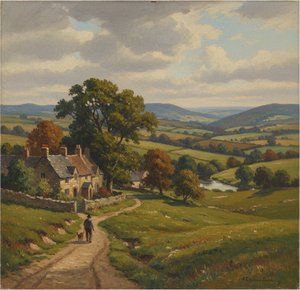
  • Subject and Composition: ‘Windmills’ transports the viewer to a tranquil rural landscape, dominated by a stately windmill set against a backdrop of billowing clouds. The composition is carefully balanced; the windmill acts as a central focal point, yet doesn't overwhelm the scene. A modest building – perhaps a shed or small barn – nestles nearby, suggesting human presence and agricultural life. Two figures animate the field, one positioned to the left and another to the right, subtly guiding the eye through the painting. The inclusion of a grazing horse further enhances the sense of peaceful activity within this idyllic setting.
  • Style and Technique: Painted in 1911, ‘Windmills’ reflects influences of Post-Impressionism and early Modernism, though Murray maintains a distinctly representational approach. His brushwork is visible yet controlled, creating texture and depth without sacrificing clarity. The color palette is muted and harmonious, dominated by earthy tones and soft greys that evoke the atmosphere of a cloudy day. Murray’s technique emphasizes light and shadow to define form and create a sense of spaciousness within the landscape.

Historical Context & Artistic Lineage

  • A Scottish Artist in Transition: William Grant Murray (1877-1950) was a versatile British artist, renowned for his murals, portraits and mosaics. Educated at prestigious art schools including the Royal College of Art in London and the Académie Julian in Paris, he possessed a strong academic foundation. ‘Windmills’ dates from a period where Murray was establishing himself as a landscape painter, moving away from purely decorative work towards more expressive representations of the natural world.
  • The Allure of Rural Life: The early 20th century witnessed a growing fascination with rural life and a desire to escape the rapid industrialization of urban centers. Paintings like ‘Windmills’ tapped into this sentiment, offering viewers a nostalgic vision of simpler times and harmonious coexistence between humanity and nature.

Symbolism & Emotional Resonance

  • The Windmill as Metaphor: The windmill itself carries symbolic weight. Traditionally, windmills represent progress, ingenuity, and harnessing the power of nature for human benefit. However, they can also evoke a sense of timelessness and the cyclical rhythms of agricultural life. In this painting, the windmill stands as a silent sentinel, witnessing the passage of time and the enduring beauty of the countryside.
  • A Mood of Serenity: ‘Windmills’ evokes a profound sense of peace and tranquility. The soft colors, gentle brushwork, and harmonious composition combine to create a calming atmosphere. It's a scene that invites contemplation and offers respite from the stresses of modern life. The painting’s emotional impact lies in its ability to capture a fleeting moment of beauty and stillness.

For Collectors & Interior Design

  • A Versatile Addition: With dimensions of 69 x 112 cm, ‘Windmills’ is a substantial yet manageable artwork suitable for a variety of interior spaces. Its muted color palette and pastoral subject matter make it particularly well-suited to traditional or country-style interiors.
  • Harmonious Placement: Consider pairing this painting with natural materials such as wood, linen, and stone to enhance its rustic charm. It would be a striking focal point in a living room, dining room, or study, adding warmth and character to any space. A high-quality reproduction of ‘Windmills’ offers an accessible way to bring the serenity of Murray's vision into your home.

アーティストの略歴

The Visionary of the Welsh Landscape: The Life of William Grant Murray

William Grant Murray was far more than a mere painter; he was a transformative force whose influence rippled through the British and Welsh artistic landscapes during the early twentieth century. Born in the coastal serenity of Portsoy, Scotland, in 1877, his early life was steeped in the rugged beauty of the north, a setting that would undoubtedly inform his lifelong fascination with light and atmosphere. His journey toward mastery began with rigorous academic discipline, moving from the Blairgowrie School of Art to the prestigious Edinburgh School of Art, before eventually finding himself at the heart of the London art scene within the Royal College of Art. It was during these formative years that Murray’s dedication to excellence became evident, earning him accolades that marked him as a rising star of his generation. The true metamorphosis of his style, however, occurred under the sun-drenched skies of France. In 1905, Murray immersed himself in the vibrant currents of European Impressionism while studying at the Académie Julian in Paris. This encounter with the French masters instilled in him a profound appreciation for the ephemeral—the way a sudden shadow falls across a meadow or how the morning mist clings to a harbor. He learned to see color not as static pigment, but as a living, breathing element that shifts with the passage of time. This Impressionist sensibility would become the heartbeat of his work, allowing him to capture the fleeting moments of light and movement that define the natural world.

A Legacy of Leadership and Artistic Vitality

Beyond the canvas, Murray’s life was defined by a fierce commitment to the elevation of artistic education and the preservation of culture. His career took a pivotal turn when he moved into roles of significant responsibility, serving as the Art Headmaster at West Bromwich Municipal School of Art. Yet, it was his appointment as Principal of the Swansea Municipal School of Art that would cement his historical significance. Upon arriving, Murray famously critiqued the institution's state, viewing its lack of facilities as a sign of decay. Driven by an unwavering belief in artistic vitality, he spearheaded a period of unprecedented growth, transforming the school into a premier institution that, by 1914, stood among the top twenty-five in England and Wales. His influence extended deeply into the civic life of Wales through his role as the first curator of the Glynn Vivian Art Gallery. In this capacity, he acted as a guardian of beauty, shaping the collection and fostering a community where art could flourish alongside industry. His work was not limited to the small scale of easel painting; he possessed a grand vision that embraced murals and large-scale compositions, much like his brother George, who was also renowned for his monumental works. Through his dual roles as an educator and a curator, Murray ensured that the artistic pulse of Swansea remained strong through the turbulent years of the interwar period.

The Essence of His Artistry

To look upon a work by Grant Murray is to experience a dialogue between structure and spontaneity. His technique often blended the disciplined foundations of his academic training with the fluid, emotive brushwork characteristic of the Impressionist movement. Whether he was depicting the rocky shores of his Scottish homeland or the shifting light of the Welsh coast, his paintings possess an inherent warmth and a sense of place that transcends mere representation. Key aspects of his artistic contribution include:
  • The integration of French Impressionist techniques into the British landscape tradition.
  • A profound ability to capture atmospheric light and the transient qualities of nature.
  • The institutional transformation of the Swansea Art School into a center of excellence.
  • His pivotal role in the curatorial development of the Glynn Vivian Art Gallery.
Though he passed away in 1950, the echoes of his passion remain. He left behind a legacy where art is not merely something to be observed, but something to be nurtured, defended, and celebrated as a vital component of human civilization. Through his landscapes, portraits, and murals, William Grant Murray continues to invite viewers into a world where every flicker of light tells a story of enduring beauty.
William Grant Murray

William Grant Murray

1877 - 1950 , United Kingdom

基本情報

  • Artistic Movement Or Style: Impressionism
  • Artists Who Influenced This Artist:
    • Claude Monet
    • Pierre Auguste Renoir
  • Date Of Birth: 1877
  • Date Of Death: 1950
  • Full Name: William Grant Murray
  • Nationality: British
  • Notable Artworks:
    • On the Seine
    • Carreg Cennen Castle
    • Barges on the Seine
  • Place Of Birth: Portsoy, United Kingdom