


x
 Abstract Expressionism
 1962
1962 165.0 x 137.0 cm
빠른 제작과 다양한 마감 옵션을 제공하는 박물관 품질의 지클레이 또는 캔버스 프린트. ( 손으로 그린 그림 구매 이미지 구매)
작품의 원본 비율을 유지하는 미리 설정된 크기 중에서 선택하세요.

특정 프레임이나 공간에 맞춰 직접 치수를 입력하실 수 있습니다. 선택하신 사이즈가 원본 이미지의 비율과 일치하지 않을 경우, 작품을 크롭(자르기)하거나 이미지를 대칭 또는 단색 채우기로 확장하여 제작합니다. 제작 시작 전, 최종 확인을 위해 디지털 목업이 전송됩니다.
화면상의 미리보기는 실제 크롭이나 확장 상태를 반영하지 않으므로, 최종 구도는 오직 목업을 통해서만 정확하게 확인하실 수 있습니다.
맞춤 사이즈 제작도 가능하지만, 원본 비율을 유지하기 위해서는 사전 정의된 목록에서 치수를 선택하시는 것을 권장합니다.

To Point
복제본 크기

Kenzo Okada stands as a singular figure in the tapestry of 20th-century art—a Japanese-born American painter who carved out an indelible mark within the vibrant, often turbulent landscape of Abstract Expressionism. His life and work embody a fascinating confluence of cultural heritage and avant-garde experimentation, acting as a bridge between the disciplined aesthetics of the East and the spontaneous energy of the West. Often celebrated as the first Japanese-American artist to achieve international acclaim within the Abstract Expressionist style, Okada brought to American abstraction a sense of civilized restraint, an elegance of device, and an unusual gift for the poetic transmutation of natural forms.
Born on September 28, 1902, in Yokohama, Japan, Okada’s early path was marked by a quiet struggle between familial expectation and personal passion. His father, a prominent industrialist, prioritized practical stability over the perceived instability of a creative life. Yet, following his father's passing, Okada found the freedom to pursue his true calling, enrolling at the Tokyo School of Fine Arts. This period of rigorous training in Western painting techniques provided him with a formidable foundation, but the allure of the global art scene proved too strong to resist. In 1924, driven by a thirst for the intellectual dynamism of Europe, he departed Japan for Paris, where he studied under the renowned Japanese expatriate Tsuguharu Foujita. This formative era in France exposed him to the stylistic innovations of Impressionism and Fauvism, planting the seeds for his eventual evolution toward abstraction.
The trajectory of Okada’s career was defined by a series of pivotal transitions that saw him moving from urban subjects to deeply meditative, lyrical abstractions. After debuting at the Salon d'Automne in Paris in 1927, he returned to Japan, quickly establishing himself as a respected figure through solo exhibitions and participation in prestigious groups like the Nika-ten. However, it was his eventual move to the United States that would catalyze his most significant artistic breakthroughs. In the mid-century New York art scene, Okada found a landscape that allowed him to merge his Japanese sensibilities with the burgeoning movement of Color Field painting and Abstract Expressionism.
His mature work is characterized by a profound sensitivity to color and a mastery of subtle tonalities. Unlike some of his contemporaries who relied on aggressive gestures, Okada’s technique often involved delicate, sensitive brushstrokes that created a sense of depth and atmospheric complexity. His paintings frequently evoke the essence of landscapes without explicitly depicting them; instead, they use earth colors, muted blues, and soft greens to create a poetic interpretation of the natural world. In masterpieces such as To Point and Grey, one can observe how he utilized abstract patterns and balanced compositions to achieve a state of tension and resolution, inviting the viewer into a space of quiet contemplation.
The historical significance of Kenzo Okada lies in his ability to harmonize disparate worlds. He did not merely adopt Western abstraction; he transformed it through the lens of an Eastern aesthetic rooted in subtlety and grace. This unique synthesis earned him some of the highest honors in the art world, including the Astorre Meyer Prize and the UNESCO Prize at the 29th Venice Biennale in 1958, where his work was featured in the Japan Pavilion.
His enduring influence is reflected in the prestigious collections that house his legacy. His works are held in the permanent collections of the world's most esteemed institutions, including:
Through his ability to translate the ephemeral qualities of light and nature into enduring abstract forms, Kenzo Okada remains a vital figure for scholars and lovers of art alike. He remains a pioneer who proved that abstraction could be both powerful and profoundly peaceful, leaving behind a body of work that continues to resonate with an elegance that transcends borders and generations.

1902 - 1982 , Japan
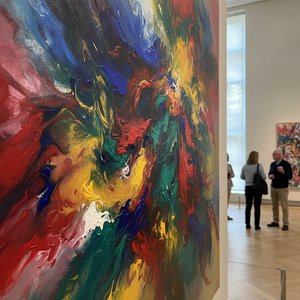
Explore the profound emotional depth of Lyrical Abstraction. Discover how masters like Raymond Parker used color and form to bridge Impressionism and Abstract Expressionism. Learn about this pivotal movement through our expert-led art history guide.

Explore the profound emotional depth of Color Field painting. Discover the history of mid-century abstraction, from Rothko to Newman, and learn how pure color transforms the viewer's experience through our expert art history guide.

Explore the profound history and emotional depth of Abstract Expressionism. From Jackson Pollock to Mark Rothko, master the nuances of the New York School through our expert art history guide. Discover museum-quality hand-painted reproductions for your collection.

Discover the profound emotional depth and investment potential of contemporary abstraction. Our expert guide explores how texture, movement, and form create timeless value for discerning art collectors and sophisticated interiors.
Master the nuances of abstract art with our expert guide. Explore the profound emotional depth of non-objective forms, from Abstract Expressionism to Color Field painting, and learn how to curate impactful, sophisticated masterpieces for your private collection.


최신 미술 뉴스, 특별 혜택 및 인테리어 아이디어를 가장 먼저 만나보세요.
프로젝트에 대해 알려주시면 저희 미술 전문가들이 맞춤형 아트 제안 3가지를 전달해 드립니다.
당신만을 위한 맞춤형 옵션 3가지를 무료로 추천해 드립니다!


 미리보기
미리보기
 공유하기
공유하기 공유하기
공유하기
 상세 정보
상세 정보

 다운로드
다운로드
 유사 작품
유사 작품 X-레이
X-레이 슬라이드 쇼
 더 보기
더 보기






































 유리 옵션은 110cm 미만 크기에서만 선택 가능합니다.




![Abstract Composition [triptych] — Vaclav Vytlacil, Abstract Expressionism](/media/artworks/images/thumbnails/e5/3d/e53db42ea02644b9a8e722f9d4dd3742.jpg)

