


x

Muziejų lygio „giclée“ arba drobos spausdinimas: greita gamyba ir lankstios apdailos parinktys. ( Pirkti rankomis tapytą paveikslą Pirkti vaizdą)





























Pasirinkite iš mūsų nustatytų dydžių, atitinkančių originalaus meno kūrinio proporcijas.

Galite nurodyti savo matmenis, kad vaizdas atitiktų konkretų rėmą ar erdvę. Jei pasirinktas dydis nesutaps su originalaus paveikslėlio proporcijomis, mes arba apkirpsime kūrinį, arba išplėsime vaizdą naudojant veideliu atspindėtą arba vientisą šoną. Skaitmeninis maketas bus išsiųstas jums patvirtinti prieš pradedant gamybą.
Atkreipkite dėmesį, kad ekrane matomas vaizdinys neatspindi tikrojo apkirpimo ar išplėtimo. Tik maketas tiksliai parodytų galutinę kompoziciją.
Nors galima rinktis ir individualius dydžius, rekomenduojame pasirinkti vieną iš išanksti nustatytų matmenų, kad būtų išlaikytos originalios proporcijos.
Pristatymas visame pasaulyje () per 2 weeks, o ne įprastas 4/5 savaičių laikotarpis. (22 rugpjūtis)


untitled (951)
Reprodukcijos matmenys
The untitled portrait attributed to Hans Holbein the Younger—identified as “951” within Most-Famous-Paintings's collection—offers a compelling window into the world of 16th-century nobility and the burgeoning artistry of the Northern Renaissance. The painting immediately draws the eye with its central figure: a man of evident status, cloaked in dark attire and distinguished by a striking black hat. He is not merely *wearing* his finery; he embodies it, radiating an air of quiet authority and contemplative power. The most captivating element, however, is undoubtedly the hawk perched upon his gloved hand. This isn’t simply a decorative addition; it's a carefully considered symbol deeply rooted in the aristocratic culture of the time.
To understand the significance of this portrait, one must consider the practice of falconry itself. In Holbein’s era, falconry was not merely a sport; it was an exclusive privilege reserved for the upper echelons of society. Owning and expertly handling a bird of prey—particularly a hawk, known for its keen eyesight and swiftness—demonstrated wealth, skill, and noble lineage. The man's confident grip on the bird speaks volumes about his social standing and mastery over both nature and his own domain. The hawk, therefore, becomes an emblem of power, control, and refined taste. Holbein was a master of imbuing his portraits with such subtle yet potent symbolism, elevating them beyond mere likenesses to become complex statements about the sitter’s identity and place in the world. The ring on his finger further emphasizes this status, hinting at family connections or perhaps a significant alliance.
Holbein’s technical prowess is readily apparent even in reproductions of this work. He was renowned for his meticulous attention to detail—a hallmark of the Northern Renaissance style—and his ability to capture not just physical resemblance, but also a sense of inner character. The textures of the man's clothing, from the rich folds of his robe or coat to the smooth leather of his glove, are rendered with remarkable precision. This dedication to realism wasn’t simply about technical skill; it was about conveying the sitter’s presence and personality with unwavering accuracy. The deep blue background serves not as a mere backdrop but as a complementary element that enhances the colors of the man's attire and the bird, creating a harmonious visual balance. Holbein’s use of light and shadow is also masterful, subtly modeling the face and hands to create a sense of depth and volume.
Hans Holbein the Younger (1497-1543) stands as one of the most significant portraitists of his time. Born in Augsburg, Germany, he honed his skills within his father’s artistic workshop before embarking on a career that would take him across Switzerland and ultimately to England. His arrival at the court of Henry VIII proved pivotal, establishing him as the King's Painter and securing his place in history. Holbein’s portraits of Henry VIII and other members of the Tudor dynasty are iconic representations of power and authority. While this particular work—untitled (951)—may not depict a royal figure, it embodies the same level of artistry and attention to detail that defined Holbein's oeuvre. It offers a fascinating glimpse into the broader world of Renaissance nobility and the cultural values of the era.

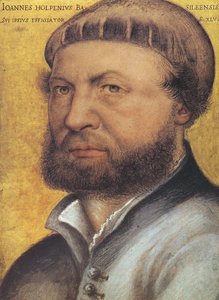
1497 - 1543 , Vokietija

Explore the profound mastery of Northern Renaissance art. Discover the technical brilliance of Flemish oil painting, the intricate symbolism of Bosch and Bruegel, and the revolutionary realism that redefined European art history through an expert historical lens.


Sekite naujausias meno naujienas, išskirtinius pasiūlymus ir dekoravimo idėjas.
Pasakokite mums apie savo projektą, o mūsų meno ekspertai parengs jums 3 asmeniškus meno pasiūlymus.
Leiskite mums parinkti 3 variantus būtent jums – nemokamai!


 Peržiūrėti realybėje
 Pasidalinti
 Dalintis
 Išsamiau

 Atsisiųsti
 Panašūs eksponatai
 Rentgeno nuotrauka
 Automatinė diorama

 Skaityti daugiau







 Stiklo variantas prieinamas tik pasirinkus dydį iki 110 cm


![Jean de Dinteville ir Georges de Selve dvigubas portretas (žinomas kaip „Ambassadoriai“) [detalė]](/media/artworks/images-thumb/42/81/42813dc49b2f72bce897aaf8b747ad5b.jpg)

