x

Картина маслом на холсте в выбранном вами размере и раме, написанная на заказ нашими художниками. ( Перейти к печати Переключиться на изображение)
Выберите один из наших стандартных размеров, соответствующих оригинальным пропорциям произведения искусства.

Вы можете указать собственные размеры, чтобы картина идеально вписалась в выбранную раму или пространство. Если выбранный вами размер не соответствует пропорциям оригинала, мы либо обрежем полотно, либо расширим его за счет дополнительных элементов, написанных вручную. Цифровой макет будет отправлен вам на утверждение перед началом производства.
Обратите внимание, что предварительный просмотр на экране не отражает фактическую обрезку или расширение. Только макет точно покажет окончательную композицию.
Хотя доступны индивидуальные размеры, мы рекомендуем выбирать вариант из предопределенного списка, чтобы сохранить исходные пропорции.
Доставка по всему миру () за 3–4 недели вместо стандартных 5 недель. (5 Август). Без компромиссов в качестве.


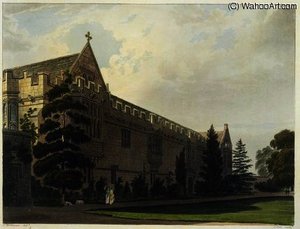
First Master's House
Размер репродукции

The history of nineteenth-century art is often told through the sweeping gestures of Romanticism, yet there exists a parallel narrative found in the meticulous, quiet brilliance of architectural draughtsmanship. Frederick Mackenzie stands as a profound figure within this tradition, embodying the Victorian era's deep reverence for structure, detail, and historical continuity. Born in Montreal in 1841, Mackenzie’s life was a tapestry woven from the threads of North American heritage and British artistic refinement. As the son of John Gordon Mackenzie, a prosperous dry goods merchant, his upbringing provided the stability and intellectual foundation necessary to pursue a career that would bridge the gap between technical precision and aesthetic grace.
While his early life was rooted in the burgeoning landscape of Canada, his artistic soul was deeply connected to the established traditions of the United Kingdom. This duality allowed him to approach his subjects with both a fresh perspective and a profound respect for classical forms. His education at McGill University provided him with a disciplined mind, a trait that would later manifest in the unwavering accuracy of his watercolour compositions. In an era where the world was rapidly changing due to industrialization, Mackenzie’s work served as a vital record of permanence, capturing the architectural grandeur and topographical truth of a landscape in transition.
To observe a Mackenzie watercolour is to enter a world where light and shadow perform a delicate dance upon stone and mortar. His technique was characterized by an extraordinary command over the medium of watercolour, using pigments not merely for color, but to evoke the very texture of the surfaces he depicted. He possessed a rare ability to translate the cold, hard reality of masonry into something breathing and atmospheric. Through subtle washes and precise linework, he could convey the weathered patina of ancient walls or the sharp, clean edges of contemporary Victorian design.
His artistic development was heavily informed by the architectural principles of his time, drawing inspiration from the monumental styles championed by figures such as John Nash and Auguste Pugin. This influence is evident in the way he approached composition; his works were never merely sketches, but rather thoughtful explorations of space and proportion. He understood that architecture is the skeleton of history, and through his drawings, he sought to give that skeleton a soul. His mastery lay in the balance between the scientific accuracy required for architectural draughtsmanship and the emotive power of fine art, ensuring that every structure he rendered possessed both structural integrity and poetic resonance.
The significance of Frederick Mackenzie extends beyond the mere documentation of buildings; his work represents a cultural bridge between the Old World and the New. In the context of the nineteenth century, his ability to capture the essence of architectural beauty helped foster a sense of identity and continuity during a period of immense social upheaval. His contributions to the visual record of his era remain invaluable to historians and art enthusiasts alike, offering a window into the aesthetic values of the Victorian age.
Though his life was relatively brief, ending in 1889, the impact of his meticulous vision remains etched in the annals of watercolour history. His legacy is defined by:
Today, as we look back upon his oeuvre, we see more than just drawings of buildings; we see the heartbeat of an era captured through the eyes of a man who found divinity in the details.

1841 - 1889 , Canada

Explore the exquisite topographical paintings of Thomas H. Shepherd, renowned for his detailed depictions of Victorian London and beyond. Discover his legacy & artistic techniques.

Explore the captivating world of Edwin Deakin, a Victorian artist who masterfully captured California's landscapes, Spanish missions & Chinatown. Discover his legacy and influence on art history.

Explore the captivating world of William Henry Pyne (1769-1843), a key figure in early 19th-century English art. Discover his stunning watercolours, architectural studies & contribution to the rise of watercolour painting. Learn about this fascinating artist's life and legacy.

Explore the captivating world of Frederick Goodall (1822–1904), a celebrated Victorian artist renowned for his detailed genre paintings and evocative Egyptian scenes. Discover his life, legacy & find high-quality reproductions at Most-Famous-Paintings.

Explore the captivating world of Frederick Morgan, a key figure in Victorian Aestheticism. Discover his beautiful paintings, recurring themes, and lasting legacy with our expert analysis. Learn more today!


Будьте в курсе последних новостей из мира искусства, эксклюзивных предложений и идей для оформления интерьера.
Расскажите нам о вашем проекте, и наши эксперты по искусству предложат вам 3 персонализированных варианта произведений искусства.
Мы подберем для вас 3 варианта — бесплатно!


 Предпросмотр
 Поделиться
 Поделиться
 Детали произведения

 Скачать
 Похожие работы
 Рентгенография
 Слайд-шоу
 Читать далее




































 Вариант со стеклом доступен только для размеров менее 110 см