x
 WatercolorWallArtAbstraction
 1921Modern
 23.0 x 18.0 cm
 格鲁吉亚艺术宫 - 文化历史博物馆
从与原作比例一致的预设尺寸中进行选择。

您可以输入自定义尺寸,以适配特定的画框或空间。如果您选择的尺寸与原图比例不符,我们将对作品进行裁剪,或通过镜像填充/纯色填充边缘的方式来扩展图像。在开始制作之前,我们会向您发送一份数字效果图供您确认。
请注意,屏幕上的预览并不能反映实际的裁剪或扩展效果。只有效果图才能准确展示最终的构图。
虽然我们提供定制尺寸,但为了保持原图比例,我们建议您从预设列表中选择尺寸。

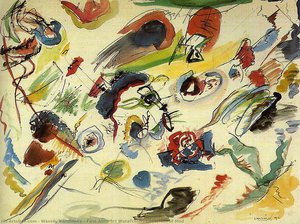
Abstraction Based on Flower Forms, I
复制品尺寸
In the delicate interplay of "Abstraction Based on Flower Forms, I," we encounter a profound moment in the evolution of Georgian Modernism. Created in 1921 by the visionary polymath David Kakabadze, this watercolor on paper serves as a mesmerizing window into an era where the boundaries of reality were being courageously redrawn. The composition unfolds upon a deep, evocative blue background, acting as a nocturnal or celestial stage for a dreamlike arrangement of shapes. While the title suggests a botanical origin, the painting transcends mere representation, inviting the viewer into a surrealist landscape where organic floral motifs collide with unexpected, almost whimsical elements. The presence of scattered yellow and black shapes—reminance of shoes—alongside a subtle clock in the upper corner, creates a delightful tension between the natural world and the artifacts of human existence, challenging our perceptions of time and space.
The technique employed by Kakabadze is nothing short of masterful, utilizing the fluid, translucent nature of watercolor to achieve a sense of ethereal lightness. Each stroke contributes to a layered complexity, where earthy tones and vibrant accents bleed into one another, creating a rhythmic movement across the 23 x 18 cm surface. This piece exemplifies the early 20th-century shift toward abstraction, where the artist’s goal was not to mimic the physical world, but to capture its underlying energy and essence. For the discerning collector or interior designer, this artwork offers a sophisticated focal point; its intricate textures and balanced color palette provide a sense of intellectual depth and quiet contemplation, making it an ideal centerpiece for spaces that value avant-garde history and artistic nuance.
To understand the emotional resonance of this work, one must look to the life of David Kakabadze himself. A true pioneer, Kakabadze was a figure who bridged the gap between the traditional roots of his native Georgia and the radical currents of the European avant-garde. His scientific background in natural sciences allowed him to approach art with a unique structural understanding, which is evident in the way he deconstructs floral forms into geometric abstractions. This painting is not merely an aesthetic exercise; it is a testament to a period of intense cultural transformation. The juxtaposition of the ephemeral—the flower—with the mechanical—the clock—speaks to the broader modernist preoccupation with the fleeting nature of life amidst the encroaching industrial age.
Owning a high-quality reproduction of such a significant piece allows one to bring a fragment of art history into the contemporary home. The artwork’s ability to evoke both mystery and tranquility makes it a versatile choice for modern decor, whether placed in a minimalist gallery-style setting or a richly textured study. It serves as a conversation starter, a piece of "living" history that continues to pulse with the creative spirit of 1921. As we gaze upon these abstracted forms, we are reminded of the power of art to reshape our reality, offering a timeless escape into a world where color and shape tell stories far beyond the reach of words.


1889 - 1952 , 格鲁吉亚

Explore the profound impact of Minimalism and Geometric Abstraction. From Mondrian to Malevich, discover how stripping art to its essential forms revolutionized modern aesthetics through our expert-led historical guide.


第一时间获取最新的艺术新闻、独家优惠及装饰灵感。
向我们介绍您的项目需求,我们的艺术专家将为您提供 3 个个性化的艺术品推荐。
由我们的专家为您精选 3 款心仪之作 —— 完全免费!


 效果预览
效果预览
 购买手绘画作
 分享
分享 分享
分享
 详情
详情

 下载
下载
 相似作品
相似作品 X射线
X射线 幻灯片播放
幻灯片播放 展开详情
展开详情






































 玻璃选项仅适用于110厘米以下的尺寸。