作品详情
Architectural Composition by Dia al-Azzawi: A Fragmented Echo of Mesopotamian Spirit
Dia al-Azzawi’s “Architectural Composition,” created in 1971, isn't merely a painting; it’s a distillation of Iraqi cultural memory—a visual meditation on the grandeur and complexity of Mesopotamia against the backdrop of a rapidly changing political landscape. Born in Baghdad in 1939, al-Azzawi’s artistic journey began amidst the echoes of ancient civilizations, shaping his profound understanding of symbolism and storytelling that would permeate his oeuvre. His formative years instilled within him an unwavering fascination with the monumental ruins of Sumerian and Akkadian cities, fueling a desire to translate these impressions onto canvas in ways that transcended mere representation.
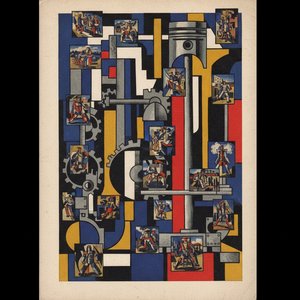
The artwork itself is immediately striking—a square canvas dominated by hues of blue, punctuated by bursts of crimson, saffron, violet, ivory, and charcoal. At first glance, it appears as an abstract exploration of geometric forms – rectangles, squares, circles – meticulously arranged to suggest the fractured facades of buildings or perhaps even stylized depictions of temple complexes. However, delving deeper reveals a sophisticated layering of technique that speaks volumes about al-Azzawi’s artistic sensibilities. The artist employs oil paints on canvas with a deliberate blending process, creating subtle gradations of color and texture that imbue the piece with an ethereal quality. While brushstrokes are visible, they remain restrained, prioritizing tonal harmony over dramatic impasto—a conscious decision reflecting the artist's commitment to conveying serenity and contemplation.
Beyond its formal qualities lies a rich tapestry of symbolic resonance. The pervasive blue palette evokes not only the azure expanse of the Tigris River but also deeper associations with spirituality and melancholy – colors frequently employed in Islamic art to express profound emotion. Scattered amongst these dominant shades are vibrant accents—red symbolizing passion and vitality, yellow representing enlightenment—suggesting an interplay between earthly ambition and divine aspiration. Furthermore, integrated within some of the geometric shapes are fragments of Arabic calligraphy, adding layers of cultural significance and hinting at a connection to Mesopotamian traditions of monumental inscriptions. These symbols aren’t merely decorative; they actively participate in conveying the artwork's overarching theme: the enduring spirit of Mesopotamia—its resilience amidst upheaval and its capacity for breathtaking beauty.
The piece’s stylistic influences are discernible in the confluence of Cubism and Modern Art movements, mirroring a broader artistic dialogue occurring during the early 1970s. Like Picasso and Braque before him, al-Azzawi dismantles traditional perspective, presenting flattened planes that prioritize visual impact over illusionistic realism. This deliberate rejection of convention underscores his desire to communicate ideas directly—to engage the viewer’s intellect as much as their emotions. “Architectural Composition” isn't simply a depiction of form; it’s an invitation to contemplate the relationship between past and present, between fragmentation and wholeness—a timeless testament to the enduring power of art to capture the essence of cultural heritage.
Ultimately, this artwork transcends its technical merits to offer a poignant reflection on Iraqi identity during a period marked by political instability. It speaks to a yearning for continuity amidst change, conveying a sense of solemn beauty that lingers long after viewing. Its muted palette and carefully considered composition encourage introspection—making it an ideal choice for interior designers seeking pieces that inspire contemplation and evoke the spirit of ancient Mesopotamia.