x
从与原作比例一致的预设尺寸中进行选择。

您可以输入自定义尺寸,以适配特定的画框或空间。如果您选择的尺寸与原图比例不符,我们将对作品进行裁剪,或通过镜像填充/纯色填充边缘的方式来扩展图像。在开始制作之前,我们会向您发送一份数字效果图供您确认。
请注意,屏幕上的预览并不能反映实际的裁剪或扩展效果。只有效果图才能准确展示最终的构图。
虽然我们提供定制尺寸,但为了保持原图比例,我们建议您从预设列表中选择尺寸。

untitled (5831)
复制品尺寸
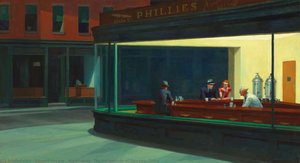
Edward Hopper’s “Nighthawks,” completed in 1942, is more than just a painting; it’s a distilled moment of American experience – a poignant exploration of loneliness and the quiet drama unfolding within the heart of a bustling city. The canvas depicts a late-night diner scene, bathed in an almost theatrical artificial light, instantly captivating viewers with its stark simplicity and profound emotional resonance. Hopper masterfully captures a sense of detachment, inviting us to contemplate the lives of these anonymous figures and the unspoken narratives that surround them.
The painting’s composition is meticulously crafted. The diner itself – a brightly lit rectangle against the enveloping darkness – acts as a stage, isolating its occupants within a carefully constructed space. Hopper's use of color is deliberate and restrained; the dominant hues of red, green, and yellow create a vibrant yet unsettling atmosphere, contrasting sharply with the muted tones of the surrounding cityscape. The sharp angles and geometric forms contribute to the painting’s sense of unease, reinforcing the feeling of confinement and isolation.
Hopper's style is firmly rooted in American Realism, but he transcends mere representation through his masterful manipulation of light and shadow. He employs a technique known as “accidental realism,” capturing fleeting moments of everyday life with an almost photographic precision. However, it’s not simply about accurate depiction; Hopper imbues his scenes with a deep sense of psychological depth. Notice the subtle details – the man's slumped posture, the woman's averted gaze, the bartender’s impassive expression – each contributing to the overall mood of quiet melancholy.
The painting’s execution is characterized by smooth brushstrokes and precise detailing, reflecting Hopper’s meticulous approach to his craft. He utilized oil paints on canvas, layering thin glazes to achieve a luminous effect and create a sense of depth and atmosphere. The use of reflected light within the diner's glass creates an illusion of transparency, further enhancing the painting’s dramatic impact.
"Nighthawks" was created during World War II, a period marked by uncertainty and anxiety in America. This context undoubtedly influenced Hopper’s themes of isolation and alienation, reflecting a growing sense of disillusionment among many Americans. The diner itself can be interpreted as a symbol of the American Dream – a place of refuge and connection – yet ironically, it becomes a space of profound loneliness.
The painting's title, "Nighthawks," evokes images of nocturnal birds, suggesting a sense of vulnerability and solitude. The figures within the diner are left ambiguous, their identities unknown, allowing viewers to project their own emotions and experiences onto the scene. Some art historians suggest Hopper was inspired by Ernest Hemingway’s short story “The Killers,” exploring themes of isolation and despair.
"Nighthawks" remains one of the most iconic images in American art, captivating audiences with its haunting beauty and enduring relevance. It speaks to a universal human experience – the feeling of being alone even amidst crowds, the quiet contemplation of life’s mysteries, and the search for connection in an increasingly fragmented world. Hopper's ability to capture these emotions with such precision and subtlety has ensured that “Nighthawks” continues to resonate with viewers today, solidifying its place as a masterpiece of American Realism.

1931 - 1967 , 美国

Explore the profound history of American Regionalism. Discover how Grant Wood captured the heart of the Midwest through masterpieces like American Gothic. An expert guide to the movement, its cultural impact, and the enduring beauty of American Realism.


第一时间获取最新的艺术新闻、独家优惠及装饰灵感。
向我们介绍您的项目需求,我们的艺术专家将为您提供 3 个个性化的艺术品推荐。
由我们的专家为您精选 3 款心仪之作 —— 完全免费!


 效果预览
效果预览
 购买手绘画作
 分享
分享 分享
分享
 详情
详情

 下载
下载
 相似作品
相似作品 X射线
X射线 幻灯片播放
幻灯片播放
 展开详情
展开详情






































 玻璃选项仅适用于110厘米以下的尺寸。