藏品详情
A Glimpse into Léger’s Cinematic Vision: “Study for Cinematic Mural, Study VII”
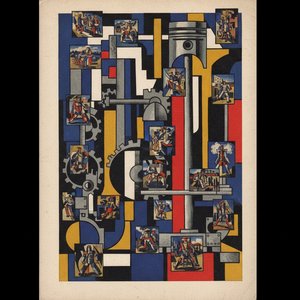
This captivating artwork, “Study for Cinematic Mural, Study VII,” created in 1938 by the celebrated French artist Fernand Léger, offers a compelling window into his exploration of modern form and movement. Measuring 51 x 38 cm, this piece is not merely a study, but a vibrant composition brimming with energy and intellectual rigor – a crucial stepping stone towards Léger’s ambitious mural projects.
Deconstructing the Visual Language
The artwork presents a dynamic abstract landscape constructed from bold geometric shapes and striking color blocks. Léger deliberately fragments recognizable forms, reducing them to their essential elements—circles, ovals, rectangles, and triangles—arranged in an overlapping and intersecting manner. This creates a sense of depth and propels the eye across the canvas. The dominant lines are angular and rectilinear, reinforcing the structured yet energetic feel. Notice how Léger’s application of paint is intentionally somewhat naive or ‘folk-art’ inspired, with visible brushstrokes adding texture and immediacy to the work.
Style & Influences: Cubism, Fauvism, and Beyond
Léger's style in this piece resides at a fascinating intersection of artistic movements. While rooted in Cubism, particularly its analytical phase, he diverges from Picasso and Braque’s more muted palettes. The vibrant color choices—a powerful interplay of red, blue, yellow, and white, accented with green and black—reveal the influence of Fauvism. Furthermore, a hint of “primitivism” can be detected in the simplification of forms and bold application of color, reflecting Léger’s interest in non-Western art. He developed his own distinct style often referred to as "Tubism," characterized by its emphasis on cylindrical forms – though less pronounced here than in some of his later works.
The Cinematic Mural Project & Historical Context
“Study for Cinematic Mural, Study VII” is part of a series of preparatory sketches Léger created for a large-scale mural project intended for the 1937 International Exposition in Paris. This was a period of significant social and political upheaval, with the rise of totalitarian regimes across Europe. Léger’s work, however, remained optimistic, celebrating the dynamism of modern life and the potential of technology. He envisioned murals that would be accessible to all, reflecting the energy and spirit of the machine age – a vision aligning with his communist sympathies and belief in art for the people. Exploring the other studies (I-VI) reveals how Léger meticulously worked through compositional ideas before realizing these grand public works.
Symbolism & Emotional Resonance
While abstract, the artwork isn’t devoid of meaning. The interplay of shapes and colors can be interpreted as representing balance, energy, and the inherent dynamism of modern existence. The flattened perspective and overlapping forms create a sense of spatial ambiguity, inviting viewers to actively engage with the composition and construct their own interpretations. The overall effect is one of controlled chaos, a visual representation of the complexities and contradictions of the 20th century.
A Piece for Collectors & Designers
“Study for Cinematic Mural, Study VII” offers more than just aesthetic appeal; it’s a piece of art history. Its bold colors and dynamic composition make it a striking focal point in any collection or interior design scheme. The artwork's energy would complement modern and contemporary spaces, adding a touch of intellectual sophistication and artistic flair. A high-quality reproduction allows you to experience Léger’s vision and bring the spirit of innovation into your home or office.