x
 Contemporary Realism
 1990
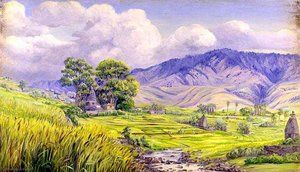
1990 76.0 x 61.0 cm
 Kerala Museum




























从与原作比例一致的预设尺寸中进行选择。

您可以输入自定义尺寸,以适配特定的画框或空间。如果您选择的尺寸与原图比例不符,我们将对作品进行裁剪,或通过镜像填充/纯色填充边缘的方式来扩展图像。在开始制作之前,我们会向您发送一份数字效果图供您确认。
请注意,屏幕上的预览并不能反映实际的裁剪或扩展效果。只有效果图才能准确展示最终的构图。
虽然我们提供定制尺寸,但为了保持原图比例,我们建议您从预设列表中选择尺寸。

Untitled
复制品尺寸

Born in 1929 amidst the poignant beauty and complex history of Srinagar, Ghulam Rasool Santosh – often known as G.R. Santosh – emerged from a modest background to become one of Kashmir’s most distinctive and spiritually resonant artistic voices. His life was a tapestry woven with threads of personal sacrifice, academic pursuit, and an unwavering dedication to expressing the profound themes of Kashmir Shaivism through a uniquely vibrant and sensual visual language. Santosh's journey is not merely that of a painter; it’s a testament to the power of art to transcend social boundaries and embody cultural identity.
Ghulam Rasool was born into a Kashmiri Muslim family in the Chinkral Mohalla, a vibrant neighborhood within old Srinagar. His early life was marked by hardship following his father’s death, forcing him to contribute financially from a young age. He initially worked as a signboard painter, weaver of silk, and whitewasher – skills that instilled an appreciation for texture, color, and the tactile nature of materials, all later reflected in his art. A pivotal moment arrived in 1954 when he secured a scholarship to study fine arts at the Maharaja Sayajirao University of Baroda in Gujarat—a significant departure from traditional Kashmiri artistic practices and a bold step towards formal training. This move was further complicated by an extraordinary personal choice: he married his childhood sweetheart, Santosh – a Kashmiri Pandit woman – defying societal norms and embracing a union that would profoundly shape his artistic perspective.
Upon returning to Srinagar, Santosh immersed himself in the study of Tantric art and, crucially, Kashmir Shaivism. This philosophical tradition, with its emphasis on union with the divine through sensory experience and ecstatic devotion, became the bedrock of his artistic vision. He began to translate these complex spiritual concepts into visual form, developing a distinctive style characterized by intense color palettes—deep blues, vibrant reds, and shimmering golds—and meticulously rendered lines that seemed to pulse with energy. His work moved beyond mere representation; it aimed to evoke a state of heightened awareness and connection to the divine, drawing heavily on the symbolism inherent in Tantric iconography.
Santosh’s art quickly gained recognition both within India and internationally. He participated in prestigious events such as the Tenth São Paulo Art Biennial in 1969, a landmark exhibition showcasing contemporary art from across the globe, and ‘Neo-Tantra: Contemporary Indian Art Inspired by Tradition’ at the University of California, Los Angeles, in 1985. These exhibitions brought his work to a wider audience, solidifying his reputation as a leading figure in modern Indian art. His paintings were celebrated for their spiritual depth, technical mastery, and sensual quality – a potent combination that resonated with viewers seeking both aesthetic beauty and profound meaning. He was also recognized for his literary contributions, writing plays, poetry, and essays in the ancient Kashmiri language of Sharda, demonstrating a deep connection to his cultural heritage.
Ghulam Rasool Santosh passed away in New Delhi in 1997, leaving behind a body of work that continues to captivate and inspire. His art stands as a powerful testament to the fusion of tradition and modernity, spirituality and sensuality. He skillfully blended the rich symbolism of Kashmir Shaivism with the dynamism of Tantric aesthetics, creating paintings that are both visually stunning and deeply evocative. Santosh’s legacy extends beyond his individual creations; he helped to preserve and revitalize the ancient Kashmiri language of Sharda, ensuring its continued existence alongside his artistic output. His work remains a vital window into the soul of Kashmir, offering viewers a glimpse into a world where art serves as a conduit for spiritual exploration and cultural preservation.

1929 - 1997 , India

Journey through the vibrant world of Marianne North’s botanical paintings! Explore 25 iconic artworks from this Victorian artist, celebrating exotic flora & travel. Find museum-quality reproductions and curated decor ideas at Most-Famous-Paintings.com.

Explore the captivating landscapes of Thomas Daniell, a pioneering artist who documented India's beauty in the 19th century. Discover his 'Oriental Scenery,' aquatint technique & lasting legacy. Hand-painted reproductions available at Most-Famous-Paintings.

Explore the captivating 'Oriental Scenery' by Thomas & William Daniell. Discover their pioneering aquatint prints of India, imperial context, artistic collaboration, and lasting legacy. A deep dive for history lovers.
探索保罗·塞尚25幅经典杰作!深入了解后印象派大师的艺术生涯、独特技法与色彩运用。Most-Famous-Paintings提供高清油画复制品,为您的家居带来博物馆级艺术体验。立即发现更多名画,点亮生活空间!

Explore the art of serenity with Most-Famous-Paintings. Discover historical & contemporary artworks evoking peace & tranquility. Find paintings for relaxation, meditation, and a calming home aesthetic. Expert guidance included.


第一时间获取最新的艺术新闻、独家优惠及装饰灵感。
向我们介绍您的项目需求,我们的艺术专家将为您提供 3 个个性化的艺术品推荐。
由我们的专家为您精选 3 款心仪之作 —— 完全免费!


 效果预览
效果预览
 购买手绘画作
 分享
分享 分享
分享
 详情
详情

 下载
下载
 相似作品
相似作品 X射线
X射线 幻灯片播放
幻灯片播放 展开详情
展开详情









 玻璃选项仅适用于110厘米以下的尺寸。