x

 Acrylic On CanvasWallArtRealism
 186519th Century
 65.0 x 90.0 cm
 加拿大国家美术馆




























从与原作比例一致的预设尺寸中进行选择。

您可以输入自定义尺寸,以适配特定的画框或空间。如果您选择的尺寸与原图比例不符,我们将对作品进行裁剪,或通过镜像填充/纯色填充边缘的方式来扩展图像。在开始制作之前,我们会向您发送一份数字效果图供您确认。
请注意,屏幕上的预览并不能反映实际的裁剪或扩展效果。只有效果图才能准确展示最终的构图。
虽然我们提供定制尺寸,但为了保持原图比例,我们建议您从预设列表中选择尺寸。

The Third-class Carriage
复制品尺寸
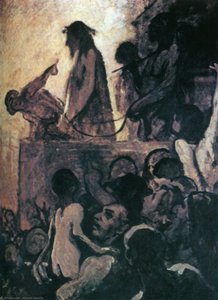
Honoré Daumier's 1865 painting, “The Third-Class Carriage,” is more than a simple depiction of a train journey; it’s a poignant snapshot of mid-19th century French society, rendered with the artist’s characteristic blend of realism and social commentary. Measuring 65 x 90 cm, this black and white composition immediately draws the viewer into the cramped confines of a third-class railway car, capturing a moment of everyday life that speaks volumes about class divisions and the burgeoning urbanization of France during the Second Empire.
Daumier’s style is immediately recognizable through his meticulous draftsmanship and a deliberate avoidance of idealized beauty. He was deeply influenced by artists like Rubens, particularly in his use of dramatic lighting (chiaroscuro) to sculpt forms and create mood. In “The Third-Class Carriage,” this influence is evident in the strong contrasts between light and shadow, which highlight the textures of the benches, luggage, and clothing. The artist’s technique relies on precise lines and detailed observation, reflecting his commitment to capturing reality with unflinching honesty. His work was often characterized by a rough, almost sketch-like quality, contributing to its raw emotional impact.
Painted in 1865, “The Third-Class Carriage” reflects the significant social and political changes occurring in France during this period. The rapid growth of Paris and other industrial centers led to a massive influx of rural populations seeking work and opportunity – often finding themselves crammed into overcrowded, poorly maintained train cars like the one depicted here. Daumier’s work aligns with the broader trend of Realist art, which sought to depict everyday life without romanticizing or idealizing it. The painting subtly critiques the social inequalities inherent in this transition, offering a glimpse into the lives of those marginalized by industrialization and urbanization.
Beyond its documentary value, “The Third-Class Carriage” possesses a powerful symbolic resonance. The presence of a woman holding a baby amidst the bustling crowd evokes themes of family, vulnerability, and the challenges faced by working-class families. The scattered luggage represents not just possessions but also dreams, aspirations, and the burdens carried on journeys – both literal and metaphorical. The overall mood is one of quiet observation, inviting viewers to contemplate the lives of these anonymous individuals and consider their place within a rapidly changing society. This artwork’s enduring appeal lies in its ability to capture a fleeting moment of human experience with remarkable sensitivity and artistic skill.


1808 - 1879 , 法国

探索纽约大都会艺术博物馆25幅传世杰作!从梵高、莫奈到达芬奇,深入了解艺术大师的故事与创作灵感。精美油画复制品,为您的家居带来艺术气息。立即在Most-Famous-Paintings.com发现更多经典作品。

探索纽约MoMA博物馆25幅经典杰作!从梵高的《星夜》到毕加索的立体主义,感受艺术史上的震撼与灵感。Most-Famous-Paintings.com提供高清艺术复制品和定制装饰画,将大师作品带入您的家。立即发现更多名画!

探索丹特·加布里埃尔·罗塞蒂的25幅传世杰作!深入了解普拉拉斐利前派大师的艺术世界,感受维多利亚时代的浪漫主义与象征主义。在Most-Famous-Paintings.com欣赏高清油画复制品,为您的家居增添诗意与格调。立即探索完整系列!

探索底特律艺术学院25幅杰作!从梵高的情感自画像到莫奈的光影诗篇,领略艺术的魅力与历史。Most-Famous-Paintings.com为您呈现博物馆级复制品和家居装饰灵感。立即在线发现更多经典名画!
探索美国国家艺术馆的25幅大师级杰作!深入了解塞尚、马蒂斯等艺术家的故事,感受印象派与现代艺术的魅力。Most-Famous-Paintings.com提供高品质油画复制品,点亮您的家居空间。立即在线探索完整系列!


第一时间获取最新的艺术新闻、独家优惠及装饰灵感。
向我们介绍您的项目需求,我们的艺术专家将为您提供 3 个个性化的艺术品推荐。
由我们的专家为您精选 3 款心仪之作 —— 完全免费!


 定制手绘复刻品
 分享
分享 分享
分享
 详情
详情

 下载
下载
 相似作品
相似作品 X射线
X射线 幻灯片播放
幻灯片播放 展开详情
展开详情









 玻璃选项仅适用于110厘米以下的尺寸。