


x


 Contemporary Realism
 2001
2001 4.0 x 40.0 cm
 Tel Aviv Museum of Art
从与原作比例一致的预设尺寸中进行选择。

您可以输入自定义尺寸,以适配特定的画框或空间。如果您选择的尺寸与原图比例不符,我们将对作品进行裁剪,或通过镜像填充/纯色填充边缘的方式来扩展图像。在开始制作之前,我们会向您发送一份数字效果图供您确认。
请注意,屏幕上的预览并不能反映实际的裁剪或扩展效果。只有效果图才能准确展示最终的构图。
虽然我们提供定制尺寸,但为了保持原图比例,我们建议您从预设列表中选择尺寸。

Sand books
复制品尺寸

Micha Ullmann, born in Tel Aviv in 1939 amidst the echoes of a rapidly changing Middle East, is an Israeli sculptor whose work has profoundly resonated with audiences worldwide. His career, spanning over seven decades, isn’t defined by flamboyant displays or easily digestible narratives; instead, it's characterized by a quiet intensity and a deliberate engagement with themes of memory, absence, and the unsettling spaces between history and the present. Ullmann’s sculptures aren’t simply objects in a room; they are carefully constructed voids, inviting contemplation on loss, displacement, and the enduring power of what remains unseen.
Ullmann's early life was shaped by his family’s immigration from Germany to Palestine in 1933, a journey fraught with uncertainty and carrying the weight of historical trauma. This personal history undoubtedly informs the melancholic undercurrent that runs through much of his work. He began his artistic education at Bezalel Academy of Art and Design in Jerusalem (1960-1964), absorbing the influences of both classical forms and emerging modernism. A subsequent period studying etching in London (1965) honed his technical skills and introduced him to a different approach to image-making, laying the groundwork for his later explorations of materiality and space. These formative years instilled in him a deep appreciation for craftsmanship and a sensitivity to the subtle nuances of form.
Perhaps Ullmann’s most internationally recognized work is the "Empty Library" memorial on Bebelplatz in Berlin. Completed in 1995, this subterranean installation serves as a poignant reminder of the Nazi book burnings of 1933—an event that irrevocably altered the course of European history. The sculpture consists of a single window overlooking a darkened plaza below, revealing rows of empty bookshelves illuminated by artificial light. A bronze plaque bears the words of Heinrich Heine: “Where books are burned in the end people will burn.” Ullmann’s intention wasn't to offer a literal representation of the event but rather to evoke the *feeling* of loss and the chilling realization that destruction often leads to self-destruction. As he himself described, "It begins with the void that exists in every pit and will not disappear. You could say that emptiness is a state, a situation formed by the sides of the pit: The deeper it is, the more sky there will be and the greater the void." The memorial’s stark simplicity and its deliberate avoidance of explicit imagery create an atmosphere of profound unease and reflection.
Ullmann's sculptures are characterized by a distinctive subterranean aesthetic. Many of his works emerge only partially from the ground, creating a sense of concealment and suggesting that they exist in a liminal space between earth and sky. He frequently employs iron and sand – materials that evoke both strength and fragility, solidity and transience. This juxtaposition reflects a central preoccupation with themes of absence, emptiness, and the meaning of place. His work isn’t about depicting tangible objects but rather about capturing intangible states—the lingering effects of trauma, the weight of history, and the quiet dignity of loss. He often utilizes minimalist forms, allowing the viewer to project their own experiences and interpretations onto the sculptures.
Throughout his career, Micha Ullmann has received numerous accolades recognizing his artistic merit. He was awarded the Israel Prize for Sculpture in 2009, the Sonborn Prize in 1963, and the Käthe Kollwitz Prize in 1995—honors that attest to the profound impact of his work. His sculptures are held in prominent collections, including those of the Staatliche Museen zu Berlin. Ullmann’s legacy extends beyond individual artworks; he has profoundly shaped contemporary sculpture by demonstrating the power of emptiness and absence as artistic tools. He continues to create works that challenge viewers to confront uncomfortable truths about history and human experience, solidifying his position as one of Israel's most significant sculptors.

1939 - , Israel

探索纽约大都会艺术博物馆25幅传世杰作!从梵高、莫奈到达芬奇,深入了解艺术大师的故事与创作灵感。精美油画复制品,为您的家居带来艺术气息。立即在Most-Famous-Paintings.com发现更多经典作品。

Journey through art history with our Top 10 bronze sculptures! Explore masterpieces by Rodin, Michelangelo & more. Discover stories behind iconic statues and find museum-quality reproductions for your home decor at Most-Famous-Paintings.com.

探索底特律艺术学院25幅杰作!从梵高的情感自画像到莫奈的光影诗篇,领略艺术的魅力与历史。Most-Famous-Paintings.com为您呈现博物馆级复制品和家居装饰灵感。立即在线发现更多经典名画!

Journey through art history with 10 legendary bronze sculptures – from Michelangelo's David to Rodin’s Thinker. Explore the stories, techniques & timeless beauty of these masterpieces. Find museum-quality reproductions & elevate your home decor on Most-Famous-Paintings.com.
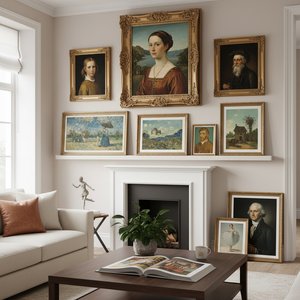
探索美国国家艺术馆的25幅大师级杰作!深入了解塞尚、马蒂斯等艺术家的故事,感受印象派与现代艺术的魅力。Most-Famous-Paintings.com提供高品质油画复制品,点亮您的家居空间。立即在线探索完整系列!


第一时间获取最新的艺术新闻、独家优惠及装饰灵感。
向我们介绍您的项目需求,我们的艺术专家将为您提供 3 个个性化的艺术品推荐。
由我们的专家为您精选 3 款心仪之作 —— 完全免费!


 Preview
 定制手绘复刻品
 分享
分享 分享
分享
 详情
详情

 下载
下载
 相似作品
相似作品 X射线
X射线 幻灯片播放
幻灯片播放 展开详情
展开详情






































 玻璃选项仅适用于110厘米以下的尺寸。


