


x
 InkWallArtAbstract Expressionism
 Modern
 119.0 x 119.0 cm
 Barjeel Art Foundation
从与原作比例一致的预设尺寸中进行选择。

您可以输入自定义尺寸,以适配特定的画框或空间。如果所选尺寸与原图比例不符,我们将通过裁剪作品或添加手绘元素来扩展画面。数字样稿将在制作开始前发送给您确认。
请注意,屏幕预览无法准确反映实际的裁剪或扩展效果,只有样稿才能真实呈现最终的构图。
虽然我们提供定制尺寸服务,但为了保留原作比例,建议您从预设列表中选择尺寸。

Untitled (
复制品尺寸
Born in Berlin in 1931, Frank Auerbach’s life was profoundly shaped by the tumultuous events of the 20th century. His early years were marked by upheaval – his Jewish parents fled Nazi Germany when he was just a boy, seeking refuge in England. This experience, coupled with the loss of his family during World War II, instilled within him a deep sense of melancholy and a profound connection to the human condition, themes that would become central to his intensely personal and emotionally charged paintings.
Auerbach’s artistic journey began at St Martin's School of Art in London, where he was mentored by David Bomberg. This early influence proved crucial, shaping his approach to color and composition. However, Auerbach quickly developed a distinctive style that diverged from traditional academic painting. He eschewed meticulous detail and polished surfaces, instead favoring thick, impastoed layers of paint applied with a palette knife – a technique that lent his work a raw, almost sculptural quality. His subjects were largely drawn from the lives around him: his wife Julia, his model Juliet Yardley Mills ('J.Y.M.'), and his close friend Estella West ('E.O.W.')—figures rendered in muted tones and imbued with an aura of quiet contemplation.
Auerbach’s work is often described as “School of London” art, a loosely defined group of British painters who emerged in the post-war era. This movement was characterized by its rejection of abstract expressionism and its focus on subjective experience and emotional intensity. Auerbach's paintings are not merely representations of his subjects; they are expressions of feeling—a visceral outpouring of grief, loneliness, and a yearning for connection. Critics initially struggled to categorize his work, with some dismissing it as “sculpture” due to the sheer physicality of the paint application, while others recognized its profound painterly qualities.
Auerbach’s technique is arguably his most defining characteristic. He built up layers of paint—often several inches thick—using a palette knife and other tools, creating surfaces that are both tactile and visually arresting. This impastoed style wasn't simply about adding texture; it was a deliberate attempt to convey emotion directly onto the canvas. The physicality of the paint itself becomes an integral part of the narrative, mirroring the intensity of his inner world.
His color palette is deliberately restrained—primarily consisting of dark blues, greens, and browns, punctuated by occasional flashes of red or yellow. These muted tones contribute to the paintings’ somber mood, while also creating a remarkable sense of depth and luminosity. Auerbach rarely used brushes; instead, he favored tools that allowed him to manipulate the paint in a more direct and expressive manner. This hands-on approach resulted in a unique visual language—one that is both deeply personal and universally resonant.
Among Auerbach’s most celebrated works are “Mornington Crescent – Summer Morning” (1954), a poignant depiction of his neighborhood, and the series of portraits featuring Julia, J.Y.M., and E.O.W. These paintings offer intimate glimpses into the lives of these figures, capturing their quiet dignity and vulnerability. His 1978 retrospective at the Hayward Gallery in London cemented his place as one of Britain’s most important post-war painters.
He received an Arts Council retrospective in 1978 and had solo exhibitions at the British Pavilion in the 1986 Venice Biennale, and at the Rijksmuseum Vincent Van Gogh, Amsterdam, 1989. His work has been exhibited extensively throughout Europe and America.
Frank Auerbach’s legacy extends far beyond his individual paintings. He demonstrated that painting could be a profoundly emotional experience—a means of confronting difficult truths and expressing the complexities of human existence. His distinctive technique, characterized by its thick paint application and muted color palette, has influenced generations of artists.
His work continues to resonate with viewers today, offering a powerful reminder of the enduring power of art to connect us to our shared humanity. Auerbach’s paintings are not simply beautiful objects; they are windows into a soul—a testament to the transformative potential of artistic expression.

1931 - 2019 , Egypt
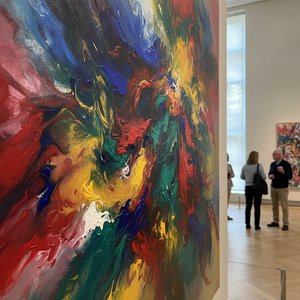
Explore the profound emotional depth of Lyrical Abstraction. Discover how masters like Raymond Parker used color and form to bridge Impressionism and Abstract Expressionism. Learn about this pivotal movement through our expert-led art history guide.

Explore the profound artistry of black and white photography. From the chemistry of gelatin silver to the chiaroscuro of the Old Masters, discover how monochrome captures the eternal essence of light, form, and emotion for the discerning art collector.

Explore the profound emotional depth of Color Field painting. Discover the history of mid-century abstraction, from Rothko to Newman, and learn how pure color transforms the viewer's experience through our expert art history guide.


第一时间获取最新的艺术新闻、独家优惠及装饰灵感。
向我们介绍您的项目需求,我们的艺术专家将为您提供 3 个个性化的艺术品推荐。
由我们的专家为您精选 3 款心仪之作 —— 完全免费!


 效果预览
效果预览
 购买印刷品
购买印刷品 分享
分享 分享
分享
 详情
详情

 下载
下载
 相似作品
相似作品 X射线
X射线 幻灯片播放
幻灯片播放 展开详情
展开详情






































 玻璃选项仅适用于110厘米以下的尺寸。


![Abstract Composition [triptych] — Vaclav Vytlacil, Abstract Expressionism](/media/artworks/images-thumb/08/3c/083c0675045645fd42d4e6c6d63f1ced.jpg)


