x
购买高分辨率增强版数字图像,其品质远超在线预览。
每一份文件都由我们的内部专家使用先进工具与专业的后期润色技术精心打造。我们确保每一张图像都具备卓越的清晰度、精准的色彩还原度以及细腻的细节表现。
最终文件将在 72 小时内通过电子邮件交付,并针对专业、编辑及印刷用途进行了优化。其品质与顶级设计工作室、出版社和画廊所信赖的标准完全一致。
选择 Most-Famous-Paintings.com,您获得的不仅仅是一张图像——您收到的是经过专业级增强、精雕细琢的数字艺术作品,并享有满意保证。以下是您的订单中自动包含的所有内容:

您的高分辨率数字图像文件将在下单后 72 小时内通过电子邮件发送给您 —— 即可立即使用。

您的艺术品经过专业优化,结合先进的 AI 技术与人工修饰,确保呈现极致的细节、清晰度与色彩准确度。

不小心删除了文件或找不到了?没关系——我们将随时为您免费重发。

即刻拥有您的艺术作品,无需支付任何关税、税费或运费——数字下载始终免税。

我们通过专业工具与色彩管理技术,确保您的数字图像尽可能真实地还原原作色彩。

如果您对所购买的数字图像不满意,我们将在60天内为您进行修改或退还100%的款项——无需任何解释。

如果不满意?在收到数字文件后的60天内,我们为您提供全额退款——无需任何理由。

购买 3 张图片可享 10% 折扣 - 购买 5 张可享 15% 折扣 - 购买 10+ 张可享 20% 折扣。非常适合创意项目、画廊和机构使用。

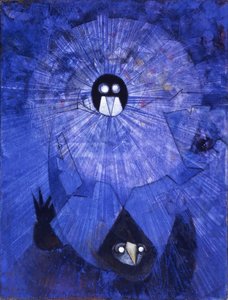
Osvaldo Licini, born on March 22nd, 1894, in the small Italian town of Monte Vidon Corrado in the Marche region, embarked on an artistic journey that would see him become a pivotal figure in the development of abstract art. His early life was somewhat unconventional; his parents relocated to Paris shortly after his birth to pursue work opportunities, leaving young Osvaldo in the care of his paternal grandfather, Filippo, back in Monte Vidon Corrado. This separation instilled in him a sense of independence and perhaps contributed to an introspective nature that would later inform his artistic vision. While his parents established themselves in Paris—his father as a commercial poster designer and his mother running a fashion house—Osvaldo received a traditional art education, beginning studies at the Accademia di Belle Arti di Bologna in 1908. It was here he forged a significant friendship with Giorgio Morandi, a fellow student who would become a lifelong companion and influence.
Licini’s initial artistic explorations were rooted in figurative representation, but even during his academic years, a subtle questioning of form and space began to emerge. He continued his studies at the Academy of Fine Arts in Florence, where he encountered the burgeoning Futurist movement. While intrigued by their dynamism and rejection of traditional aesthetics, Licini never fully embraced Futurism’s tenets, maintaining a critical distance that allowed him to forge his own unique path.
The 1920s marked a period of transition for Licini. He became increasingly interested in the “Return to Order” movement and the *Novecento Italiano*, participating in exhibitions organized by Margherita Sarfatti, a prominent figure in promoting Italian art during the Fascist era. However, his participation was always tempered by a desire to simplify volumes and explore two-dimensionality without fully adhering to the rigid classicism favored by the group. This period saw him exhibiting still lifes and landscapes that hinted at an underlying abstraction, a move away from strict representation towards a more conceptual approach.
A pivotal moment arrived in 1935 with Licini’s relocation back to Paris. It was here he encountered the Circle et Carré and Abstraction-Création groups—collectives of artists dedicated to pure abstraction. Exposure to figures like Vasily Kandinsky, Alberto Magnelli, and František Kupka profoundly impacted his artistic development. He immersed himself in abstract research, fueled by a growing intellectual curiosity and a desire to express inner realities through non-representational forms. This year also saw him participate in the first Italian Abstract Art Exhibition in Turin, solidifying his position within the burgeoning abstract art scene.
By the late 1930s, Licini had fully embraced abstraction, developing a distinctive style characterized by biomorphic shapes, floating forms, and a subtle yet powerful use of color. His paintings are not entirely devoid of reference; they often evoke organic structures, symbolic figures, and dreamlike landscapes. He sought to create a visual language that transcended the literal, tapping into universal emotions and subconscious realms.
His compositions frequently feature balanced arrangements of shapes—often described as ‘equilibristic’—suggesting a delicate interplay between opposing forces. While abstract, his works are imbued with a sense of poetic resonance, hinting at narratives and emotional states without explicitly depicting them. The influence of Surrealism is also discernible in his art, particularly in the juxtaposition of unexpected forms and the exploration of psychological themes.
Following World War II, Licini returned to Monte Vidon Corrado where he unexpectedly entered public life, being elected Mayor in 1946. He continued to paint prolifically throughout his later years, refining his abstract language and exploring new compositional possibilities. His work gained increasing recognition both nationally and internationally.
Osvaldo Licini passed away on October 11th, 1958, leaving behind a significant body of work that continues to captivate and inspire. In 1986, the town of Monte Vidon Corrado established the Centro Studi Osvaldo Licini—a testament to his enduring legacy and commitment to his artistic vision. Licini’s contribution lies in his ability to blend abstraction with a subtle symbolic depth, creating paintings that are both visually compelling and emotionally resonant. He stands as a key figure in Italian abstract art, bridging the gap between figurative tradition and the radical experimentation of the avant-garde.

1894 - 1958 , Italy


第一时间获取最新的艺术新闻、独家优惠及装饰灵感。
向我们介绍您的项目需求,我们的艺术专家将为您提供 3 个个性化的艺术品推荐。
由我们的专家为您精选 3 款心仪之作 —— 完全免费!


 效果预览
效果预览
 购买印刷品
购买印刷品 分享
分享 分享
分享
 详情
详情

 下载
下载
 相似作品
相似作品 X射线
X射线 幻灯片播放
幻灯片播放
 展开详情
展开详情