A Life Immersed in Color and Spirit
Wassily Wassilyevich Kandinsky, born December 4, 1866, in Moscow, Russia, was a revolutionary figure who irrevocably altered the course of modern art. His journey wasn’t one of immediate artistic calling; initially destined for a career in law and economics at the University of Moscow, it was a profound encounter with Impressionist painting – specifically Claude Monet's “Haystacks” – and a deeply moving experience witnessing Wagner’s opera "Lohengrin" that ignited within him an irrepressible desire to pursue art. This pivotal moment, occurring around age thirty, marked not merely a career change but a complete transformation of perspective, setting him on a path toward pioneering abstraction. He soon relocated to Munich, enrolling at the prestigious Academy of Fine Arts and studying under Franz von Stuck, though even within formal training, Kandinsky’s spirit yearned for exploration beyond conventional boundaries.
Early Influences: Russian Folk Art and Impressionism's Embrace
Kandinsky’s formative years were marked by exposure to diverse cultural influences. His fascination with Russian folk art stemmed from an ethnographic expedition to the Vologda region in 1889, fostering a deep appreciation for vibrant color palettes and symbolic imagery—elements that would permeate his early artistic endeavors. Simultaneously, Monet's “Haystacks” captivated him with its masterful depiction of light and atmosphere, introducing him to the principles of Impressionism and prompting an initial foray into representational painting. This dual influence laid the groundwork for his evolving artistic sensibilities.
The Dawn of Abstraction: Expressionism and Beyond
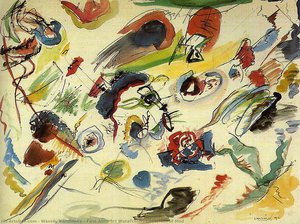
His early works exhibited a pronounced expressionistic style—characterized by bold colors and emotional intensity—exemplified by “Papeln (Poplars)” from 1902. However, Kandinsky swiftly recognized that mere visual representation couldn’t fully capture the complexities of inner experience. Driven by an unwavering conviction that color possessed inherent psychological effects, he embarked on a transformative journey away from representational art toward abstraction. This quest was profoundly shaped by his burgeoning interest in Theosophy—a spiritual movement emphasizing esoteric knowledge and universal brotherhood—inspiring him to explore visual language as a conduit for expressing profound spiritual truths.
- He believed that art should not aim to imitate nature but rather to reveal the artist’s inner world.
The Blaue Reiter Group and Geometric Harmony
A watershed moment arrived in 1911 with his co-founding of the influential artist group
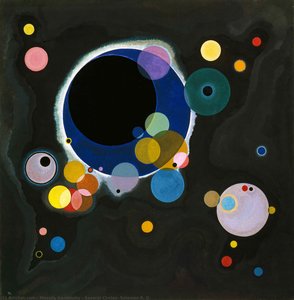
Der Blaue Reiter (The Blue Rider), alongside Franz Marc. This collaboration propelled Kandinsky's artistic exploration into new territories, fostering experimentation with geometric abstraction—particularly circles, triangles, and squares—as evidenced by “Several Circles” from 1913. He sought to create a visual equivalent of music, where color and form harmonized to evoke profound emotional responses.
- His theoretical writings articulated these beliefs, laying the groundwork for a new understanding of abstract art.
Bauhaus Influence and Legacy
The Bauhaus school in Germany provided Kandinsky with an ideal environment for furthering his artistic vision—a space where he championed color theory and geometric abstraction. He instilled these principles into generations of artists, solidifying his place as one of the most important figures in 20th-century art history. His enduring legacy resides in his unwavering conviction that art could transcend mere visual perception to communicate spiritual truths—a belief that continues to inspire artists today. Kandinsky’s monumental “Composition VII,” housed in the Tretyakov Gallery in Moscow, stands as a testament to his artistic genius and transformative contribution to modern art.