


x
 1877
1877 60.0 x 121.0 cm
从与原作比例一致的预设尺寸中进行选择。

您可以输入自定义尺寸,以适配特定的画框或空间。如果您选择的尺寸与原图比例不符,我们将对作品进行裁剪,或通过镜像填充/纯色填充边缘的方式来扩展图像。在开始制作之前,我们会向您发送一份数字效果图供您确认。
请注意,屏幕上的预览并不能反映实际的裁剪或扩展效果。只有效果图才能准确展示最终的构图。
虽然我们提供定制尺寸,但为了保持原图比例,我们建议您从预设列表中选择尺寸。

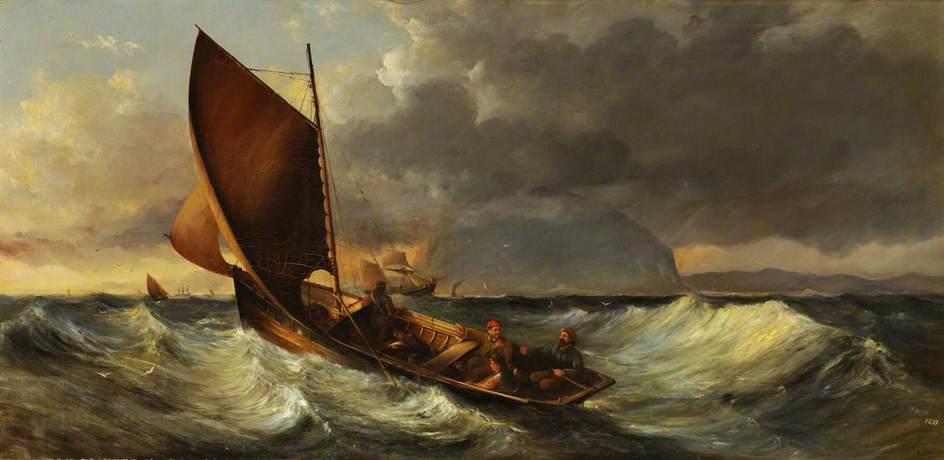
Squall off Ailsa Craig
复制品尺寸

William Muir (1828 – 1910) remains a figure shrouded in artistic mystery, largely due to his self-taught status and the relative scarcity of biographical information. Yet, his distinctive landscapes—particularly those depicting the rugged coastline of Ayrshire and Tasmania—have secured him a place among Scotland’s most accomplished Romantic artists. His work possesses an unparalleled sensitivity to light and atmosphere, capturing the essence of coastal environments with remarkable precision and emotional depth. Born in Girvan, Ayrshire, into a family of farmers, Muir did not follow the traditional path of formal academy training. Instead, he honed his skills through intense observation and experimentation, primarily by studying the works of masters like Turner and Constable, whose techniques profoundly influenced his artistic vision.
Muir’s formative years were spent immersed in the Ayrshire landscape, a period that would define the soul of his early oeuvre. He meticulously documented the dramatic cliffs, windswept beaches, and turbulent seas surrounding Girvan and Troon. These paintings are far more than mere representations of scenery; they are imbued with a palpable sense of place—a feeling for the raw beauty and elemental power of the coast. His mastery is particularly evident in works such as “The Firth of Clyde” (1863), which showcases a Turnerian atmospheric perspective, and “Troon Harbour” (1870), which captures the bustling activity of a seaside town with a command of color and brushwork that prioritizes expressive gesture over photographic accuracy.
The trajectory of Muir’s career took an unexpected and transformative turn in 1875 when he emigrated to Tasmania. This relocation introduced him to a landscape that, while possessing a similar dramatic character to his beloved Ayrshire, offered much warmer hues and a softer, more luminous light. Inspired by this new environment, Muir began to embrace Impressionistic principles, gradually abandoning the heavier, Turnerian gloom of his youth in favor of brighter palettes and a more delicate touch. This evolution is beautifully captured in his later works, where the interplay of light on water and land becomes the central protagonist of the canvas.
His technical development can be observed through several key characteristics that define his most celebrated pieces:
Throughout his life, Muir’s work served as a bridge between the dramatic Romanticism of the early 19th century and the burgeoning Impressionist movements. His ability to translate the ruggedness of the Scottish coast and the vibrant light of Tasmania into oil on canvas has left an indelible mark on maritime and landscape art. Even today, his paintings—such as “Bend on the Water of Girvan” and “The Silver Strand”—continue to resonate with viewers, offering a window into a vanished era of coastal life and a profound meditation on the eternal beauty of the natural world.

1828 - 1910


第一时间获取最新的艺术新闻、独家优惠及装饰灵感。
向我们介绍您的项目需求,我们的艺术专家将为您提供 3 个个性化的艺术品推荐。
由我们的专家为您精选 3 款心仪之作 —— 完全免费!


 效果预览
效果预览
 购买手绘画作
 分享
分享 分享
分享
 详情
详情

 下载
下载
 相似作品
相似作品 X射线
X射线 幻灯片播放
幻灯片播放 展开详情
展开详情






































 玻璃选项仅适用于110厘米以下的尺寸。


