x


Hand-painted oil on canvas in your size and frame, made to order by our artists.





























Pick from our preset sizes that match the artwork's original proportions.

You may enter your own dimensions to fit a specific frame or space. If your selected size does not match the original image's proportions, we will either crop the artwork or extend the painting with additional hand-painted elements. A digital mockup will be sent for your approval before production begins.
Please note that the on-screen preview does not reflect the actual cropping or extension. Only the mockup will accurately show the final composition.
While custom sizes are available, we recommend selecting a dimension from the predefined list to preserve the original proportions.
Worldwide Delivery () in 3/4 weeks instead of standard 5 weeks. (18 July). No compromise on quality.


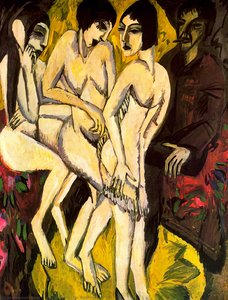
Three Nudes in the Mountain Forest
Reproduction Size
Ernst Ludwig Kirchner’s “Three Nudes in the Mountain Forest,” completed in 1928, stands as a cornerstone of German Expressionism and embodies the movement's preoccupation with psychological turmoil amidst the burgeoning anxieties of the interwar period. More than just a depiction of figures posed against a rugged landscape, it’s a profound meditation on isolation, vulnerability, and the confrontation with an indifferent universe—themes that resonate powerfully even today.
Kirchner, alongside Fritz Bleyl and Karl Schmidt-Rottluff, formed Die Brücke (“The Bridge”), a collective dedicated to rejecting academic conventions and forging a new visual language rooted in emotion and subjective experience. This painting exemplifies their stylistic ethos: bold brushstrokes, flattened perspective, and jarring color palettes—particularly the dominant hues of ochre, crimson, and slate gray—are deliberately employed to disrupt any semblance of tranquility.
The composition itself is strikingly asymmetrical. The three nude women are positioned on opposite sides of the canvas, their backs turned towards each other, creating a palpable sense of separation and unspoken tension. Their postures convey both defiance and vulnerability; they appear to gaze outwards, attempting to find solace in the vastness of the forest while simultaneously confronting its imposing presence. This duality reflects the broader existential concerns prevalent during Kirchner’s time—the questioning of traditional values and beliefs amidst rapid societal change.
Technically, Kirchner utilized oil paint on board, applying thick impasto strokes that capture the texture of bark and stone with remarkable accuracy. The artist's meticulous attention to detail isn’t merely descriptive; it serves to heighten the emotional impact of the scene. The harsh lighting casts dramatic shadows across the figures and foliage, intensifying their vulnerability and emphasizing the desolate beauty of the mountainous terrain.
Symbolically, “Three Nudes in the Mountain Forest” speaks to a deeper yearning for connection amidst profound loneliness. The nude bodies represent humanity stripped bare—exposed to the forces of nature and confronting its own mortality. Yet, they are not entirely passive; their gaze suggests an active engagement with the world, albeit one fraught with uncertainty. The forest itself symbolizes both refuge and danger – a space where individuals can find solace but also face overwhelming challenges.
Ultimately, Kirchner’s masterpiece transcends mere representation, inviting viewers to contemplate fundamental questions about human existence. It remains a hauntingly beautiful testament to the Expressionist impulse—to capture not just what is seen but what is felt—and continues to inspire artists and collectors alike with its uncompromising honesty and evocative imagery.

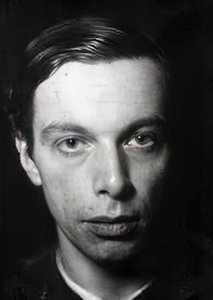
1880 - 1938 , Germany
Delve into the haunting world of Egon Schiele with our curated selection of his 25 most iconic Expressionist paintings. Explore the artist's life, technique & emotional depth. Find museum-quality Schiele reproductions and elevate your home decor on Most-Famous-Paintings.com.

Journey through 25 iconic artworks at the Metropolitan Museum of Art! Explore Van Gogh, Monet, Rembrandt & more. Discover art history, inspiring stories, and museum-quality reproductions to elevate your home decor. Explore the full collection on Most-Famous-Paintings.com.
Journey through Henri Matisse's 25 most iconic paintings! Explore Fauvism, vibrant colors & the stories behind masterpieces like 'The Dance'. Find museum-quality art reproductions and curated decor ideas to elevate your space. Discover all masterpieces on Most-Famous-Paintings.com.
Explore 25 iconic artworks from Washington DC's National Gallery of Art! Discover masterpieces by Cézanne, Matisse & Picasso. Find museum-quality art reproductions and elevate your home decor with timeless paintings. Explore the full collection online at Most-Famous-Paintings.com.
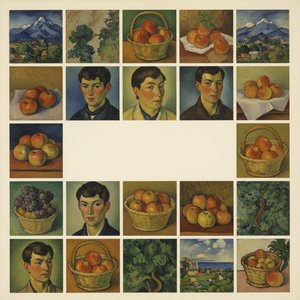
Journey through 25 iconic artworks by Paul Cézanne – a master of Impressionism and Post-Impressionism. Explore his landscapes, still lifes, and the stories behind these timeless masterpieces. Discover museum-quality reproductions & curated decor at Most-Famous-Paintings.com.


Stay updated with the latest art news, exclusive offers, and decoration ideas.
Tell us about your project and our art experts will provide you with 3 personalized art suggestions.
Let Us Curate 3 Options Just for You - Free!


 Buy print
 Send
Send Share
Share
 Details

 Download
 Similars
 X-Ray
X-Ray Diaporama


 Read More







 Glass option is only available in size under 110 CM