x


 Oil On CanvasWallArtImpressionism
 188219th Century
 115.0 x 69.0 cm
Hand-painted oil on canvas in your size and frame, made to order by our artists.





























Pick from our preset sizes that match the artwork's original proportions.

You may enter your own dimensions to fit a specific frame or space. If your selected size does not match the original image's proportions, we will either crop the artwork or extend the painting with additional hand-painted elements. A digital mockup will be sent for your approval before production begins.
Please note that the on-screen preview does not reflect the actual cropping or extension. Only the mockup will accurately show the final composition.
While custom sizes are available, we recommend selecting a dimension from the predefined list to preserve the original proportions.
Worldwide Delivery () in 3/4 weeks instead of standard 5 weeks. (18 July). No compromise on quality.


Portrait of Cecilia de Madrazo Fortuny
Reproduction Size
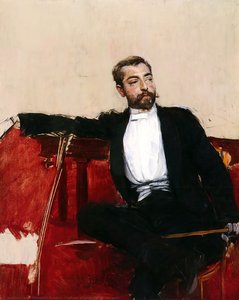
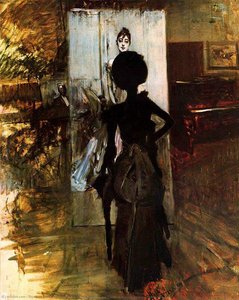
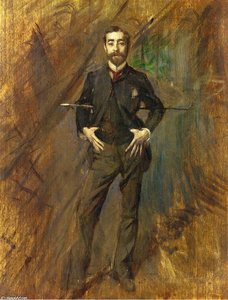
To stand before Giovanni Boldini's Portrait of Cecilia de Madrazo Fortuny is to step directly into the shimmering, sophisticated heart of the late nineteenth century. This oil on canvas, painted in 1882, is far more than a mere likeness; it is a vibrant encapsulation of Belle Époque glamour and refined social standing. Boldini, the master chronicler of Parisian high society, possessed an unparalleled gift for capturing not just the physical appearance of his sitters, but the very spirit that animated them. Cecilia de Madrazo Fortuny, rendered here in striking black attire accented by a delicate pink ribbon, exudes an aura of poised mystery. Her direct gaze meets the viewer's eye with an intensity that suggests untold stories beneath the surface of impeccable composure.
Technically, the painting is a breathtaking display of Boldini’s virtuosity. One observes immediately his signature bold brushwork—a technique that lends the entire composition a palpable sense of energy and immediacy. The paint seems to move, echoing the lively atmosphere of the era it depicts. Yet, this boldness never sacrifices subtlety. Consider the masterful handling of light; it sculpts the contours of Cecilia’s face and drapes across the folds of her gown, giving the figures a remarkable three-dimensionality that leaps off the canvas. The incorporation of minute details, such as the soft blush of the pink ribbon or the gleam on unseen jewelry, serves to anchor the grand sweep of color and form in exquisite reality.
The composition itself is carefully orchestrated to draw the viewer into an intimate moment. While Cecilia remains the undeniable focal point—her serious expression commanding attention—the presence of two other figures subtly populates the background, lending depth and context to the portrait. These secondary figures frame the central subject, suggesting a social gathering or a moment paused in time. This arrangement allows Boldini to explore complex spatial relationships while ensuring that Cecilia’s captivating personality remains the undeniable emotional core of the work. It is a study in controlled drama.
For those who appreciate art that speaks of enduring elegance, this portrait offers profound resonance. Owning a reproduction of Portrait of Cecilia de Madrazo Fortuny is not simply acquiring decoration; it is curating a piece of cultural history. It invites conversation, whispers tales of grand balls and artistic zenith, and brings the vibrant spirit of Italian artistry into contemporary living spaces. The painting’s enduring appeal lies in its perfect balance: the formality of portraiture meeting the spontaneous vitality of Impressionistic technique. It remains a timeless testament to human grace.


1842 - 1931 , Italy

Journey through 25 iconic artworks at the Metropolitan Museum of Art! Explore Van Gogh, Monet, Rembrandt & more. Discover art history, inspiring stories, and museum-quality reproductions to elevate your home decor. Explore the full collection on Most-Famous-Paintings.com.
Journey through 25 iconic James Abbott McNeill Whistler paintings! Explore his masterpieces of Aestheticism, from 'Nocturne in Black and Gold' to captivating portraits. Find museum-quality art reproductions & elevate your home decor with Most-Famous-Paintings.com. Discover the full collection online.
Explore 25 iconic artworks from Washington DC's National Gallery of Art! Discover masterpieces by Cézanne, Matisse & Picasso. Find museum-quality art reproductions and elevate your home decor with timeless paintings. Explore the full collection online at Most-Famous-Paintings.com.
Delve into the haunting world of Egon Schiele with our curated selection of his 25 most iconic Expressionist paintings. Explore the artist's life, technique & emotional depth. Find museum-quality Schiele reproductions and elevate your home decor on Most-Famous-Paintings.com.

Explore 25 iconic artworks by Dante Gabriel Rossetti, a leading Pre-Raphaelite artist. Discover the stories behind masterpieces like 'Proserpine' & 'Beata Beatrix'. Find museum-quality art reproductions and elevate your home decor with Most-Famous-Paintings.com.


Stay updated with the latest art news, exclusive offers, and decoration ideas.
Tell us about your project and our art experts will provide you with 3 personalized art suggestions.
Let Us Curate 3 Options Just for You - Free!


 Buy print
 Send
Send Share
Share
 Details

 Download
 Similars
 X-Ray
X-Ray Diaporama
 Read More







 Glass option is only available in size under 110 CM