x

 Oil On CanvasWallArtSymbolist Late Works
 1918
1918 70.0 x 70.0 cm
Museum-quality giclée or canvas print with fast production and flexible finish options. ( Buy Hand Made Painting Buy Image)





























Pick from our preset sizes that match the artwork's original proportions.

You may enter your own dimensions to fit a specific frame or space. If your selected size does not match the original image's proportions, we will either crop the artwork or extend the image with a mirrored or solid-fill edge. A digital mockup will be sent for your approval before production begins.
Please note that the on-screen preview does not reflect the actual cropping or extension. Only the mockup will accurately show the final composition.
While custom sizes are available, we recommend selecting a dimension from the predefined list to preserve the original proportions.
Worldwide Delivery () in 2 weeks instead of standard 4/5 weeks. (22 August)


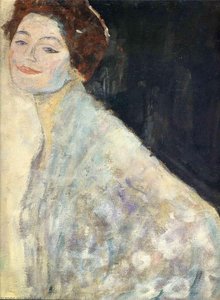
Lady in White
Reproduction Size
Gustav Klimt's “Lady in White,” conceived during a tumultuous period in his artistic life—immediately following a debilitating stroke that tragically curtailed his creative journey—stands as a poignant testament to the artist’s unwavering vision. Completed in 1918, just months before his untimely demise, this painting embodies the spirit of Klimt's final phase, marking a decisive departure from his earlier opulent decorative style towards a more introspective and emotionally resonant expression.
The artwork’s striking simplicity is deceptive. Klimt eschews elaborate ornamentation, focusing instead on a tightly cropped portrait of a woman's face and upper torso against a stark black backdrop—a bold decision that amplifies the figure’s presence and draws attention to her serene gaze. Executed in oil paint with visible brushstrokes, “Lady in White” showcases Klimt’s masterful manipulation of texture; layers upon layers of pigment build up a surface imbued with subtle roughness, mirroring the softness of skin and drapery alike. The artist's deliberate use of loose lines contributes to the painting’s unfinished quality, hinting at an immediacy that captures the fleeting moment of artistic creation.
The color palette is deliberately restrained, prioritizing variations of white and cream accented by delicate hues of pale blue and subtle pink on the woman’s face. This luminous contrast against the enveloping black background serves not only to delineate form but also to evoke a profound sense of melancholy—a reflection of Klimt's own mortality and perhaps an acknowledgement of beauty’s inherent fragility. The inclusion of brown tones in the hair adds another layer of visual interest, grounding the ethereal figure within earthly materiality.
"Lady in White" resides within Klimt’s broader exploration of Symbolism—a movement that sought to transcend representational realism and delve into psychological states and spiritual truths. Influenced by Nietzschean philosophy and Eastern mysticism, Klimt's work reflects a fascination with mythology and archetypal imagery. This painting aligns seamlessly with Klimt’s stylistic evolution, marking a crucial step away from the gilded grandeur of his earlier commissions towards a more emotionally charged aesthetic—one that anticipates the expressive innovations of Surrealism.
More than just a portrait, “Lady in White” communicates an aura of quiet contemplation and inner peace. The woman’s gentle smile conveys serenity, inviting viewers to contemplate themes of femininity, vulnerability, and timeless beauty. Its unfinished state underscores the artist's creative impulse—a poignant reminder that art is never truly complete but rather exists as a conduit for emotion and experience. Today, reproductions of this masterpiece continue to inspire admiration for Klimt’s artistic genius and his ability to distill profound psychological insight into deceptively simple visual forms.


1862 - 1918 , Austria

Explore the profound impact of the Vienna Secession movement. Discover how visionaries like Gustav Klimt revolutionized modern art through symbolism, gold leaf, and the concept of Gesamtkunstwerk in this expert-led historical guide.

Explore the profound history and technical brilliance of oil on panel painting. From Renaissance masters to modern techniques, discover why this rigid support offers unparalleled precision and permanence for fine art lovers and collectors.


Stay updated with the latest art news, exclusive offers, and decoration ideas.
Tell us about your project and our art experts will provide you with 3 personalized art suggestions.
Let Us Curate 3 Options Just for You - Free!


 Preview
 Send
Send Share
Share
 Details

 Download
 Similars
 X-Ray
X-Ray Diaporama
 Read More







 Glass option is only available in size under 110 CM