x
 Oil On CanvasWallArtImpressionistic Aesthetic
 189519th Century
 133.0 x 162.0 cm
 Metropolitan Museum of Art
Hand-painted oil on canvas in your size and frame, made to order by our artists.





























Pick from our preset sizes that match the artwork's original proportions.

You may enter your own dimensions to fit a specific frame or space. If your selected size does not match the original image's proportions, we will either crop the artwork or extend the painting with additional hand-painted elements. A digital mockup will be sent for your approval before production begins.
Please note that the on-screen preview does not reflect the actual cropping or extension. Only the mockup will accurately show the final composition.
While custom sizes are available, we recommend selecting a dimension from the predefined list to preserve the original proportions.
Worldwide Delivery () in 3/4 weeks instead of standard 5 weeks. (18 July). No compromise on quality.


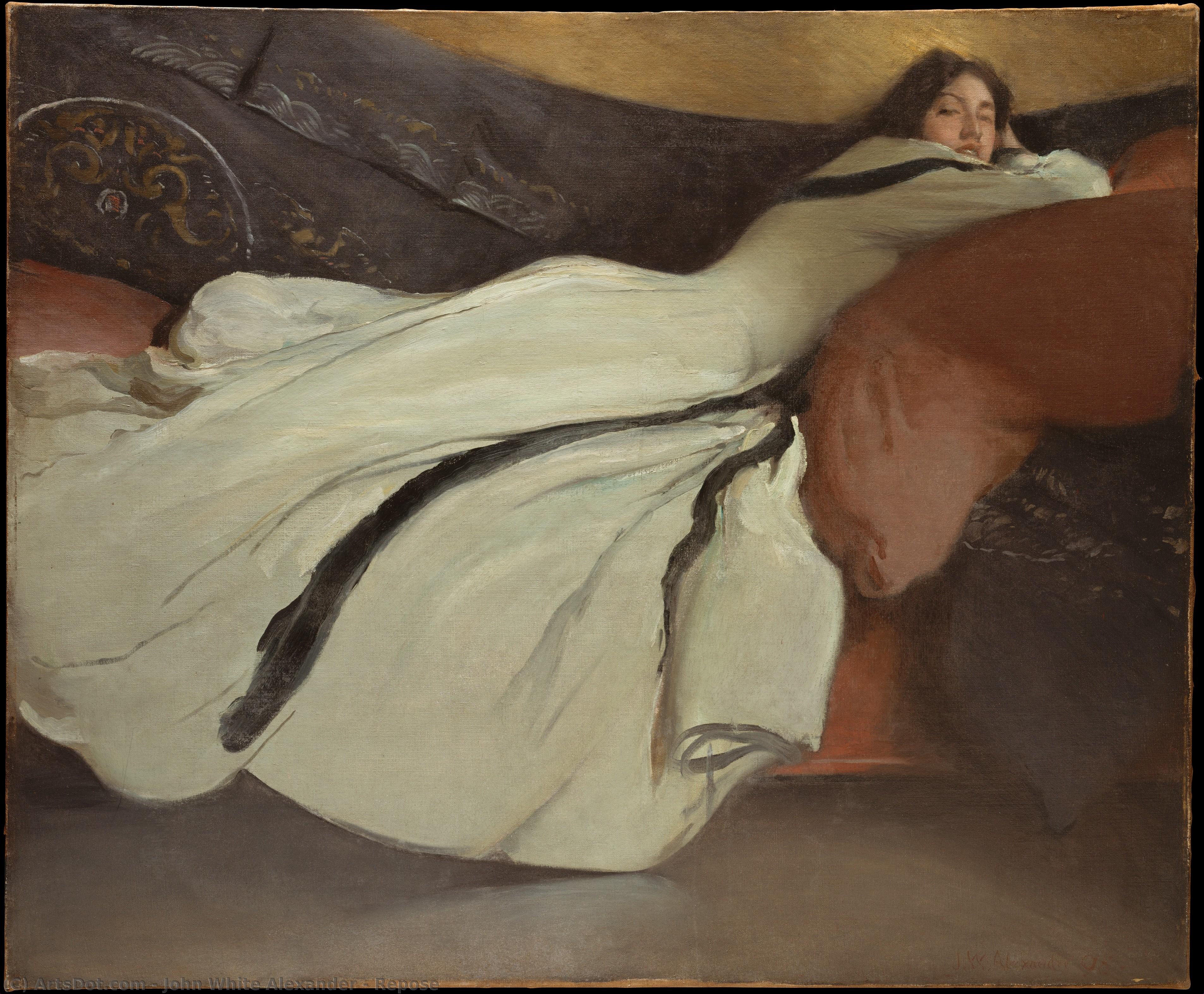
Repose
Reproduction Size
To gaze upon Alexander's "Repose" is to step directly into the languid, dreamlike atmosphere of turn-of-the-century Parisian salon life. This painting is not merely a depiction of a woman resting; it is a carefully orchestrated study in sensual grace and decorative elegance. The subject reclines with an almost breathtaking ease, enveloped in swathes of pristine white fabric that seem to catch the very light of the room. Her posture speaks of utter surrender to comfort, yet her expression hints at a deeper narrative—a captivating blend of vulnerability and knowing allure that defined much of the Belle Époque aesthetic.
The stylistic hallmarks of Art Nouveau are unmistakable here. Notice how the lines do not merely exist; they undulate. The sweep of the white drapery, the gentle curve of the body against the plush couch—these elements create a rhythmic flow across the canvas, characteristic of the period's fascination with organic, sinuous forms. Alexander masterfully captures this undulating linearity. Furthermore, the painting’s provocative yet delicate portrayal of the female form resonated deeply with contemporary French taste, making it an immediate touchstone for those who appreciated art that blurred the lines between high art and decorative pleasure.
The historical context adds a layer of fascinating intrigue. The painting was famously lampooned in a French magazine as a portrait echoing Loïe Fuller, the celebrated American dancer known for her spectacular manipulation of silk folds at the Folies Bergère. This suggests that "Repose" functions on multiple levels: it is both an intimate portrait and a commentary on public performance. The presence of other partially visible figures subtly frames the central subject, suggesting she is part of a larger social tableau—a moment observed by others, yet existing in her own private sphere of tranquility.
For those considering bringing this exquisite vision into your home or design space, consider the painting's overall atmosphere. The palette, dominated by soft whites against muted background tones, imbues the piece with an immediate sense of serenity. It is a work that whispers rather than shouts, perfect for creating a sophisticated sanctuary. When acquiring a hand-painted reproduction, you are not just purchasing an image; you are inviting a curated moment of quiet contemplation—a breath drawn in the heart of Parisian refinement from 1895.

John White Alexander (1856-1915) emerges from the late 19th and early 20th centuries as a significant, yet often overlooked, figure in American art. His work, deeply rooted in the Aesthetic Movement and characterized by an exquisite sensitivity to light, color, and form, offers a captivating glimpse into a world of refined beauty and quiet contemplation. Born in Allegheny County, Pennsylvania – now part of Pittsburgh – Alexander’s early life was marked by personal tragedy, shaping his artistic sensibility with a poignant awareness of loss and the fleeting nature of experience. His upbringing, fostered by his grandparents after being orphaned at a young age, instilled within him a deep appreciation for art and learning, ultimately leading to an education steeped in European artistic traditions.
Alexander’s formal training began in New York City, where he apprenticed under Edwin Austin Abbey at Harper's Weekly. This early exposure to illustration honed his technical skills and introduced him to the vibrant world of contemporary visual culture. However, it was a pivotal journey to Europe – specifically Munich, Florence, and Paris – that truly shaped his artistic vision. He studied with Frank Duveneck in Munich, absorbing the Impressionistic techniques and embracing a looser, more expressive approach to painting. The influence of Whistler’s emphasis on color and atmosphere proved particularly formative, guiding him toward a nuanced understanding of light and its transformative power.
Alexander’s work is inextricably linked to the broader context of the Aesthetic Movement, a late 19th-century artistic and intellectual current that prioritized beauty, emotion, and individual expression above all else. Rejecting the didacticism and moralizing tendencies of earlier art movements, aesthetes sought to create works that were purely beautiful, regardless of their representational accuracy or social significance. Alexander’s paintings perfectly embody this ethos – they are not merely depictions of reality but rather carefully constructed expressions of feeling and atmosphere.
His portraits, in particular, are notable for their psychological depth and subtle emotional resonance. He eschewed the formal poses and stiff gazes often associated with traditional portraiture, instead capturing his subjects in moments of quiet introspection or private contemplation. Consider “Miss Dorothy Quincy Roosevelt (later Mrs. Langdon Geer),” a stunning example of his ability to convey elegance and grace through delicate brushwork and a masterful use of light. The painting’s luminous quality and the subject's serene expression evoke a sense of timeless beauty, solidifying Alexander’s reputation as a painter of exquisite detail.
A defining characteristic of Alexander’s work is his extraordinary sensitivity to light and atmosphere. He meticulously observed how light transformed surfaces, creating subtle shifts in color and tone that conveyed a sense of depth and realism. “Still Life with Flagon and Roses,” for instance, showcases this talent brilliantly. The loose brushwork and the careful rendering of reflected light on the flagon and the velvety petals of the roses create an intimate and evocative scene—a testament to his ability to capture the ephemeral beauty of everyday objects.
His landscapes are equally compelling, often depicting quiet scenes of rural life or glimpses of the natural world bathed in soft, diffused light. These paintings are not merely representations of scenery but rather expressions of a profound connection with nature – a sense of wonder and reverence for the beauty that surrounds us. “Young Woman Arranging Her Hair” exemplifies this approach, presenting a serene portrait of a young woman engaged in a simple, yet deeply personal act.
Despite his considerable talent and critical acclaim, John White Alexander’s work remained relatively obscure for many years. However, in recent decades, there has been a growing appreciation for his unique artistic vision and technical skill. His paintings are now recognized as important contributions to the American art landscape of the late 19th and early 20th centuries – a testament to his ability to capture the delicate beauty of the world around him.
Alexander’s legacy extends beyond his individual works; he also played a significant role in the development of the National Academy of Design, serving as its president from 1909 until his death. His dedication to art education and his commitment to fostering artistic excellence ensured that his influence would continue to resonate within the American art community for generations to come. His work continues to be exhibited and studied today, offering a poignant reminder of the enduring power of beauty and the importance of capturing fleeting moments of grace.

1856 - 1915 , United States of America
Journey through John Constable's 25 most celebrated landscapes. Explore Romanticism, Dedham Vale & his masterful use of light in iconic paintings like 'Hay Wain'. Find museum-quality art reproductions and elevate your home decor on Most-Famous-Paintings.com.
Journey through 25 iconic James Abbott McNeill Whistler paintings! Explore his masterpieces of Aestheticism, from 'Nocturne in Black and Gold' to captivating portraits. Find museum-quality art reproductions & elevate your home decor with Most-Famous-Paintings.com. Discover the full collection online.

Explore 25 iconic John Singer Sargent paintings – from dazzling portraits to Impressionist landscapes. Discover the stories behind Madame X, El Jaleo & more! Find museum-quality art reproductions and elevate your home decor with Most-Famous-Paintings.com.

Journey through 25 iconic artworks at the Metropolitan Museum of Art! Explore Van Gogh, Monet, Rembrandt & more. Discover art history, inspiring stories, and museum-quality reproductions to elevate your home decor. Explore the full collection on Most-Famous-Paintings.com.

Explore 10 iconic white paintings by Monet, Whistler & Rothko! Discover the stories behind these serene masterpieces and their impact on art history. Find museum-quality reproductions for your home decor at .


Stay updated with the latest art news, exclusive offers, and decoration ideas.
Tell us about your project and our art experts will provide you with 3 personalized art suggestions.
Let Us Curate 3 Options Just for You - Free!


 Buy print
 Send
Send Share
Share
 Details

 Download
 Similars
 X-Ray
X-Ray Diaporama
 Read More







 Glass option is only available in size under 110 CM